Skip to content

Knowledge Of Sea

We will keep you updated

  • Home
  • Video
  • Chartering Terms
  • Rule of the Road (COLREG)
    • Nautical Flags
    • Rule of the Roads – CARDS
  • Tanker Definitions
  • Downloads
  • ORAL NOTES
    • ORAL NOTES- 2ND OFFICER
    • ORAL NOTES- CHIEF MATE
    • ASM ORAL NOTES 1
    • ASM ORAL NOTES 2
    • ASM ORAL NOTES 3
  • About Me
  • Toggle search form

COLREG in easy language (Rule 17)

Posted on November 22, 2019February 19, 2020 By admin No Comments on COLREG in easy language (Rule 17)
COLREG in easy language (Rule 17)

Rule 17 Action by stand-on vessel (a) (i) Where one of two vessels is to keep out of the way, the other shall keep her course and speed. (ii) The latter vessel may however take action to avoid collision by her maneuver alone, as soon as it becomes apparent to her that the vessel required…

Read More “COLREG in easy language (Rule 17)” »

Navigation

COLREG in easy language (Rule 15 & 16)

Posted on November 22, 2019March 8, 2023 By admin No Comments on COLREG in easy language (Rule 15 & 16)
COLREG in easy language (Rule 15 & 16)

Rule 15 Crossing situation  When two power-driven vessels are crossing so as to involve risk of collision, the vessel which has the other on her own starboard side shall keep out of the way and shall, if circumstances of the case admit, avoid crossing ahead of the other vessel.  Rule 16 Action by give-way vessel …

Read More “COLREG in easy language (Rule 15 & 16)” »

Navigation

COLREG in easy language (Rule 14)

Posted on November 22, 2019February 19, 2020 By admin No Comments on COLREG in easy language (Rule 14)
COLREG in easy language (Rule 14)

Rule 14 Head-on situation  (a) When two power-driven vessels are meeting on reciprocal or nearly reciprocal courses so as to involve risk of collision each shall alter her course to starboard so that each shall pass on the port side of the other. Rule 14: HEAD-ON SITUATION Always alter course to starboard when you see…

Read More “COLREG in easy language (Rule 14)” »

Navigation

COLREG in easy language (Rule 13)

Posted on November 22, 2019February 19, 2020 By admin No Comments on COLREG in easy language (Rule 13)
COLREG in easy language (Rule 13)

Rule 13  Overtaking (a). Notwithstanding anything contained in the Rules of part B, sections I and II, any vessel overtaking any other shall keep out of the way of the vessel being overtaken. Rule 13: OVERTAKING  Rule 13 has no exceptions; the overtaking vessel always keeps out of the way. If you are not sure…

Read More “COLREG in easy language (Rule 13)” »

Navigation

COLREG in easy language (Rule 10)

Posted on November 22, 2019February 19, 2020 By admin No Comments on COLREG in easy language (Rule 10)
COLREG in easy language (Rule 10)

Rule 10 Traffic separation schemes  (a) This Rule applies to traffic separation schemes adopted by the Organization and does not relieve any vessel of her obligation under any other Rule. Nothing in Rule 10 is saying that sailing in a lane of a Traffic Separation Scheme you have any “priority” with cross traffic coming from…

Read More “COLREG in easy language (Rule 10)” »

Navigation

COLREG In Easy Language (Rule 2,5,7 & 8)

Posted on November 22, 2019February 19, 2020 By admin No Comments on COLREG In Easy Language (Rule 2,5,7 & 8)
COLREG In Easy Language (Rule 2,5,7 & 8)

Collisions are among the most high profile of all maritime accidents. The number of collisions and their cost (personal and financial) has increased in recent years and “human error” seems to be the only common factor. Collisions should not happen but they do; sometimes with disastrous consequences.If the regulations are followed to the letter, then…

Read More “COLREG In Easy Language (Rule 2,5,7 & 8)” »

Navigation

Emergency wreck marking buoy

Posted on November 22, 2019February 19, 2020 By admin No Comments on Emergency wreck marking buoy
Emergency wreck marking buoy

Emergency wreck marking buoy • IALA has introduced on trial basis. • For temporary response. • Typically to be used for first 24‐72 hrs. • Deployment to be promulgated through usual maritime safety information system. • Designed to provide a prominent aid to navigation. • To be placed as close of wreck as possible. It…

Read More “Emergency wreck marking buoy” »

Navigation

ECDIS

Posted on November 22, 2019March 6, 2020 By admin No Comments on ECDIS
ECDIS

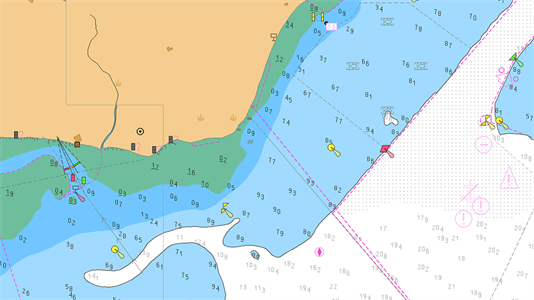
General ECDIS allows for monitoring of a ship’s position in real-time throughout the voyage and integrates information from GPS, Gyro, Radar, ARPA, AIS and other navigational equipments into a single display. It has several advantages over paper charts as listed below; Continuous route monitoring Continuous monitoring of depth safety contours and soundings Easier voyage planning…

Read More “ECDIS” »

Navigation

Grain Code ‐ How to do strapping and lasing?

Posted on November 22, 2019February 19, 2020 By admin No Comments on Grain Code ‐ How to do strapping and lasing?
Grain Code ‐ How to do strapping and lasing?

Shifting Board a) Longitudinal divisions (called shifting board), which must be grain tight may be fitted in both “filled” and “partly filled compartments”. b) In “filled compartments, they must extend downwards from the underside of the deck or hatch covers, to a distance below the deckline of at least one‐eighth the breadth of the compartment,…

Read More “Grain Code ‐ How to do strapping and lasing?” »

Bulk Carrier

ECDIS Contour Setting depth

Posted on November 21, 2019February 19, 2020 By admin 4 Comments on ECDIS Contour Setting depth
ECDIS Contour Setting depth

Safety Contour = Dynamic draft + Minimum Net UKC requirement – Height of tide Shallow Contour = One Contour less than Safety Contour 1. Why Height of Tide is being subtracted from the Safety Contour depth?   Why it is not added, as we do for depth calculation? Let us use an example to understand this….

Read More “ECDIS Contour Setting depth” »

Navigation

Posts pagination

Previous 1 … 44 45 46 47 Next

Categories

  • Bulk Carrier
  • Cargo handling
  • Engine Room Operations
  • LSA & FFA
  • Maritime Industry
  • Maritime Law
  • Merchant Shipping
  • Navigation
  • Rules and Regulation
  • Ship Construction
  • Shipboard operation
  • Stability
  • Tanker
  • Uncategorized

Blog is primarily for candidates appearing for certificate of competency exams but such is the detail that while being equally suitable for the beginner, it is also reference work for experienced seaman, and the layout and style of blog make it suitable for shipboard training where practical experience can be allied to the theoretical approach.

Recent Comments

  • capt on Radar Best Practice -ARPA
  • admin on Dry Docking (Theory & Numericals)
  • Stelios Karamplakas on Dry Docking (Theory & Numericals)
  • Farid OMARI on Demurrage
  • admin on Tanker Cargo Calculations

Copyright © 2018 knowledge of sea – All Rights Reserved.

If you’re unsure about what type of training will work best for you, just tell us a little more about your needs. We will get back to you as soon as possible with the answers you need!

All answers will be from sailor mouth, who is practically working on board.

January 2026
S M T W T F S
 123
45678910
11121314151617
18192021222324
25262728293031
« Dec    

Copyright © 2026 Knowledge Of Sea.

Powered by PressBook WordPress theme