What is Gauging ?
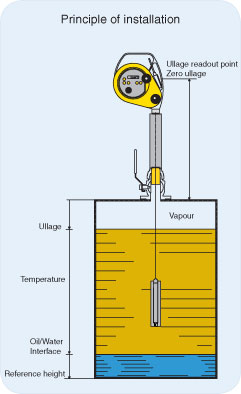
- Measurement of Ullage or Sounding
- Measurement of Temperature
- Measurement of Interface
Ullage and Sounding
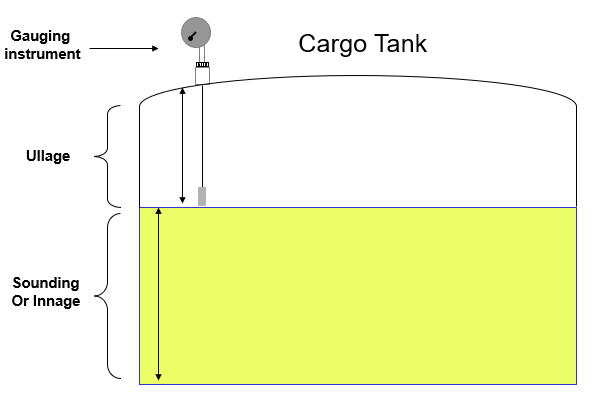
Usually ullages are used for calculation.
In rare cases soundings may be used
What is interface?
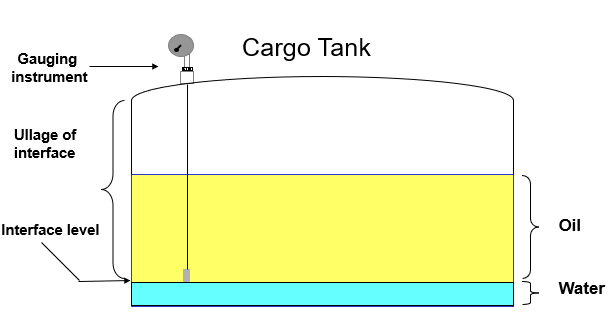
The water in the cargo settles after loading and is called free water. Interface is the separation level between the cargo and the free water .
Trim Correction
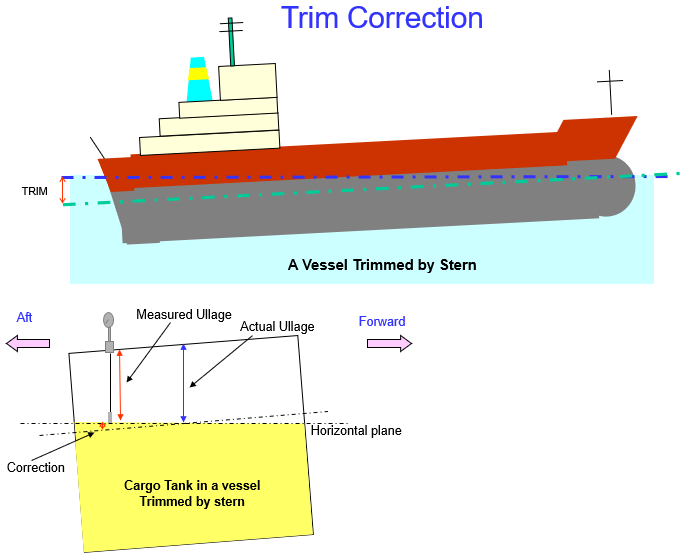
To obtain the actual cargo quantity in a tank, Trim correction must be applied to the measured ullage
List Correction
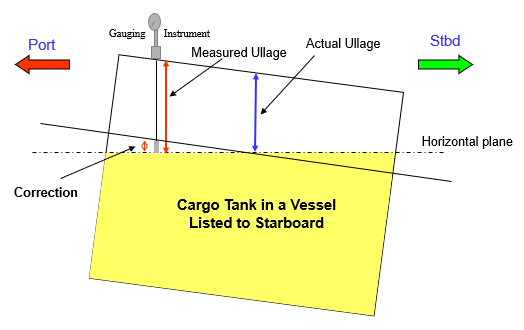
To obtain the actual quantity of cargo in a tank, List Correction must be applied to the measured ullage
The basics of Cargo Calculation
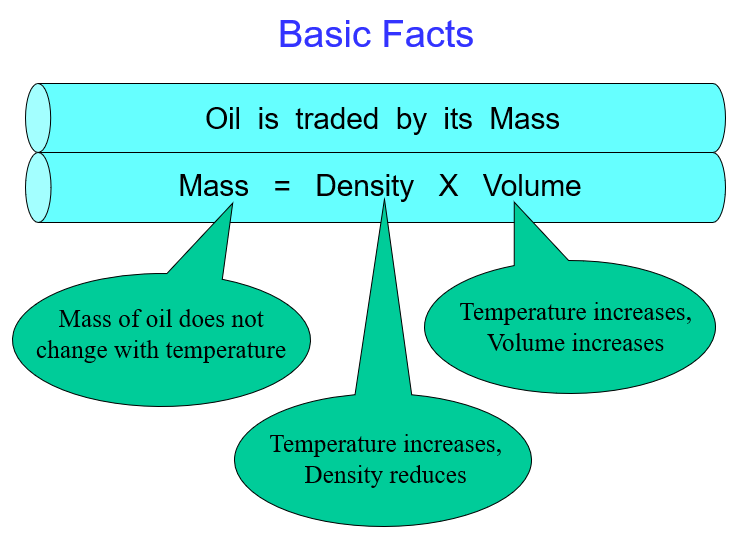
Various forms of Density
Density in one of the following forms is provided by the Supplier
a) Density at 15 C – This is the mass per unit volume of oil at 150 C.
b) Relative density at 60 F – This is the density of oil at 600 F divided by
the density of water
c) API gravity – Bears a purely mathematical relation to relative density
API gravity at 60 F = (141.5 / Relative Density at 60 F) minus 131.5
Standard Temperature
Volume of oil on board is measured at Observed temperature
Since the density and volume of oil change with change in temperature, a Standard temperature has to be used for calculations
The standard temperatures used are 15 C and 60 F.
15 C is not the same as 60 F.
In fact 15 C = 59 F
Tank volumes
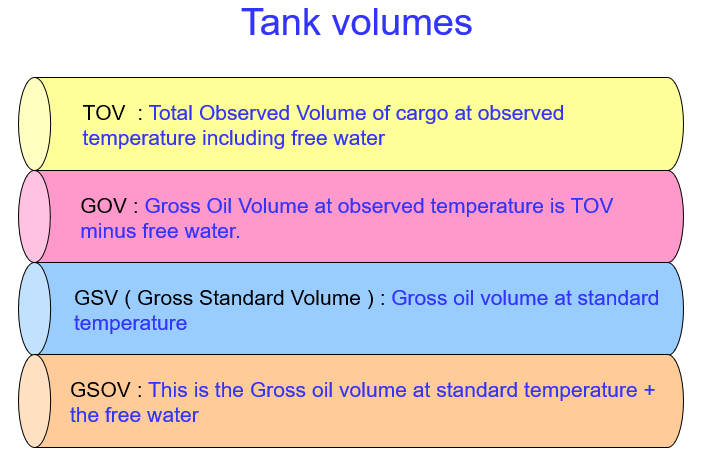
TOV : Total Observed Volume of cargo at observed temperature including free water
GOV : Gross Oil Volume at observed temperature is TOV minus free water.
GSV ( Gross Standard Volume ) : Gross oil volume at standard temperature
GSOV : This is the Gross oil volume at standard temperature + the free water
Tank volumes – units
Tank Volumes are usually calculated in
US Barrels
OR
Cubic Meters
1 Cubic Meter = 6.28981 US Barrels
Correction Factors
VCF
or
Volume Correction Factor
Also called Volume Reduction Factor Obtained from ASTM tables
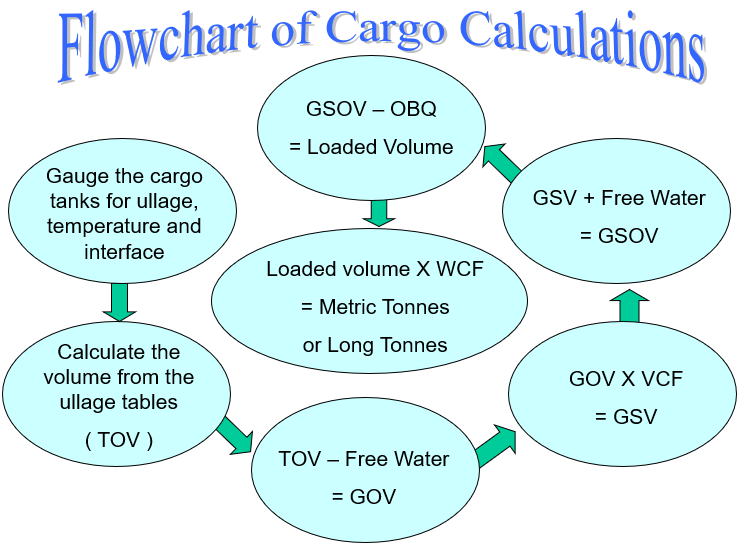
GOV x VCF = Vol at standard temp.
WCF
or
Weight Correction Factor
Also called Weight Reduction Factor
Obtained from ASTM tables
Vol at standard temp x WCF = Mass
ASTM Tables
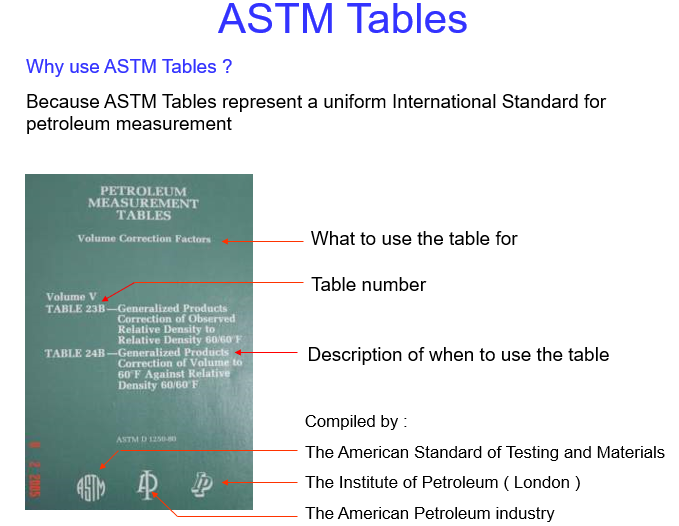
Tables for VCF
Table 6A – For crude oils
For correction of US Barrels at Observed temperature to US Barrels at 60 F.
Table 6B – For Products
For correction of US Barrels at Observed temperature to US Barrels at 60 F.
These tables are entered using the API and the observed temperature
Table 24A – For crude oils
For correction of US Barrels at Observed temperature to US Barrels at 60 F.
Table 24B – For Products
For correction of US Barrels at Observed temperature to US Barrels at 60 F.
These tables are entered using the Relative Density and the observed temperature
Table 54A – For crude oils
For correction of Cubic meters at Observed temperature to Cubic meters at 15 C.
Table 54B – For Products
For correction of Cubic meters at Observed temperature to Cubic meters at 15 C.
These tables are entered using the Density at 15 C and the observed temperature
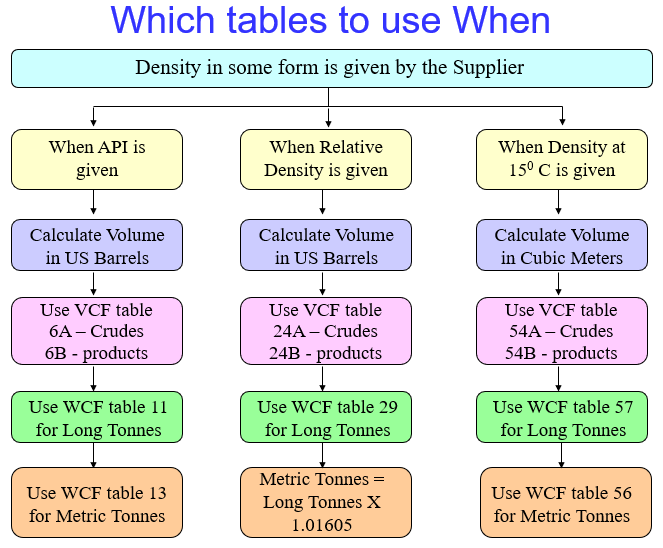
Tables for WCF
Table 11 – For converting US Barrels at Standard temperature to Long Tonnes using API.
Table 13 – For converting US Barrels at Standard temperature to Metric Tonnes using API.
Table 29 – For converting US Barrels at Standard temperature to Long Tonnes using Relative Density at 60 F.
Table 56 – For converting Cubic meters at Standard temperature to Metric Tonnes using Density at 15C.
Table 57 – For converting Cubic meters at Standard temperature to Long Tonnes using Density at 15C.
Tables for Interconversion of units
Table 1 – Interrelation between Various units of measurement.
Table 2 – For Temperature conversion. Centigrade to Fahrenheit and vice versa.
Table 3 – Conversion of API gravity at 60 F to Relative density at 60 F and Density at 15 C
Table 52 – For converting Barrels at 60 F to Cubic meters at 15 C and vice versa.
ASTM tables can be broadly divided into three main groups
Tables used for volume Correction Factors ( VCF )
Tables used for Weight Correction Factors ( WCF )
Tables used for conversion of volume and density measures
Other Factors
Line Content
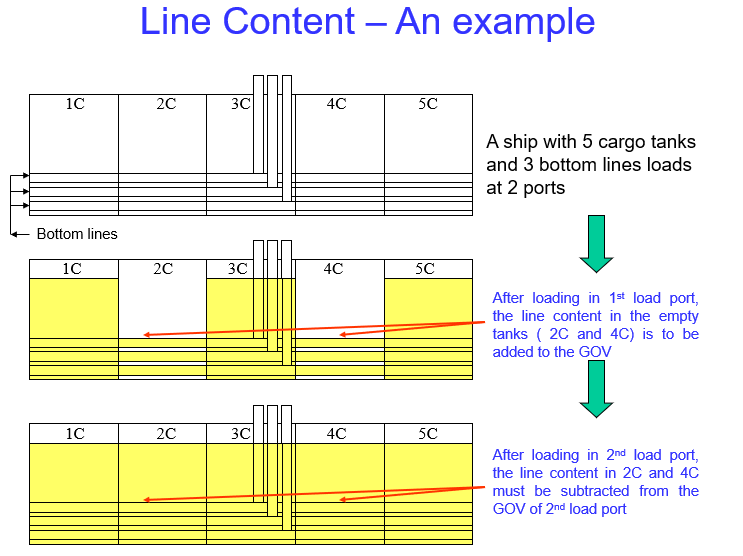
Line content refers to the cargo in the bottom line of the ships cargo tanks.
•The ullage tables normally state whether the line content is included within the tabulated volume of each tank or not.
•If not stated, it is implied that the line content is included within the tabulated volumes for each tank.
•Line contents must be added to or subtracted from the GOV.
Add line content:
•If any lines passing through empty tanks are filled with cargo.
•Contents of all lines if the line content is not included in the tabulated volume of each tank
Line content may have to be subtracted in certain cases
In oil floating roof storage tank , oil volume decreases with increase with in temperature and increases with decrease in temperature . just give clarification .
Very useful & graphics are clearly easy to understand
At Table for VCF
Why two Table 54a, the one should be Table 54B for petroleum products.
Thanks for correcting the typo. Amended the same