Monitoring the drag with swing circle
A ship at anchor will swing around the anchored position in the wind.
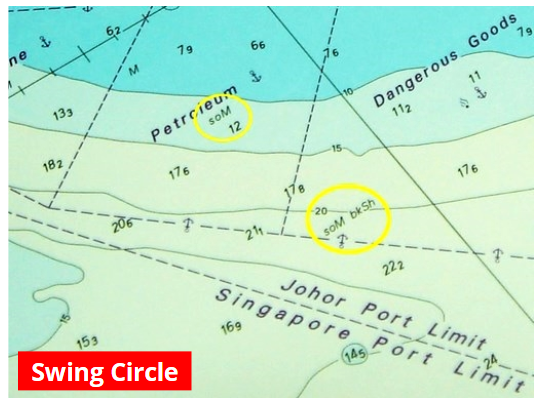
A ship at anchor will swing around the anchored position in the wind. It is also recommended to draw a small circle on the chart around the location of the “dropped” anchor that is based on the vessel’s length and the length of the cable. Vessel must remain inside the circle.
Swinging radius
Swinging radius of the vessel = Length of vessel + length of cable – Depth of water.
For example
- Length of ship from bridge to hawse pipe = 122 m
- Length of cable = 6 shackles (6 x 27.5) = 165 m(+)
- Depth of water = 12 m(-)
- Swing circle radius of the vessel = 275 m
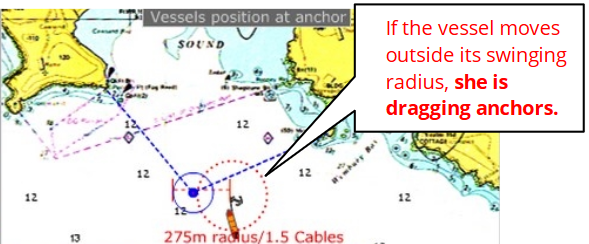
The main engines should be kept in a state of readiness at all times, except when the Master is very confident of the anchorage/weather conditions. The cable should be checked visually at least once every watch & more often if the weather deteriorates.
Dragging Anchor
Dragging anchor will occur when the anchor loses its grip on the bottom and starts sliding over the bottom, a result of impulse force exceeding the anchors holding power.
How would you know vessel is dragging anchor?
Cross checking for dragging of anchor is done by following means:
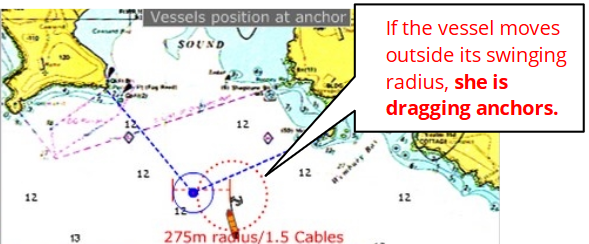
- Confirm vessel is within the swing circle.
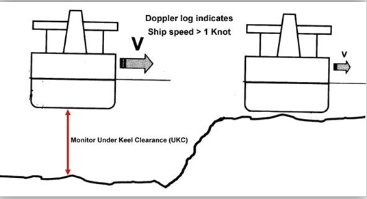
- Doppler log indicates, ship is moving in certain direction with a speed of more than 1 knot.
- Check position by radar (range bearing), GPS & UKC (Under keel clearance)
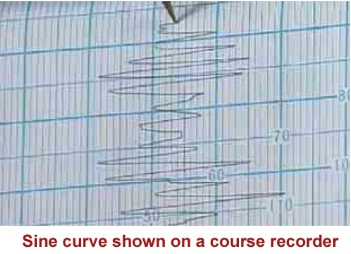
- Course recorder indicates distorted curve rather than regular sine curve.
- Abnormal vibrations felt on hull
- Taut cable condition continues
- Relative position to surrounding ships changes
Action, if vessel drags anchor
If risk of collision or contact with another vessel exists then:
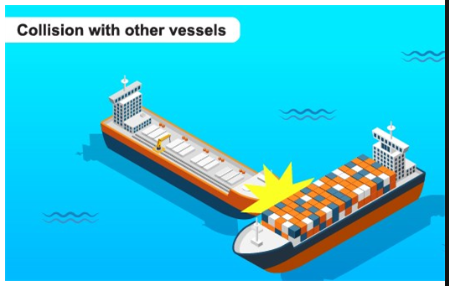
- Vessel should consider which of the two is the better option to be taken within the short time available
- Picking up anchor and moving away
- Paying out /slipping the cable to increase the distance / time from contact.
- If time and circumstances permit, pick up anchor and move to a safer location
- If time or circumstances do not allow for picking up the anchor then:
- Try running out the rest of the chain to increase distance.
- If this is likely not to or will not avoid contact with other vessel then cable may be slipped from the bitter end (with anchor buoy which was rigged on arrival) and the vessel maneuvered out of the danger.
- If time or circumstances do not allow for slipping of the anchor then use engines boldly to dredge the anchor, in which case the crew should be in a safe area well clear of the windlass and anchor chain.
- In the worst case scenario an astern movement (full) on the engines will only result in the cable snapping at the stopper and being lost with the anchor.
- In an emergency, if collision is imminent, it is preferable to lose the anchor than to have contact with another vessel. In many cases it has been observed that even when collision is imminent (where another vessel is dragging on to own vessel at anchor, etc) the bridge team tend to be intent on picking up the anchor.
This will only result in precious time being lost and will do very little to avert an impact. In such cases losing the anchor and chain is far less expensive and damaging than a collision.
So if the situation warrants DO NOT HESITATE to slip the anchor.