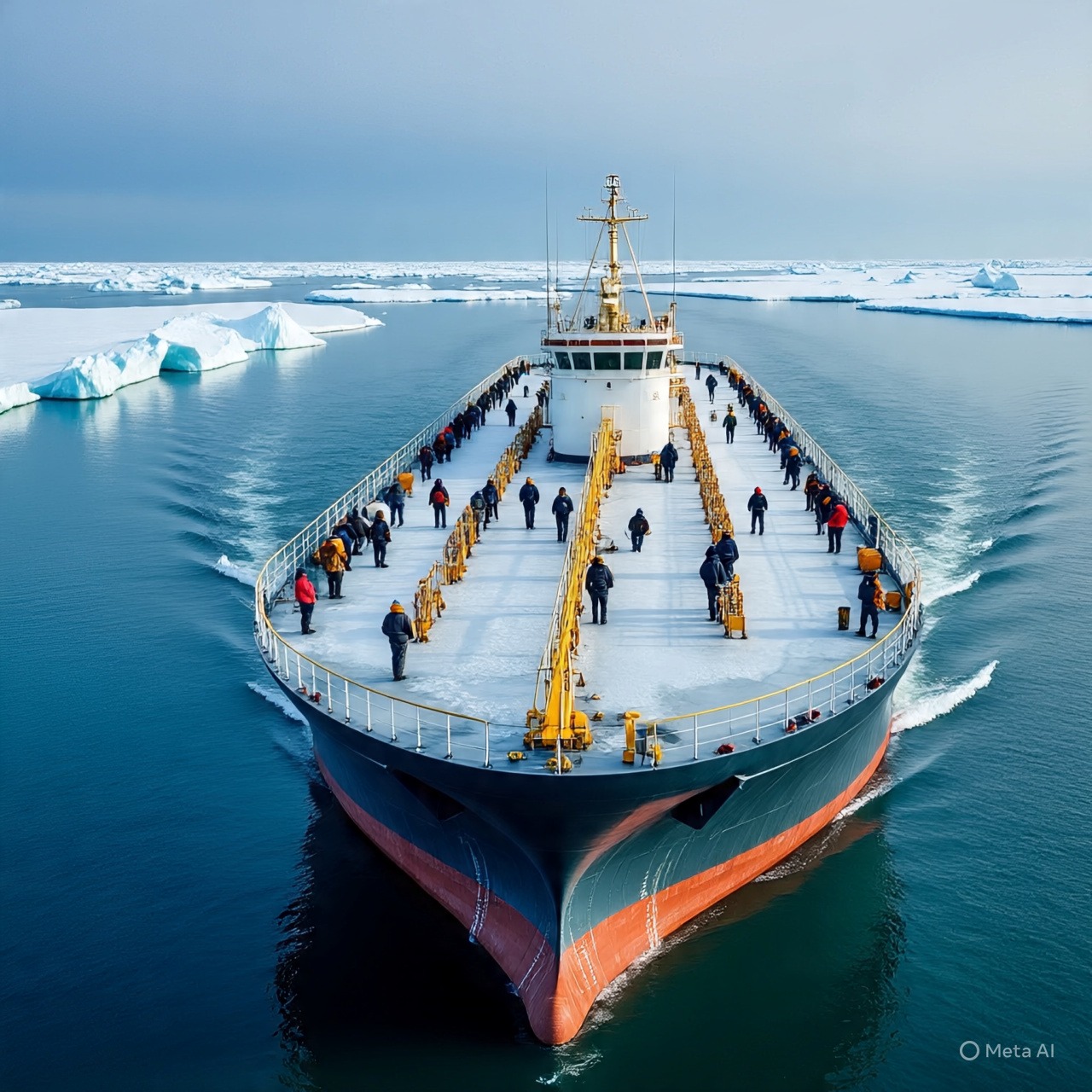
Deck Preparations
The Master shall ensure that the following measures have been taken to prevent damage to Vessel, Machinery, Pipelines and Equipment prior entry into areas with Freezing Conditions.
1) Freeze prevention for Pipe lines and Valves / Systems related
2) Draining Fresh and Sea water Pipe lines, Valves, etc
3) Fire line, deck wash lines, ballast water lines, tank cleaning lines, and various lines containing water shall be drained.
4) Where remaining water cannot be drained by gravity because of piping layout, flanges shall be removed for draining.
5) Steam supply and return lines, exposed to freezing temperatures shall be drained completely.
6) Prior steam usage and entry in freezing temperatures, all steam traps should be cleaned, so that the flow will not be impeded by condensation or freezing.
7) Freshwater lines outside accommodation and E/R should be drained
8) Suitable cautionary placards to be posted at pumps and main valves
9) Except for unavoidable cases, do not flow water in a line that has once been drained.
10) Draining Heating Coils / Traces in Machinery space and/or Under passage
When not in use, coils shall be shut from steam and exhaust lines by applying blind plates at Steam / Exhaust valves, and Heating coils in tanks shall be airblown to flush drain out.
Additional for Tankers // Draining and isolating of Heating Coils and Traces for:
Cargo Oil Tanks and Pipes
AUS, Seal Water Tank
IGS, Deck Seal Water Tank
Freeze prevention for Apparatuses
Air Motors and Float Gauges
Fill void with waste rags, cover the unit with waste blanket and further, cover them with Plastic sheet to prevent wetness and freezing.
Replace Lub. Oil with that for Exclusive use in Cold districts.
Drain sections of Pneumatic lines to remove traces of moisture carried over into driving air.
Life boats
Add Antifreeze mixture or Drain for cooling fresh water from the Boat Engine
Emergency generator
Add sufficient quantity of Antifreeze liquid inside the Radiator.
Additional for Tankers // Refill Freshwater of P/V Breaker with Antifreeze liquid
Freeze prevention for Fresh and Sea Water Tanks.
Ensure full tanks have sufficient void to allow for expansion.
Pay attention to fresh water tanks in life boats (To leave some void)
Crew protection
Crew shall be well equipped with warm working gear.
Crew work shall be planned such that they are less exposed to cold weather.
Heating in accommodation shall be checked for satisfactory working.
Consideration for adding de-icing salt to prevent slipping could be carried out.
All personnel shall be instructed in hazards of working in freezing conditions.
Freeze prevention for Deck machinery
Keep the Hydraulic Pumps running continuously
Replace Hydraulic Oil in Hydraulic pumps with that for exclusive use in cold districts
No-load operation of the Windlass, Winches and other Deck machinery for a few minutes prior taking load.
Also under severe Cold district, above No-load operation may be required Prior to enter such an area.
Additional for Tankers // Maintain Heating the Deck Seal water Tank, AUS (Auto Unloading Systems) Seal Water Tank, etc if provided with heating lines or Maintaining a Continuous Flow.
Additional for Tankers // Drain seal water inside Vacuum pump
Freeze Prevention for Nautical instruments
Continuous operation of the Radar, subject to the Port or Terminal regulation, while in port.
Turn on Navigation Lights at all times (at sea).
Switch on Heaters of the Air horn, Bridge Clear View Screen, Windows, etc.
Freeze Prevention in Machinery space
Close openings to the outside
Adjust the number of ventilating fans on operation in the machinery space.
Open the door between the Machinery Space and Steering gear room to prevent temperature drop in the Steering gear room
(During times of manned machinery spaces only)
Continuous operation of Hydraulic Pumps for the Steering gear (Turn the rudder every 30 min. while in port)
Measures For Navigation In Areas Where Ice May Be Encountered
For navigation in areas where Ice may be encountered, or across a sea which might Freeze, the Master shall carry out the following items to assure safe navigation of the vessel.
Study of Detour
Never make light of the danger and difficulty of navigation in Ice. If a route to detour around the frozen sea is available, the detour should be selected even if the distance increases greatly.
Collection of Ice Information
Try to obtain the latest information through telecommunication, Ice information via weather facsimile, and information from local agency.
Ice information from WNI Ocean-routes and Weather Associations. If under contract on weather routing service, request the supply of such information (Such information is available free of charge).
Ice information from BIMCO (the Baltic and International Maritime Council) is obtained through agent.
(North Europe and the East Coast of Canada).
Master is also reminded of the obligation, under SOLAS to transmit danger messages on observation of ice.
Preparations for entering into Ice Sea
The Master shall ensure that the following preparation is made prior to navigating in Ice Sea:
Confirm that the main engine is available at any time and that the Steering gear is fully operational.
Confirm Nautical instruments and telecommunication equipments are fully operational.
Control the Draft, Trim, and Heel
(Use ballasting to obtain Maximum possible Draft and Trim by the stern).
Use the Low suction for Main Engine Cooling Sea Water suction, to avoid blockage of Sea chests.
Keep contingency plans ready at hand to prepare for the blockage of the Sea chest.
This study includes the possible lineup that can use Sea water in Ballast tanks as Engine Cooling Water.
Ensure all Water-tight / Weather-tight closures have been shut
Pull up the Electromagnetic Log for protection of its sensor block if the block is normally projected from the vessel’s bottom.
Maneuvering Vessel During Navigation in Ice
The Master shall pay the following special attention during Navigation in Ice Sea.
The Master shall be on the bridge to Command the vessel directly.
Make a strict Watch & Look out by means of Sight and Radar.
The Main Engine must be ready for “Go astern” any time.
For “Go astern”, the Rudder must be Mid-ship to prevent the Propeller and Rudder from damage.
Except in an emergency, the Rudder angle must be limited to Minimize to prevent of Large athwart-ship motion of the Stern.
To prevent the hull from damage due to impact, enter the ice at Low speed, and then increase to moderate speed to maintain headway and control of the ship.
If an ice block has come under the bottom of the vessel, drop the speed immediately to protect the rudder and propeller.
Do not drop anchor where ice is dense to avoid the danger of anchor chain being cut. Frequency of Sounding Tanks to be increased.
Preventive Measures Against Icing On Hull
The Master shall take the following preventive measures to prepare for icing on the hull:
Try to obtain weather information on icing as much as possible if very heavy icing is expected, notify the operator.
Consideration should be given to the reduction in Meter-centric Height (GM) caused by ice accretion and its countermeasures.
If icing has occurred, carry out De-icing work to the Windlass, Winches, Cargo handling equipment etc., and notify such situation to the Operator, consulting on the following actions with the operator:
a. The vessel goes south to waters where sea water temperature is higher for prevention of icing or for thawing.
b. If De-icing work by the crew only is difficult, consider an arrangement for subcontractors on the shore side.
Record Keeping
The Navigation in Cold Weather Checklist shall be used on each occasion of navigating in cold districts, or in ice.