NEED FOR ASSISTANCE
When a ship suffers a casualty, or is otherwise in a position of peril, the master must decide as a matter of urgency whether assistance, including salvage assistance, is needed or if the situation can be handled using the ship’s own resources.
MASTER’S RESPONSIBILITY
The master should be authorised to take whatever measures he considers necessary to protect life, his ship and the environment, without reference to a third party.
AUTHORITY OF THE MASTER
The authority of the master is not altered by engaging salvors. He remains in command of the ship despite the presence of a salvage master and he should therefore ensure that he is fully aware of the situation. Even though services have been accepted and assistance is being rendered, the salvor must cease his services if the master says so.
The master should co-operate fully with the salvors, who are experts in salvage operations, and prevent or minimise damage to the environment. He should take account of any advice given by the salvage master.
The salvors may not be experts in the safety and handling of cargo or familiar with the ship.
If in doubt about the advisability of any action suggested by the salvors, the master should not hesitate to challenge the advice given.
ASSESSMENT OF URGENCY
The master should immediately assess the dangers to which the ship is exposed and the urgency with which assistance may be required from outside sources. It is better to overreact on the side of safety and pollution prevention than to delay action in the hope that the situation may improve. When making judgements, it should be assumed that the situation will not improve.
Account should be taken of all circumstances including the following:
• Safety of personnel;
• Proximity to shore or shoal water;
• Weather and sea conditions;
• Current and tide;
• Nature of sea bed and shoreline;
• Potential for safe anchoring;
• Availability of assistance;
• Damage already sustained by the ship;
• Risk of further damage to the ship;
• Prospect of maintaining communications;
• Threat of pollution; and
• Manpower and material requirements.
OBTAINING ASSISTANCE
Once the master has decided that assistance is necessary, he should act promptly to request it from any available source using the most expeditious means at his disposal.
When one or more suitable ships respond to the call for assistance, the master should immediately request such ship(s) to undertake whatever action is necessary.
Assistance should never be delayed merely to negotiate a particular form of agreement or contract terms.
Generally, those rendering beneficial assistance to a ship in peril are entitled to salvage. It is not essential to agree upon the contractual terms for the assistance required, since there is a right under maritime law to salvage which exists independently of contract.
If the assisting ship(s) request(s) the master to agree to a contract for the assistance, Lloyd’s Standard Form of Salvage Agreement, known as Lloyd’s Open Form is the form most usually offered and should be agreed upon to avoid any delay in assistance being rendered. The Lloyd’s Form provides protection for both parties to the salvage agreement.
The engagement of one salvor does not preclude the master from engaging other salvors.
OTHER FORMS OF CONTRACT
It is possible that the ship offering assistance may decline LOF and propose other terms or an earlier edition of Lloyd’s Open Form. If the master considers that immediate assistance is essential, he should accept the terms offered, but if he feels that the terms offered are unreasonable or extortionate he should register a protest immediately or, if he thinks that this may delay the assistance, on completion of the service.
If the master considers that immediate assistance is not essential it may be possible, where time allows, to have the assistance arranged on a contractual basis stipulating ordinary tariff fixed lump sum or daily rates.
However, it is emphasised that where life, the ship, its cargo or the marine environment are in peril, such negotiations should not in any way delay the engagement of the salvors.
EMERGENCY TOWING OF TANKERS
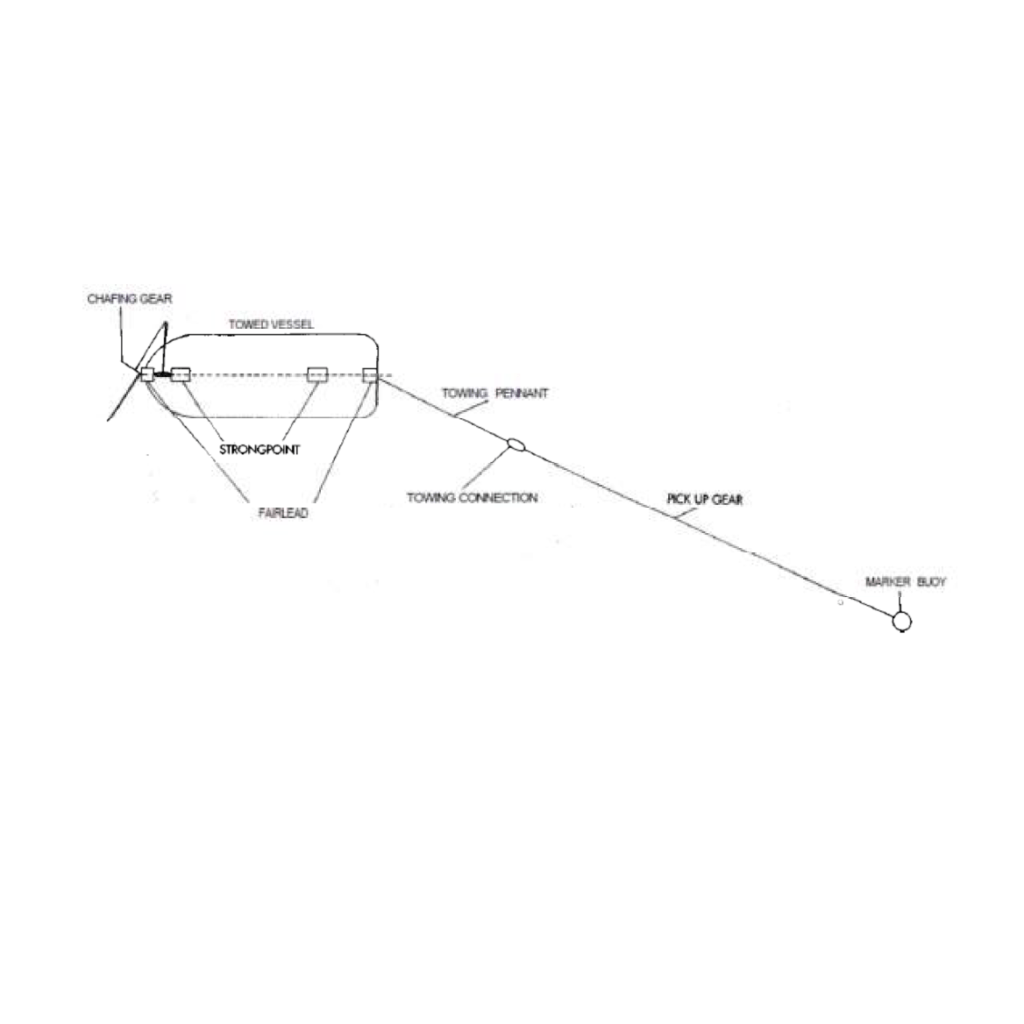
SOLAS, Chapter II-l, Part A-I, requires that tankers of 20,000 tonnes dwt and above are equipped with an emergency towing system both forward and aft. The purpose of these systems is to provide the ship with a towage capability which can be rapidly deployed and connected to a towing vessel in an emergency situation. There are a number of different methods by which this requirement can be met.
Preparation
It is a requirement that the forward system can be deployed by the ship’s crew in one hour (in harbour conditions) and the aft system by one man in fifteen minutes (in harbour conditions). To achieve this, emergency towing systems are generally made up of lightweight and/or rapidly deployed components. Whilst these are more than adequate for a limited duration tow, to pull the ship away from, or restrict her drift towards immediate danger (i.e. an “emergency tow”), the system may need some modification for a long distance tow.
Tanker Towing Arrangement
Readiness
Because these systems are intended for use in an emergency situation, it is important that they are readily available for use at all times. The components of the system should be located permanently at, or near to, the strong point site and kept free of obstructions so that they are always ready for immediate deployment.
Training
In order that all personnel are familiar with the method of operation, a clear written procedure should be on board which describes precisely how the system is to be deployed.
This procedure should be displayed on the ship where it is readily accessible to all personnel. It should also be included in the ship’s SOLAS training manual.
Deployment of the equipment should be practised in emergency drills and included in the ship’s contingency plans.
Rigging the Tow
• Where roller leads are installed to facilitate connection of the towing vessel’s line to the chafe chain, these should have a strength which is at least twice the stalling power of the most powerful ship winch likely to be used;
• Where the system includes a ship supplied towing pennant, this should be at least 100m long in order to provide sufficient scope for the towing vessel to operate safely and to minimise the possibility of putting loads on the pennant whilst the towing vessel is making the connection;
• Where the forward system consists of only a chafe chain, it is recommended that the chain is permanently attached to the strong point. This will avoid the need to make an additional connection in adverse weather conditions;
• A pad eye should be provided on the deck or on a deck fitting, at the forward point, near where the towing connection will be made. This pad eye is for securing a chain stopper which will be needed for stoppering the towing vessel’s towing wire whilst the connection is made to the chafe chain;
• Two mooring shackles should be provided with an ultimate strength and jaw width suitable to connect to the ship’s emergency towing equipment. One shackle should be stowed forward and the other should be stowed aft. This will ensure that a connection can be made-irrespective of what connection is offered by the towing vessel and will ensure that the towing vessel can make the connection to the aft towing pennant which will probably be fitted with a large thimble;
• A chain stopper should be provided, as should a hammer, pliers and split pins for the above shackles, or cut lengths of seizing wire for mousing the shackles.
Note: all the portable equipment mentioned above should be designated for emergency towing equipment use only. It should be clearly marked and securely stowed near the fixed equipment and be ready for immediate use.
EMERGENCY TOWING OF OTHER SHIPS (Non Tankers)
Although there is no requirement for tankers below 20,000 tonnes dwt and other vessels to be fitted with emergency towing equipment, such ships should have Emg Towing Booklets showing arrangements & plans for emergency towage. These plans should identify suitable strong points and fairleads for towing, and measures to prevent the chafing of tow lines.
The plans should identify any special equipment needed for this task.
PLANNED OCEAN TOWING
GENERAL
In a planned or ocean tow, the procedures to be adopted should be agreed with the towing master who, knowing the capabilities and the type of equipment available to him, can suggest a towing arrangement that will best suit the intended voyage.
PREPARATIONS FOR TOWING
Once the master has decided that he requires the assistance of a towing vessel, he should immediately begin to plan the possible methods of making the towing connection. The nature and extent of any damage to the ship which is to be towed will be relevant in deciding whether it should be towed from the bow or the stern to minimise further damage while under tow.
Early communications should be established with the towing vessel to exchange information and determine the equipment available on the vessel to be towed and the proposed towing method. The master can then decide what preparations should be made.
This may include preparing the insurance/towing wire for use or breaking the anchor cable on deck and having suitable shackles and chain available for use with a towing bracket.
Alternatively the tow can be established by removing an anchor from its cable and connecting the towing wire to the anchor cable which is left rigged through the hawse pipe.
The chain can then be veered by use of the windlass to allow the chain to be moved in the hawse pipe. Breaking the anchor cable can be performed on the ship’s deck or on the deck of the towing vessel.
It should be noted that during towing, the greatest stresses on the towing system occur when the inertia of the disabled ship is being overcome and, later, during its tendency to yaw. It is at these times that the tow line is most likely to part. In order to minimise the risk of parting the tow line, the highest possible resilience should be incorporated. One possible means of achieving this is by lowering the ship’s anchor and cable a little way and connecting the tow line directly to the cable with the anchor still attached.
On tankers fitted with emergency towing equipment, the preferred method will probably be to connect the towing wire to the forward chafe chain attached to a strong point and deploy it through a central fairlead.
If towing from aft is deemed necessary, any limitations of the emergency towing equipment must be taken into account when considering its use.
If the towing vessel is an ocean-going tug, the tug master is likely to prefer to have his own towing pennant attached to the distressed ship. If time allows, the tug master will incorporate into his towline a length of chain where the connection leads through the fairlead of the ship to be towed.
CONNECTING THE TOW
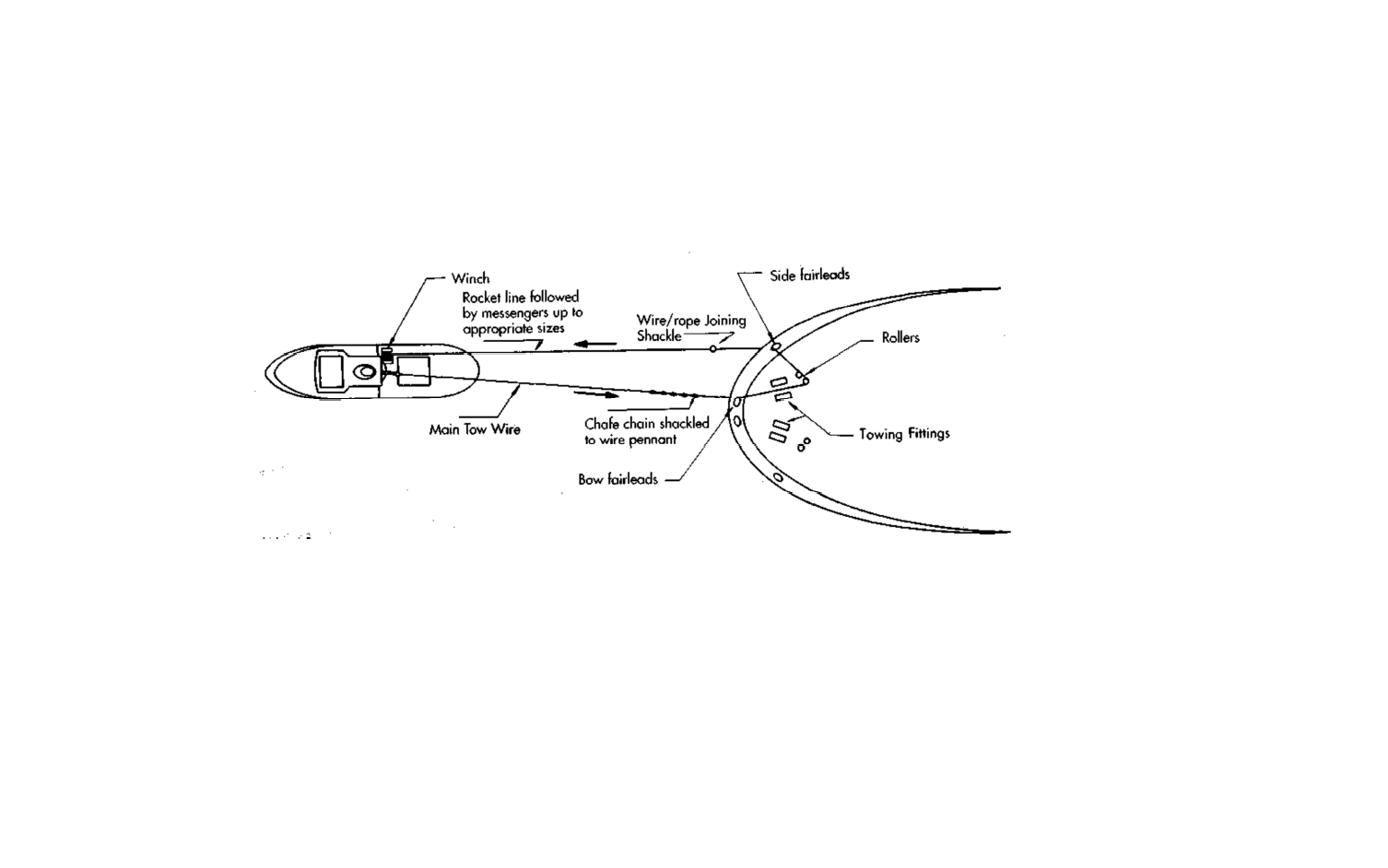
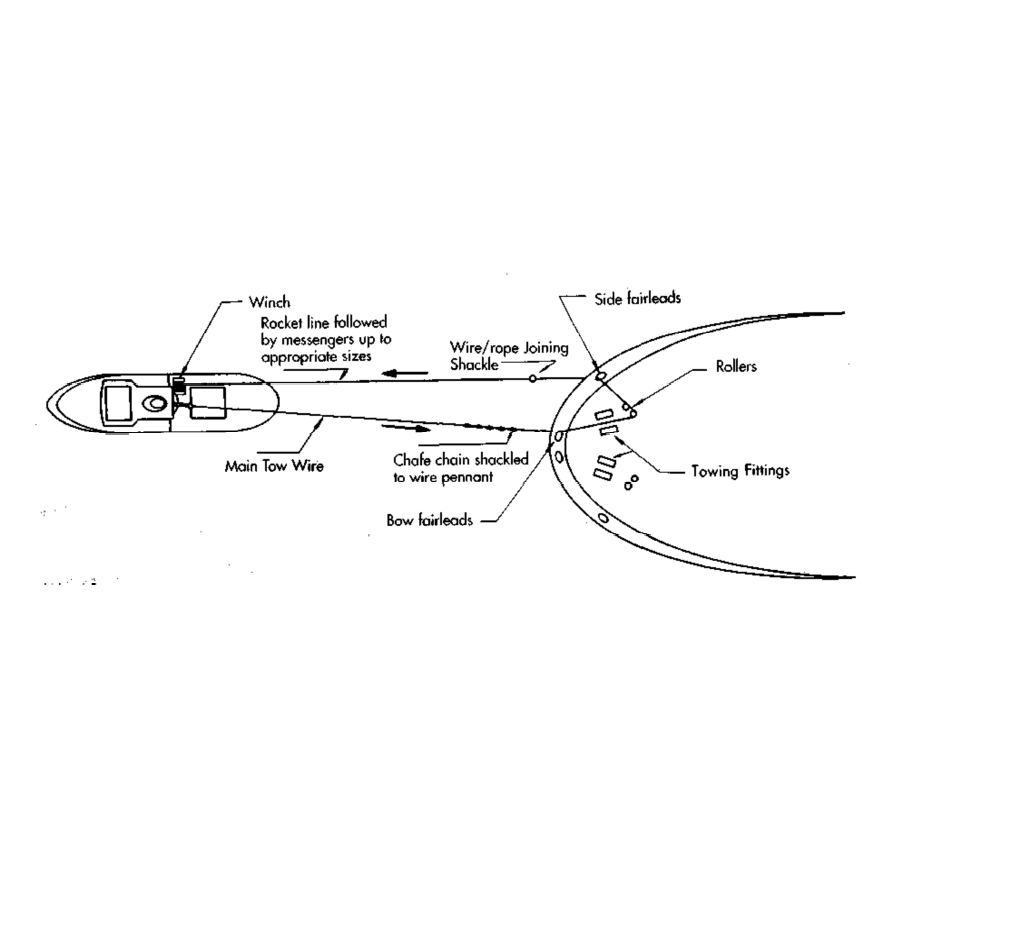
The method of transferring the towing hawser is dependent on the location of the vessels and the weather conditions at the time of connection. In appropriate circumstances use can be made of line throwing guns to pass an initial light line, to be followed by successive lines of increasing size.
Another method is for the tug to tow a lifebuoy with a messenger across the bows of the disabled ship which can then be grappled by the disabled ship. The use of rocket line throwing apparatus should be given a low priority due to its inherent unreliability.
The fairlead or chock to be used should be of strong construction and should also provide a smooth guide for the towline in various directions. Roller fairleads are usually unsatisfactory because of their inadequate radius. Fixed fairleads/chocks with the largest possible radius of curvature are preferable.
Radio communications should be maintained between the distressed ship’s towing party and the towing vessel. Adequate manpower should be standing by to make the connection.
Initial connection will normally be made by passing a light line, such as a heaving line, and using this to take on board a messenger, which in turn will be used to pass a tow line between the ships.
Should it prove impossible to lift the tug’s gear on board then the method shown in below Figure should be used. A light line followed by a heavy messenger are passed back to the tug, after which the chafe chain and towing line are heaved up to the towing point on the disabled vessel, using the tug’s own power. If this is impracticable an alternative may be to lower an anchor into the water to enable the tug to connect a line directly to the anchor cable. Once the tug line is secure, with the agreement of the tug, several shackles of cable may then be paid out.
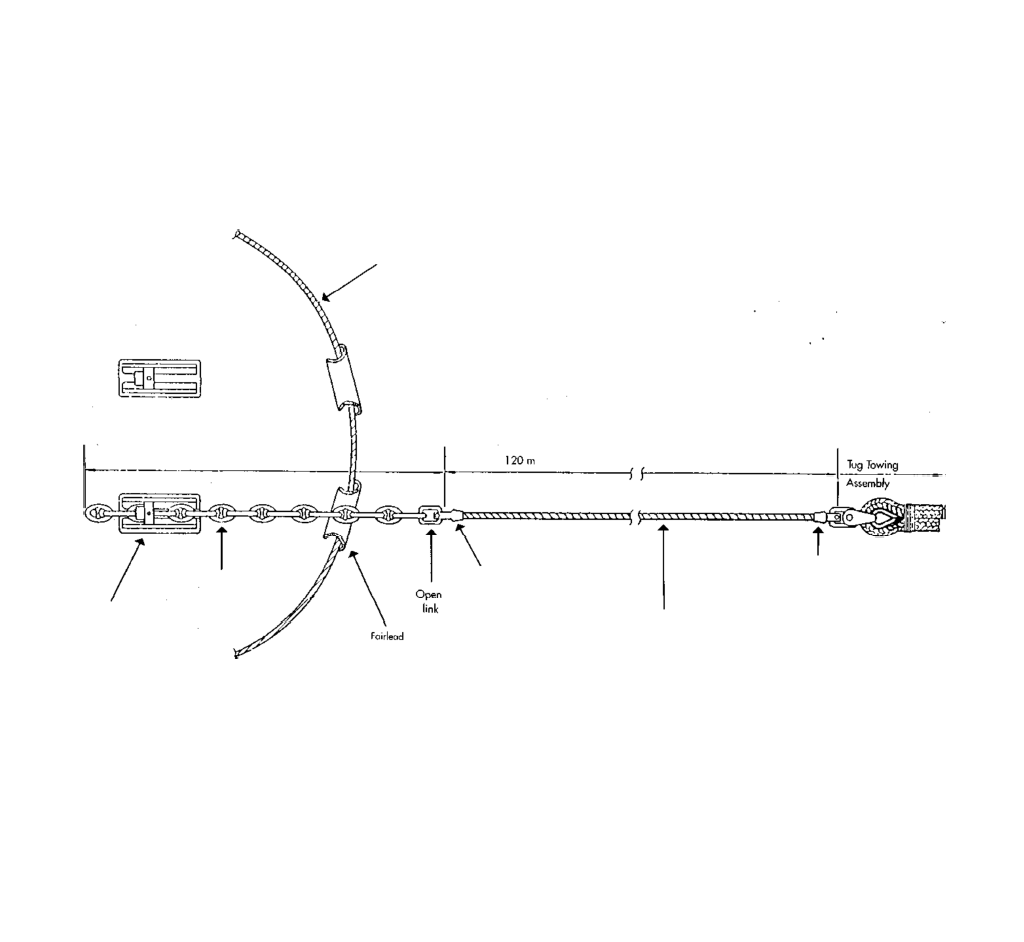
The tow line may be secured on board the disabled ship in one of several ways for example by either turning up on two or more sets of bitts, or securing the chafe chain which in turn is secured in a towing bracket or in a chain stopper as shown below.
When the anchor cable is used, precautions should be taken to prevent the cable from running out. Claws, pawls, guillotines or other mechanical means may be employed.
If the disabled ship is to be towed by the stern, the after mooring winches and mooring wires can be set up to form a bridle using suitable shackles.
COMMENCING TOWING
Before commencing the tow continuous radio communication should be established between the ships. No action should be taken in regard to navigation or engine manoeuvres by either master without first informing the other.
A modern cargo ship or tanker, with the accommodation aft, will naturally ‘seek the wind’ (the weathervane effect) as it gathers way under tow and has no propeller thrust over the rudder. A towing ship should therefore ensure this happens under control by beginning the tow into the wind, and be ready to alter its own course to stay ahead of the towed ship until the latter can steer itself.
If this is not successful, the turn into the wind can be effected by first gaining headway.
However, such headway should not exceed about one knot for maximum effect. Indeed, speeds in excess of this may hinder the tug as the towed ship could take charge out of alignment with the tow line.
A tug of lesser power may manage to turn the ship by making use of the weathervane effect, holding the bow and letting the stern drift downwind.
It may well be easier to turn a ship stern to wind rather than head to wind. However, once turned stern to wind, towing may be difficult due to the tendency of the ship to sheer;
nevertheless the direction of drift can be significantly influenced.
If it is available, the ship’s steering gear, properly used in conjunction with the tug, will also help the manoeuvre and assist the tow to steady on the required course.
If the disabled ship’s steering gear cannot be used, the rudder should, where possible, be secured amidships. Securing the rudder, as well as assisting towing, will minimise any damage that could be caused by the rudder slamming in heavy seas. When a disabled ship is towed ahead with an unsecured rudder, the rudder may well slipstream amidships and be no problem, but if engines are being used, the propeller race can cause the rudder to assume a hard over position with consequent steering difficulties.
If the ship is to be towed astern, a secure rudder in the amidships position may well be necessary to the success of the venture. A rudder which is not secured will probably move to a hard over position as the ship gathers sternway and thus make it extremely difficult to control the ship.
Where it is advisable to secure the propeller to avoid engine damage, this can usually be done by engaging the turning gear.
If the ship has suffered loss of steering, use of the ship’s engines may assist the tug in getting the tow under way by altering the ship’s heading with respect to the weather. In order to achieve an optimum towing speed when the disabled ship cannot steer, it should be noted that most ships have the least tendency to yaw when heading directly into the wind, although some VLCCs and ULCCs may settle best on a heading 20° or 30° off the wind.
Ship’s engines should not be used except as advised by the tug
LEGAL ASPECTS – CONTRACTS FOR SALVAGE ASSISTANCE
Salvage assistance may be rendered without agreement being reached in advance. If no contract has been made, those rendering beneficial assistance are in any event entitled to claim salvage where a ship is in peril, since there is a right to salvage under international maritime law which exists independently of contract.
Salvage may also be rendered by agreement. There are two main types of arrangement.
Services may be rendered on the basis that remuneration will be settled later – either by agreement or by arbitration – on the traditional salvage basis, which relates the reward, inter alia, to the values salved.
Alternatively remuneration may be on the basis of a lump sum or a daily rate. In either case the services may be rendered on a no-cure, no-pay basis although a daily rate is unlikely to be offered on a no-cure, no-pay basis. As mentioned previously LOF is the most usual form of agreement offered, but there are a number of others.
In many circumstances it is possible, where time allows, to have the assistance arranged on a contractual basis stipulating ordinary tariff, fixed lump sum or daily rates. However, where the ship or the marine environment are imperilled, negotiations should not delay the engagement of salvors. LOF is the form acceptable to most salvors and may be agreed upon to avoid any delay in assistance being rendered.
GOVERNMENT INTERVENTION
The government of a country whose interests are threatened normally has a right to take action within its territorial waters in respect of a ship that has suffered a maritime casualty.
In port or estuarial waters the local port or harbour authority may have jurisdiction.
The master should comply with instructions given by the government or the port or harbour authority, and a full report should be made to the owner or operator.
If any such instructions are, in the professional judgement of the master, inadvisable or dangerous, he should question them and, if appropriate, register a protest to the government or authority.
If the ship is on the high seas, under the International Convention Relating to Intervention on the High Seas in Cases of Oil Pollution Casualties, the government of any country that is threatened by pollution may take measures to prevent, mitigate or eliminate any grave and imminent danger of pollution.
The Convention requires the government to consult, if possible, with other affected governments, including that of the ship’s flag state, and the owners of the ship and cargo if known to it. The measures taken must not be more than are reasonably necessary for the purpose, and compensation is payable if damage is caused by excessive measures.