Before starting the engine, the following checks and procedures are to be undertaken.
All components that have been overhauled to be checked and wherever possible function tested. All equipment, tools and rags used during overhaul to be removed from the engine.
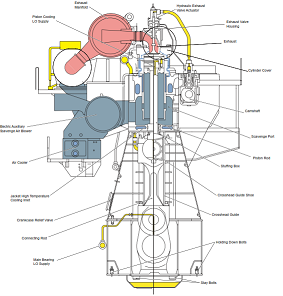
Air Systems
a) Drain any water present from the starting air system.
b) Drain any water present from the control air system at the receivers.
c) Pressurize the air systems and ensure that the pressures are correct.
d) Ensure compressed air is available at the pneumatic exhaust valves.
e) Engage the lifting/rotation check rod mounted on each exhaust valve and check that the exhaust valves are closed; these should be disengaged when lift/rotation is confirmed when the engine running.
Note: Air pressure must be applied before the camshaft lubricating oil pumpis started. This is to prevent the exhaust valves from opening too far.
Lubricating Oil Systems
a) Check the oil level in the main engine sump and replenish if necessary.
b) Start a main engine LO supply pump and a camshaft booster pump.
c) Ensure all oil pressures are correct.
d) Ensure there is adequate oil flow through the return oil sight glasses for piston cooling and the turbocharger.
e) Ensure the cylinder lubricators are filled with the correct type of oil and operate the cylinder lubricators manually to check that oil is being supplied by the pump units.
Cooling Water Systems
a) Preheat the engine cooling water system to at least 20°C but preferably to 70°C.
Note: The engine must not be started if the jacket cooling water temperature is below 20°C.
b) Start one of the main fresh water cooling pumps.
c) Start one of the main sea water cooling pumps.
d) Ensure that the cooling water system pressures are correct and that the systems are not leaking.
Slow Turning the Engine with the Turning Gear
Slow turning of the engine must be carried out to prevent damage caused by fluid leaking into any of the cylinders. Before beginning this operation, permission from the bridge must be sought.
Note: Always carry out the slow-turning operation at the latest possible moment before starting and, under all circumstances, within 30 minutes of actually starting the engine.
a) Open all of the cylinder indicator valves and engage the turning gear.
b) Turn the engine one revolution with the turning gear in the direction indicated by the reversing handle.
c) Check to see if fluid flows out of any of the indicator valves.
d) Repeat previous points in the opposite direction of rotation.
e) Disengage the turning gear.
f) Ensure the turning gear is locked in the OUT position.
h) Check that the indicator lamp for TURNING GEAR ENGAGED extinguishes.
i) Lift the locking plate of the main starting valve to the SERVICE position.
Note: The locking plate must remain in the upper position during running and in the lower position during repairs.
Fuel Oil System
a) Start a fuel oil supply pump and a fuel oil circulating pump. If the engine was running on heavy fuel oil when stopped, the circulating pump should still be running.
b) Check fuel pressures and temperatures.
Checking the Fuel Regulating Gear
a) Close the shut-off valve of the starting air distributor to prevent the engine from turning. Check the indicator lamp.
b) Switch over to ENGINE SIDE control at the engine side control console.
c) Turn the regulating handwheel to increase the fuel pump index and check that all the fuel pumps follow to the FUEL SUPPLY position. With the regulating handwheel back in the STOP position, check that all the fuel pumps show zero index.
d) Switch back engine control to REMOTE control.
e) Open the shut-off valve to the starting air distributor.
Miscellaneous
a) Switch on the electrical equipment in the control console.
b) Set the switch for the auxiliary blowers in the AUTO position.
c) The blowers will start at intervals of 10 seconds.
d) Before an actual start obtain permission from the bridge and turn the engine over on air in the ahead and astern directions to test the starting system.
e) Close all of the cylinder indicator valves.
The engine is now ready for starting.