This blog aims at understanding and planning the manoeuvres and the procedures in emergencies, such as man overboard. Mariners should take into account that these types of manoeuvres cannot possibly be practised in real life situations, for obvious reasons.
It is therefore essential that the procedures to be followed be thoroughly understood. Watchkeeping officers are required to take certain actions immediately on being informed of, or actually seeing, a man falling overboard. However, on such occasions any other consideration only delays the effectiveness of the actions.
The initial actions provide the most effective measures and should not cause damage to the ship.
On being informed of man overboard, following immediate actions should be taken:
◘ Put the wheel hard over to the side on which man has fallen. This will reduce the hazard of the person getting caught into the suction current of propeller. It will also help in reducing the speed and keep the ship close to the MOB position.
◘ Throw the man-overboard (MOB) life buoy secured with the MOB light and the smoke float. This shall identify the position of the incident with a fair accuracy. If the life buoy is released pretty quickly, it may even allow the person to get hold of it.
◘ Inform Master and the engine room and put the engines on stand by.
◘ Call out the rescue boat crew and prepare for lowering. Do not lower till the Master orders the same. Preparing the rescue boat to recover the person overboard may be done in the mean time. Engine room must be ready for immediate manoeuvring.
◘ Ascertain the following Information that the Master would have to take into account:
a. Identity of the person if possible,
b. Was the person a swimmer?
c. Was the person wearing life jacket or warm clothing’s etc.?
d. State of the wind and swell. Wind & Swell may be strong making recovery by a lifeboat difficult.
e. The position of the MOB, if ascertained immediately after the incident. Was a life buoy thrown to mark the position?
f. if the time and position where the man may have fallen overboard is not known, when was he last seen?
g. Visibility
Manoeuvres
It is not possible to state a perfect single manoeuvre, which will be suitable in all situations. What is important is that:
a. The action taken should have regard to the prevailing conditions.
b. It should be aimed to save the life or lives as far as practicable
c. The procedure or manoeuvre adopted should not endanger more lives.
International Aeronautical Merchant Ship Search And Rescue Manual (IAMSAR) gives details of the manoeuvres which allows the ship to return as near as possible to the position where the man was assumed to have fallen overboard.
Standard Methods of Recovery
Williamson turn
❑ makes good original track line
❑ good in reduced visibility
❑ simple
❑ takes the ship farther away from the scene of the incident
❑ slow procedure
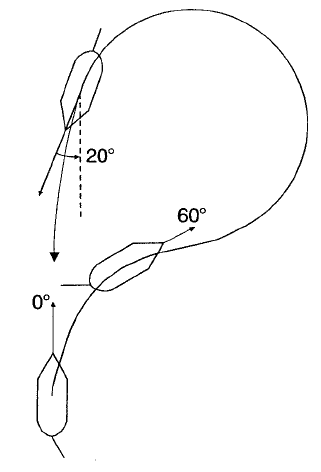
Procedure
Rudder hard over (in an “immediate action” situation, only to the side of the casualty).
After deviation from the original course by 60°, rudder hard over to the opposite side.
When heading 20° short of opposite course, rudder to midship position and ship to be turned to opposite course.
One turn (“Single turn, Anderson turn”)
❑ fastest recovery method
❑ good for ships with tight turning characteristics
❑ used most by ships with considerable power
❑ very difficult for a single-screw vessel
❑ difficult because approach to person is not straight
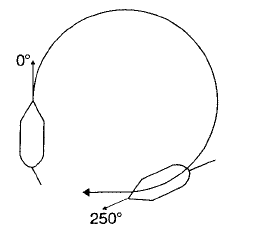
Procedure
Single turn (270° manoeuvre)
Rudder hard over (in an “immediate action” situation, only to the side of the casualty).
After deviation from the original course by 250°, rudder to midship position and stopping manoeuvre to be initiated.
Scharnov turn
❑ will take vessel back into her wake
❑ less distance is covered, saving time
❑ cannot be carried out effectively unless the time elapsed between occurrence of the incident and the commencement of the manoeuvre is known
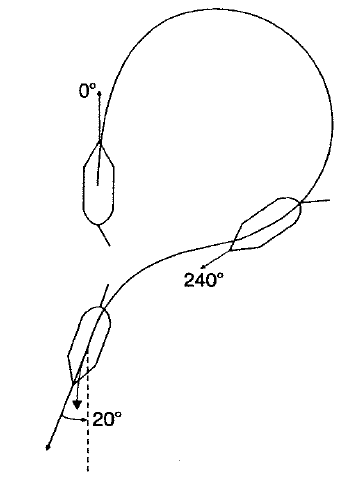
Procedure
Scharnov turn (Not to be used in an “immediate action” situation.)
Rudder hard over. After deviation from the original course by 240°, rudder hard over to the opposite side.
When heading 20° short of opposite course, rudder to midship position so that ship will turn to opposite course.