Digital Selective Calling (DSC)
Background
- Calling ships involved:
- Using traffic list or special calling channel
- Ships had to keep a listing watch on special distress & calling channels (2182kHz, 500kHz or VHF Ch. 16)
- Listing to traffic list
- Calling a SES directly, without directing all ships to keep manual watch on different calling channels did not exist.
- DSC is an essential part of GMDSS.
- DSC has become the primary alerting system on VHF, MF & HF bands.
- DSC unit is able to monitor/keep watch on all DSC frequencies allocated for distress & safety purposes.
- When a CES or SES receives a DSC distress alert a display or printout of the message is produced.
- Notification of the communicating follow-on freq. or channel for voice or telex is included.
- Importantly an audible &/or visible alarm is activated to attract the attention of the operator.
- DSC alerts can be directed to a station or a group of stations (not possible under the old system)
- When any call is received the attention of the operator is attracted by either a printout or a visual &/or audible alarm.
- Calls not recognised by the DSC controller unit is not received.
DSC
DSC system is used for calling:
– A particular ship
– A particular coast station
– A group of ships
– All ships
The system can be used from:
– Ship to shore
– Shore to ship
– Ship to ship
Ships must be fitted with a mandatory DSC equipment applicable to the sea area in which they sail.
DSC requirements:
VHF DSC
- All GMDSS ships must be fitted with VHF DSC channel 70 for distress & safety calls from ship to ship.
- In Sea Area A1, ships must also be able to execute distress and safety calls to a coast station.
MF DSC
- All GMDSS ships sailing in Sea Area A2, A3 & A4, must be fitted to
accommodate the 2187.5kHz freq. for distress and safety calls from
ship to ship. - In sea area A2, the ship must be able to execute distress and safety calls
between ship and coast station.
HF DSC - GMDSS ships sailing in Sea Area A4 and those without Inmarsat terminals sailing in Sea Area A3 must be equipped with DSC for VHF & MF and in addition HF DSC for distress and safety calls between ship and coast station.
Composition of distress call
- Dot pattern – a sequence of dots transmitted so that the scanning-receivers can be tuned and stop scanning.
- Phasing sequence – makes the receiver ready for the reception of information from the DSC transmitter.
- Format specifier – call specification
- Distress call
- All ship call
- Call for specific group of ships
- Selective calling to one specific ship
- Calls to ships in a specific geographic area
- Dialphone call for direct access to the PSTN
- Category – Types of calls such as: – Distress
– Urgency
– Safety
– Important ship traffic (ship business)
– Routine - Self Identification – Ships own MMSI number6
- Message – the number of messages may vary depending on the different type of traffic
- Message 1 –Distress call: Message 1 describes the distress situation
- Fire/explosion
- Leakage
- Collision
- Grounding
- Listing, danger of capsizing
- Sinking
- Drifting
- Unspecified
- Abandoning ship
- MOB
- Armed robbery attack
- Message 2 – Describes the distress position by means of 10 digits
- Quadrant specification, 1 digit
0: North East
1: North West
2: South East
3: South West - The next four digits denote the latitude in degrees and minute
- The next five digits denote the longitude in degrees and minutes
- Quadrant specification, 1 digit
- Message 3 – provides the point in time when the position was valid. It is given in UTC time by means of four digits
- Digits 1 & 2 denote HOURS
- Digits 3 & 4 denote MINUTES
- Message 4– describes the type of communication desired for the distress traffic (normally voice communication)
- End of sequence – the end message is transmitted to indicate
- Whether the call requires acknowledgement
- Whether the current message is a reply to a call
- Error check character – an error check character is transmitted as a control bit for the call.
DSC routine call composition
- A DSC routine call includes the same elements as explained earlier except for message 1 & 2
- Message 1: Routine call
- Indicates whether the connection is to be made by telephony, telex or data transmission
- Message 2: Routine call
- Indicates the frequency/channel for the follow-on communication.
- Message 1: Routine call
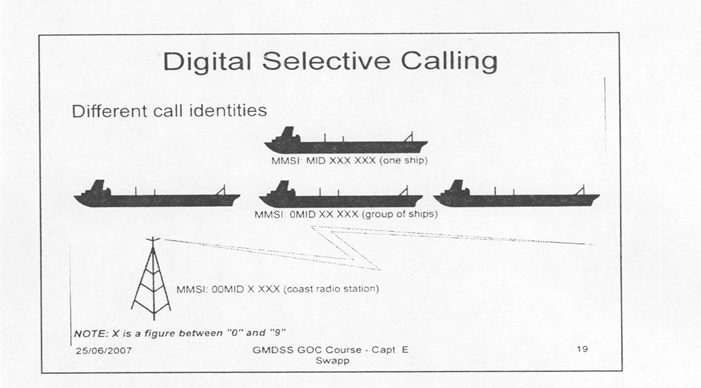
Selective calling number in GMDSS
- Issued by the administration or another body duly appointed by it to act on its behalf in assigning MMSI numbers to ships stations.
RADIO DISTRESS COMMUNICATIONS
DSC Radiotelephone
2187.5 kHz 2182.0 kHz
4207.5 kHz 4125.0 kHz
6312.0 kHz 6215.0 kHz
8414.5 kHz 8291.0 kHz
12577.0 kHz 12290.0 kHz
16804.5 kHz 16420.0 kHz
VHF Channel 70 (156.525 Mhz) VHF Channel 16 (156.800 Mhz)
DSC Procedures for VHF, MF/HF
- Transmission of a DSC Distress Alert
- DSC alerts should only be transmitted if in the opinion of the Master, a ship or a person is distress and requires immediate assistance.
- A DSC distress alert should include the ships last known position and
time when it was valid (this can be inputted automatically if the ships
position fixing device is connected or manually).
The DSC distress alert is transmitted as follows:
- Tune transmitter to DSC distress channel (2187.5kHz on MF Ch. 70 VHF)
- Time permitting, type in or select from the DSC equipment
- Nature of distress
- The ships last know position ( lat & long)
- Time in UTC
- Type of subsequent distress communication (telephony)
- Transmit DSC distress alert
- Prepare for subsequent distress traffic tuning the transmitter and the radiotelephony receiver to distress follow on channel/frequency in the same band i.e. 2182kHz MF. Ch. 16 VHF, while waiting for DSC distress acknowledgement.
Appropriate action on receipt of a distress alert
- Ships receiving a DSC distress alert from another ship should normally not acknowledge the alert by DSC since acknowledgement of a DSC distress alert by use of DSC is normally made by coast stations only.
- Only in cases where no other station appears to have received the DSC distress alert, and the transmission of it continues, should the ship acknowledge it by use of DSC in order to terminate the call.
- The ship should use all practicable available means to contact a coast station.
- Ships receiving a DSC distress alert from another ship should defer the acknowledgement of the distress alert by radiotelephony for a short interval, if the ship is within an area covered by one or more coast stations, in order to give the coast station time to acknowledge the DSC distress alert first.
Ships receiving a DSC distress alert from another ship are required to:
- Watch for reception of a distress acknowledgement on the distress channel (2187.5kHz MF, Ch. 70 VHF)
- Prepare to receive subsequent distress communication by tuning the radiotelephony receiver to the distress traffic frequency in the same band in which the DSC distress alert was received i.e. 2182.0kHz MF, Ch. 16 VHF.
- Acknowledge receipt of the distress alert by transmitting the following by radio telephony on the distress traffic frequency in the same band in which the distress alert was received (2182kHz MF, Ch. 16 VHF)
<>
MMSI # x 3
MMSI # or call sign of own ship x 3
<>
Distress Traffic
- On receipt of a DSC distress acknowledgement the ship in distress should commence the distress traffic by radio telephony on the distress traffic follow-on frequency (2182kHz MF, Ch. 16 VHF).
• Mayday
• This is
• MMSI # & call sign or other identification of the ship
• The ship’s position in (lat & long) or other reference to know geographical location
• Nature of distress and assistance wanted
• Any other information that might facilitate the rescue.
Transmission of a distress relay alert
- A ship knowing that another ship is in distress shall transmit a DSC distress relay alert if:
- The ship in distress is not itself able to transmit the distress alert.
- The Master of the ship considers that further help is necessary.
Transmission of a DSC distress relay alert
- Tune the transmitter to the DSC distress Freq/channel (2187.5kHz MF or Ch. 70 VHF
- Select the distress relay call format on the DSC equipment, type in or select on the DSC equipment keyboard
- All ship call or MMSI # of the appropriate Coast Station
- The MMSI # of the ship in distress
- The nature of the distress situation
- The latest position of the ship in distress, if known
- The time in UTC the position was valid
- Type of subsequent distress communication (telephony)
- Transmit the DSC distress relay call
- Prepare for subsequent distress traffic by tuning the transmitter and the radiotelephony receiver to the distress traffic channel on the same band, (i.e. 2182kHz MF or Ch. 16 VHF) while waiting for distress acknowledge.
Acknowledgement of a DSC Distress Relay Alert received from a Coast Station
- The coast station may if necessary retransmit the information received as a DSC distress relay call, addressed to all ships, all ships in a specific geographic area, a group of ships or a specific ship.
- Ships receiving a distress relay call transmitted by a coast station should not use DSC to acknowledge the call, but should acknowledge receipt of the call by radio telephony on the distress traffic channel on the same band in which the relay call was received (2182kHz MF, Ch. 16 VHF).
- Acknowledge the receipt of the distress alert by transmitting the following by telephony on the distress traffic frequency on the same band on which the DSC distress relay alert was received.
– <<Mayday>>
– MMSI # or call sign or other identification
– ID of the calling coast station
– This is MMSI # or call sign or ID of own ship
– <<Received Mayday>>
Acknowledgement of a DSC Distress Relay Alert received from a another ship.
- Ships receiving a DSC distress alert from another ship should normally not acknowledge the alert by DSC since acknowledgement of a DSC distress alert by use of DSC is normally made by coast stations only.
- Only in cases where no other station appears to have received the DSC distress alert, and the transmission of it continues, should the ship acknowledge it by use of DSC in order to terminate the call.
- The ship should use all practicable available means to contact a coast station.
- Ships receiving a DSC distress alert from another ship should defer the acknowledgement of the distress alert by radiotelephony for a short interval, if the ship is within an area covered by one or more coast stations, in order to give the coast station time to acknowledge the DSC distress alert first.
Ships receiving a DSC distress alert from another ship are required to:
- Watch for reception of a distress acknowledgement on the distress channel (2187.5kHz MF, Ch. 70 VHF)
- Prepare to receive subsequent distress communication by tuning the radiotelephony receiver to the distress traffic frequency in the same band in which the DSC distress alert was received i.e. 2182.0kHz MF, Ch. 16 VHF.
- Acknowledge receipt of the distress alert by transmitting the following by radio telephony on the distress traffic frequency in the same band in which the distress alert was received (2182kHz MF, Ch. 16 VHF)
<>
MMSI # x 3
MMSI # or call sign of own ship x 3
<>
Urgency
Transmission of urgency messages shall be carried out in two steps:
– Announcement of urgency message
– Transmission of urgency message
- The announcement is carried out by transmitting a DSC urgency call on the DSC distress calling channel (2187.5kHz MF, Ch. 70 VHF).
- The urgency message itself is transmitted on the distress traffic channel (2182kHz MF, Ch. 16 VHF).
The DSC urgency call may be addressed to all stations or to a specific
station. The frequency on which the urgency message will be transmitted
on should be included in the DSC urgency alert.
The announcement
- Tune the transmitter to the DSC distress calling freq./channel (2187.5kHz MF, Ch. 70 VHF)
- Type in or select from the DSC equipment keyboard:
- All ship call or the MMSI# of a specific station
- The category of the call (urgency)
- The freq. or channel on which the urgency message will be transmitted
- The type of communication in which the urgency message will be given (e.g. telephony or telex).
- Transmit the DSC urgency call.
Transmission of urgency message:
- Tune the transmitter to the frequency or channel indicated in the DSC urgency call
- Transmit the urgency message as follows:
- Panpan, Panpan, Panpan
- All stations x 3
- This is
- MMSI# and the call sign or other ID of own ship
- The text of urgency message.
Reception of an Urgency Message
– Ships receiving a DSC urgency alert announcing an urgency message to all ships should not acknowledge the receipt of the DSC alert.
– Tune the radio telephony receiver to the frequency indicated in the call and listen to the urgency message.
Safety
Transmission of a Safety Message
- The transmission of a safety message should be carried out in two steps:
- Announcement of the safety message
- Transmission of the safety message
- The announcement is carried out by transmitting a DSC safety alert on
the distress alerting freq./channel (2187.5kHz MF, Ch. 16 VHF). - The freq./channel in the same band on which the alert was made
(working channel). - DSC safety messages will be transmitted to all ships, or all ships in a specific geographical area or to a specific station.
- The frequency on which the safety message will be transmitted on should
be included.
The transmission of a safety message is done as follows:
The Announcement
- Tune the transmitter to the DSC distress alerting freq./channel (2187.5/Ch. 70).
- Select the appropriate calling format for the DSC equipment (all ship, area or selective station).
- On the DSC equipment
- Type in the MMSI # or specific area if appropriate
- The category of the call (safety)
- The frequency or channel on which the safety message will be transmitted on
- The type of communication with which the safety message will be transmitted (e.g. radiotelephony)
- Transmit the DSC safety alert.
Transmission of the safety message:
- Tune the transmitter to the frequency or channel indicated in the DSC safety alert.
- Transmit the safety message as follows
- Securite x3
- All stations or called station x3
- This is
- MMSI # & Call sign or other identification of own ship
- The text of the safety message
Reception of a Safety Message
- Ships receiving DSC safety alert announcing a safety message addressed to all ships should NOT acknowledge the receipt of the DSC safety alert, but should instead tune the radiotelephony receiver to the frequency indicated in the call and listen to the safety message.
HF DSC Message Procedures
DSC HF Alerts may be sent in two different ways
- Either by Transmitting the DSC alert on one HF band and waiting a few minutes for receiving acknowledgements by a CS. If within 3 min. no acknowledgement, the alert is resent on another HF band.
- Tx’ing the HF DSC alert on a number of HF bands or only short pauses between calls.
Transmitting the DSC HF Alert
- Tune the transmitter on the chosen HF DSC distress freq. (4207.5, 6312, 8414.5, 12577, 16804.5 kHz).
- Follow the procedure as for MF (discussed previously).
- Transmit the DSC alert.
Acknowledgment of HF DSC alert
- Procedure as discussed before
- Acknowledgement is done on all the DSC alerting frequencies that the alert was received on.
Cancellation of an Inadvertent Distress Alert
- The station TX the inadvertent distress alert shall cancel the distress alert as follows:
- Immediately TX a DSC distress acknowledgement with own ship’s MMSI inserted as identification of the ship in distress.
- Cancel the distress alert over the telephony distress traffic channel associated with each DSC channel on which the distress alert was transmitted.
- Monitor the telephony distress channel associated with the DSC channel which the distress was transmitted, and respond to any communication concerning that distress alert as appropriate.