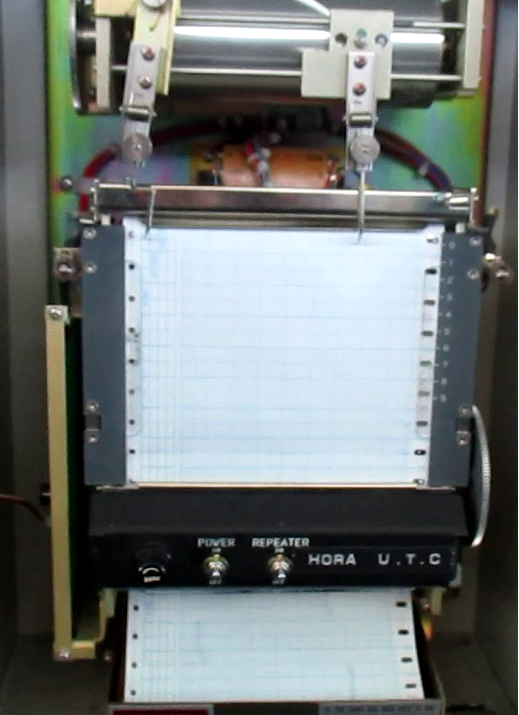
It records the Gyro course steered by the vessel continuously against a time scale.
The record is considered as useful and vital evidence in case of any accident.
The equipment is set at the commencement of a voyage with correct time and then switched on for operation.
Once set, the course recorder records the Gyro course steered on a specially designed paper throughout the voyage.
The course recorder receives a feed from the ships Master Gyro Compass
The recording paper is a specially formatted thermal paper hence an inkless stylus is used to mark the course steered,
Paper is fed by a paper feed DC motor.
Working of a Course Recorder
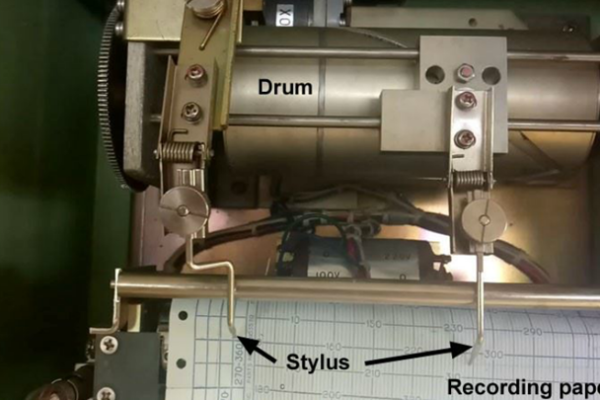
The styli (plural of stylus)
There are two styli, one for marking the quadrant of the course and the other for marking the course in that quadrant.
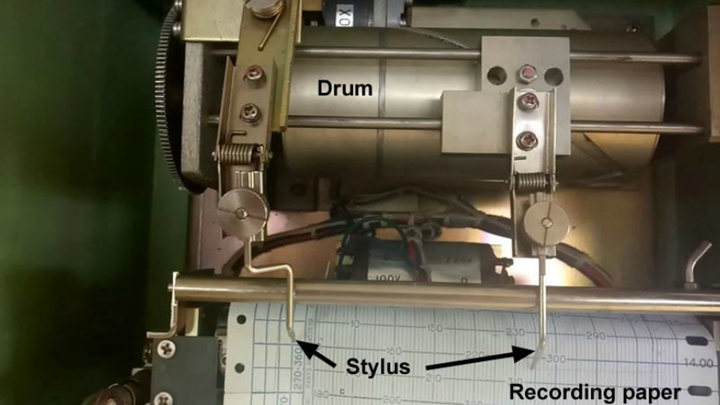
They are inkless and make impression on the thermal paper,
Both styli are mounted on a shaft and driven by a drum with groove acting as a guide.
The Recording Paper
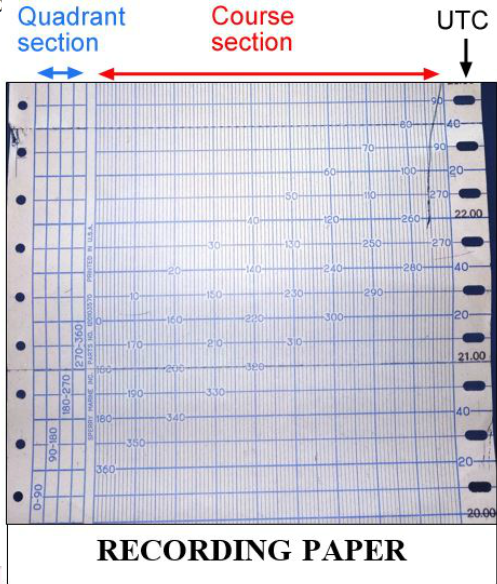
The horizontal axis of the recording paper is divided in three sections:
Quadrant section
Since the same scale is used for all four quadrants, there must be a way to identify the correct quadrant.

The quadrant section of the paper helps us to remove this ambiguity.
The quadrant section is on the left side of the paper and is divided in four columns and marked as:
0-90; 90-180; 180-270; 270-360
The second stylus draws in this section and shows the quadrant of the course.
Course Section
The course section occupies the centre of the paper and is graduated from left to right for quadrantal course as below:
00,10,20……………………080,090
180,170……………………..100,090
180,190……………………..260,270
360,350……………………..280,170
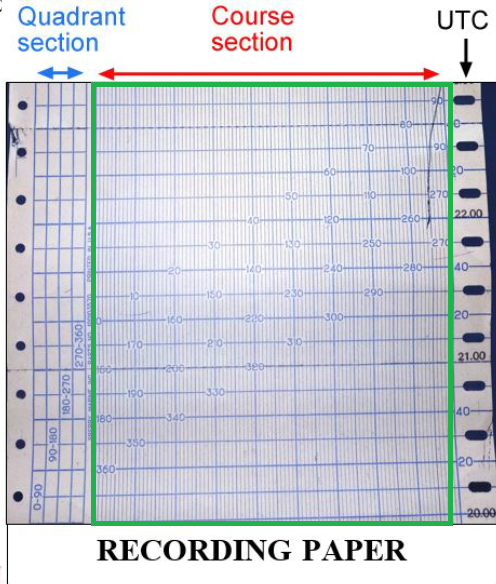
The scale is sufficiently magnified to read the course to the nearest degree.
One of the two styli marks the course on this part of the paper to show the course being steered.
Time Scale
The vertical axis is the time scale. Horizontal lines are drawn for every 10 minutes. The whole hours are printed with the 20th and 40th minutes.
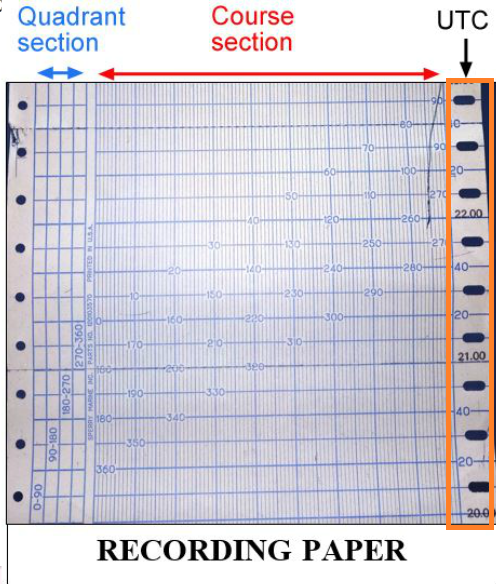
At the beginning of the voyage this must be set for the UTC.
Although, few ships prefer to set the course recorder to Ships Time.
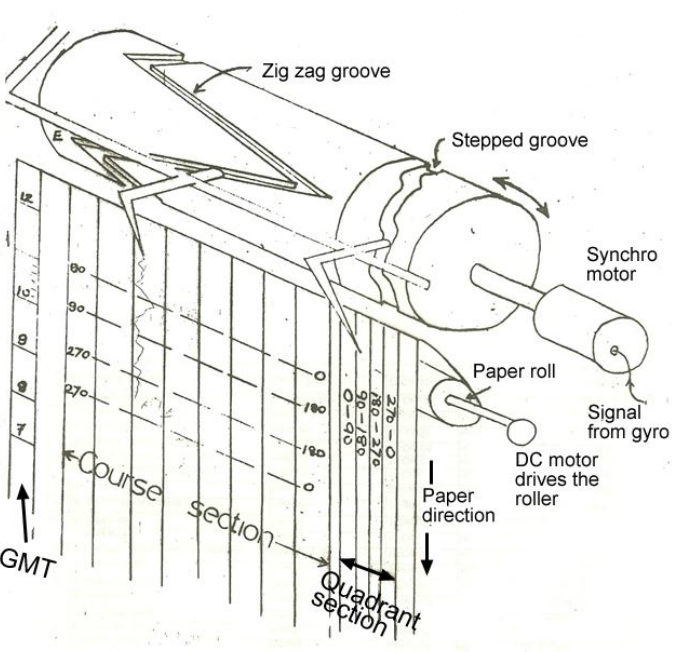
The gyro signal for the ships heading is amplified and fed to the synchro-motor which rotates the drum.
The drum consists of two sections:
- One with a continuous zigzag groove cut in it going round the drum.
- The other with a continuous a stepped groove going around the drum.
When the drum rotates the course stylus moves along the zigzag groove across the paper.
If the drum rotates clock-wise the stylus will travel from right to left and vice versa.
The quadrant stylus will remain in the present quadrant (90-180) till the time the course stylus has approached any end of the paper and the drum continuing to turn in the same direction.
The course being steered can be read simple by first checking the quadrant section and then checking the course section.
Paper roll is driven by DC motor in synch, with UTC.
2nd Officer checks for Course Recorder
- The OOE must check the styli are recording the correct course and the time indicated is correct.
- OOW should mark important event on the course recorder
- When carrying out checks and test as part of daily checks or prior arrival/departure checks
- When passing important landmark
- Noon positions
- Before any vessel movement, even shifting inside the port, it must be switched on and set for the correct course and time.
EXCELLENT EXPLANATION IN DETAIL , KEEP UP YOUR GOOD WORK OF SHARING KNOWLEDGE FOR SEAFARERS.
WELL DONE FOR ALL EFFORTS TAKEN , ESPECIALLY PHOTOGRAPHS OF COURSE RECORDER .