Records of the operations done with noxious liquids are to be maintained to provide evidence of the processes that were followed to ensure that no pollution was caused. MARPOL 73 / 78, annex II deals with noxious liquids carried in bulk. The student is advised to keep a copy of MARPOL handy while studying the module.
MARPOL Regulation concerning the cargo record book
- Every ship carrying noxious liquid substances shall be provided with a Cargo Record Book in the form specified in Appendix IV of MARPOL Ann II.
- Whenever any of the following operations takes place in respect of any noxious liquid substance a record of the operation shall be made in the Cargo Record Book in relation to each tank affected by the operation:
- Loading of cargo;
- Internal transfer of cargo;
- Unloading of cargo;
- Mandatory pre wash in accordance with the ships P&A manual,
- Cleaning of cargo tanks except mandatory prewash (other prewash operations, final wash, ventilation etc.)
- Discharge into the sea of tank washings
- Ballasting of cargo tanks;
- Discharge of ballast from cargo tanks;
- Accidental or other exceptional discharge
- Control by authorised surveyors
- Additional operational procedures and remarks
- In the event that any emergency discharge of the kind referred to in Article 8 of MARPOL and Reg 6 of Annex II of any noxious liquid substance or mixture containing such a substance is made or occurs, an entry shall be made without delay in the Cargo Record Book stating the circumstances of, and the reason for, the discharge.
- The entries in the Cargo Record Book shall be in the official language of the State in which the ship is registered and, where that language is neither English nor French, in English or French. The officer or officers in charge of the operation shall sign each entry and the master shall sign each page.
- The Cargo Record Book shall be kept in such a place as to be readily available for inspection and, except in the case of unmanned ships under tow, shall be kept on board the ship. It shall be retained on board the ship for a period of three years after the last entry in it has been made.
Form of the Cargo Record Book
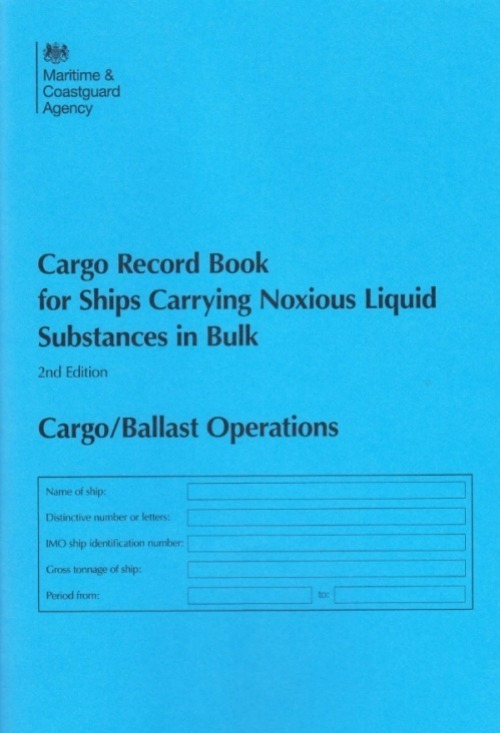
CARGO RECORD BOOK FOR SHIPS CARRYING NOXIOUS LIQUID SUBSTANCES IN BULK
Name of Ship……………………………………………………………………….
Distinctive number or letters………………………………………………………
Gross Tonnage…………………………………………………………………….
Period from………………………………. To…………………………………….
Name of ship……………………………………………………………………….
Distinctive number or letters………………………………………………………
PLAN VIEW OF CARGO AND SLOP TANKS
(To be completed on board)

Instructions
- Entries are to be made for operations involving Categories X, Y, Z, substances.
- All entries are to be made on a tank-to-tank basis.
- Items are grouped into operational sections, and a letter for easy identification denotes each.
- Date, operational code and item number should be inserted in the appropriate columns and required particulars to be recorded in the blank spaces.
- All entries are to be made in chronological order
- Each entry is to be signed by the officer in charge, and if applicable, by a surveyor authorised by the competent authority of the State in which the ship is unloading.
- Each page is to be countersigned by the Master
List of Items to be recorded
- Loading of cargo
- Place of loading
- Identify tank(s), name of substance(s) and category(ies)
- Internal transfer of cargo
- Name and category of cargo(es) transferred
- Identity of tanks
- From
- To
- Was (were) tank (s) in 4.1 emptied?
- If not, quantity remaining in the tank(s).
- Unloading of cargo
- Place of unloading.
- Identity of tank(s) unloaded.
- Was (were) tank(s) emptied?
- If yes, confirm that the procedure for emptying and stripping has been performed in accordance with the ship’s Procedures and Arrangements Manual (i.e. list, trim, stripping temperature).
- If not, quantity remaining in tank(s).
- Does the ship’s Procedures and Arrangements Manual require a prewash with subsequent disposal of reception facilities?
- Failure of pumping and/or stripping system:
- time and nature of failure;
- reasons for failure;
- times when system has been made operational.
- Mandatory pre-wash in accordance with the ship’s Procedures and Arrangements Manual
- Identify tank(s), substance(s) and category(ies).
- Washing method:
- of washing machines per tank;
- duration of wash/washing cycles;
- hot/cold wash.
- Pre-wash slops transferred to :
- facility in unloading port (identify port);
- reception facility otherwise (identify port).
- Cleaning of cargo tanks except mandatory prewash ( other prewash operations, final wash, ventilation etc.)
- State time, identify tank(s), substance(s) and category(ies) and state:
- washing procedure used;
- cleaning agent(s) (identify agent(s) and quantities);
- dilution of cargo residues with water (state how much water used (only Category D substances));
- ventilation procedure used (state number of fans used, duration of ventilation).
- Tank washings transferred:
- into the sea;
- to the reception facility (identify port);
- to slops collecting tank (identify tank).
- State time, identify tank(s), substance(s) and category(ies) and state:
- Discharge into the sea of tank washings
- Identify tank(s):
- Were tank washings discharged during cleaning of tank(s)? If so at what rate?
- Were tank washing(s) discharged from slops collecting tank? If so, state quantity and rate of discharge.
- Time pumping commenced and stopped.
- Ship’s speed during discharge.
- Identify tank(s):
- Ballasting of cargo tanks
- Identity of tank(s) ballasted.
- Time at start of ballasting.
- Discharge of ballast water from cargo tanks
- Identity of tank(s)
- Discharge of ballast:
- into the sea;
- to reception facilities (identify port).
- Time ballast discharge commenced and stopped.
- Ship’s speed during discharge.
- Accidental or other exceptional discharge
- Time of occurrence.
- Approximate quantity, substance(s) and category(ies).
- Circumstances of discharge or escape and general remarks.
- Control by authorised surveyors
- Identify port
- Identify tank(s), substance(s), category(ies) discharged ashore.
- Have tank(s), pump(s), and piping system(s) been emptied?
- Has a prewash in accordance with the ship’s Procedures and Arrangements Manual been carried out?
- Have tank washings resulting from the prewash been discharged ashore and is the tank empty?
- An exemption been granted from mandatory prewash.
- Reasons for exemption.
- Name and signature of authorised surveyor.
- Organisation, company, government agency for which surveyor works.
- Additional operational procedures and remarks
Name of ship…………………………………………………………………………..
Distinctive number or letters………………………………………………………….
CARGO/BALLAST OPERATIONS
| Date | Code (letter) | Item (number) | Record of operations/ signature of officer in charge/ name of and signature of authorized surveyor |
Signature of Master…………………………………………..