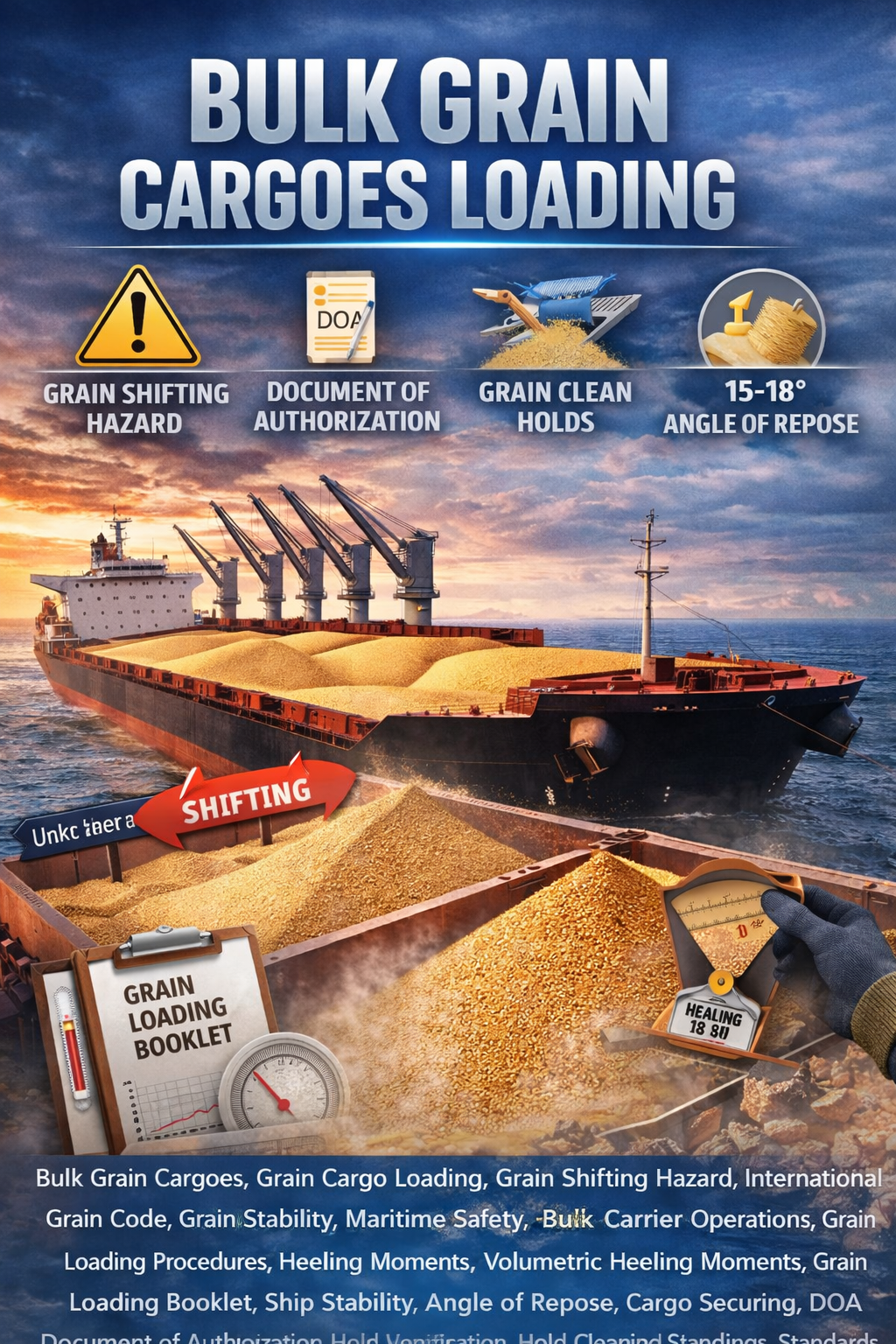
The Hazard of Grain Shifting
Grain settles by about 2% of its volume. Because of this settling, small void spaces that exist on the top of the grain surface in filled compartments increase in volume. These void spaces permit the grain to shift. The shifting of grain is the greatest hazard involved in the carriage of grain and all regulations contained in the International Code for the safe carriage of Grain in Bulk (1991) are directed towards limiting this shift of grain to within acceptable limits. This Code must always be referred to when loading grain.
The Hazard of Grain Shifting
Grain has a low angle of repose (as low as 15–18 Deg depending on the type of grain) and this results in it shifting very easily. As the ship rolls to about 15 Deg in moderate/rough seas and swells and to larger angles due to very rough seas and heavy swells, the grain cargo will definitely shift in these circumstances. If the grain surface is not trimmed level, it will shift at even lower angles of heel.
When grain shifts it causes a list (heel as per the Grain Code). The heel is the result of the heeling moment ‘w × d’, which is the weight of cargo shifted (w) multiplied by the distance by which it shifts (d). These heeling moments in all holds add up, as cargo in all holds will shift to the same side. Thus the heeling moments for the ship are to be kept as small as possible. This is done by having as many holds as possible completely filled with grain and restraining or securing the grain surface to prevent shifting.
Loading of Grain Cargoes
The planning to load a cargo of grain is to be carried out as follows:
Calculate the maximum quantity that can be loaded taking into account the ship’s deadweight, the load line zones she will pass through, the weights on board, draft limitation etc.
Distribute the cargo into the holds so as to have maximum number of filled holds but also considering draft, stability and stresses.
Multiply the cargo weight by the stowage factor to obtain the cargo volume / depth of cargo in each hold.
From the heeling moment diagrams in the Grain Loading Booklet, find out the Volumetric Heeling Moments of each hold.
Multiply the Volumetric Heeling Moments by the appropriate factor to compensate for the vertical shift of “G”. The volumetric heeling moments given in the Grain Loading Booklet take into account the transverse shift of G but not vertical shift of G.
A vertical shift of G has an adverse effect on the stability of the vessel. It greatly reduces the GM of the vessel. The compensation for vertical shift of G is carried out by:
Partly filled compartment: multiplying the VHM by 1.12
Filled trimmed compartment: multiplying the VHM by 1.06
Filled untrimmed compartment: no change in VHM
Loading of Grain Cargoes
Divide the corrected Volumetric Heeling Moments by stowage factor to obtain heeling moments which are the weight heeling moments.
Add up all the heeling moments for each hold to obtain total heeling moments.
Compare the total heeling moments with the allowable heeling moments obtained from the Grain Stability Booklet.
If the total heeling moment is greater than allowable heeling moment then re-distribute the cargo. If the total heeling moment is less than allowable heeling moment then proceed with stability calculations.
Allowable heeling moments
The allowable heeling moments are the maximum permissible heeling moments for a particular condition beyond which it will be dangerous for the ship to proceed out to sea in that condition of displacement and KG.
The allowable heeling moments decrease with an increase in KG due to reduction in GM and consequent stability. They generally decrease with increase in displacement due to angle of flooding reducing with the displacement although they sometimes increase because the heel reduces with increase in displacement.
Types of Compartments
The manner of stowage of grain gives rise to three types of compartments:
Filled compartment, trimmed – is one in which the grain after loading is trimmed so as to fill all spaces under the decks and hatch covers to the maximum extent possible, so that the grain is at its highest possible level.
Filled compartment, untrimmed – is one which is filled to the maximum extent possible in way of the hatch opening, but outside the periphery of the hatch opening the grain will be at its natural angle of heel.
Partly filled compartment – is one in which grain is at any level but is not filled whether trimmed or untrimmed.
Volumetric Heeling Moments
The heeling moments given in the Grain Loading Booklet are Volumetric Heeling Moments, i.e. they are the shift in volume of cargo under the assumed angle of heel.
It is not possible for the shipyard to provide weight heeling moments as the shift in weight of cargo will depend on the density / stowage factor of the cargo which differs for various types of grain cargoes.
However, the shift in volume at any depth for a particular assumed angle of heel remains constant. The volumetric heeling moments for each hold must be divided by the stowage factor of the grain in that hold to obtain the weight heeling moments.
Grain Loading Booklet
It will have to be noticed that all these calculations would not be possible without the volumetric heeling moments being provided to the ship. Thus information must be provided by the shipyard for all ships intending to load grain.
The information should include curves or tables of volumes, vertical centres of volumes and assumed VHM’s for every compartment, filled or partly filled, including the effect of temporary fittings.
Curves or tables of maximum permissible heeling moments for varying displacements and varying KG’s of ship.
Details of the scantlings of temporary fittings provided to meet stability requirements.
Loading instructions in the form of notes summarising the requirements of the code.
Grain Loading Booklet
A worked example for the guidance of the Master.
Typical loaded arrival and departure conditions and intermediate worst service conditions.
Additionally, other normal stability information provided for all ships should also be provided which includes ship’s particulars, lightship weight and KG, tables of liquid free surface correction, capacities and centre of gravity of all compartments, curves or tables of angles of flooding, hydrostatic data and cross curves of stability to plot the GZ curve.
Document of Authorization
Once a ship has been provided with all information it can apply for the DOA. The DOA certifies that the ship has been provided with the information necessary for it to comply with the requirements of the International Code for the safe carriage of Grain in Bulk.
The DOA is to be in the national language. The DOA together with the Grain Loading Booklet must be kept on board for inspection by the attending surveyors at the port of loading.
Stability requirements for a ship loading grain with DOA
The angle of heel due to an assumed shift of grain should not exceed 12 Deg or for ships constructed after 1 Jan 1994 the angle of heel shall not exceed 12 Deg or the angle of deck edge immersion whichever is less.
The residual area between the heeling arm curve and the righting arm curve up to the angle of maximum separation or 40 Deg or angle of flooding, whichever is the least, shall not be less than 0.075 m-radians.
The GM after correction for FSE for liquid in tanks shall not be less than 0.3 m.
The ship shall be upright before proceeding to sea.
The Master shall demonstrate compliance with the criteria at all stages of the voyage.
Stability requirements for a ship loading grain without a DOA
It must be understood that ships without DOA are most likely those not having Grain Loading Booklet and heeling moment information. Hence it is difficult to find out heeling moments for such ships.
In such case the regulations take a safe course which can be understood as follows:
The weight of grain loaded cannot exceed one third of the deadweight.
All grain surfaces in filled compartments must be restrained by centreline division extending for the full length of the compartment from the underside of the deck or hatch covers to a depth below the deck equal to B/8 or 2.4 m whichever is greater.
Alternatively saucering or bundling may be used, except for linseed.
Stability requirements for a ship loading grain without a DOA
All free grain surfaces in partly filled compartments must be trimmed level and secured by overstowing, strapping or lashing by wire mesh.
All hatch covers to tween decks must be in place and battened down.
The fluid GM throughout the voyage should not be less than 0.3 metres.
The Master should demonstrate that the ship complies with these requirements prior to loading.
HOLDS CLEANING DEFINITIONS
Cargo hold cleaning standards: Preparation of a cargo hold prior grain loading is not just a question of sweeping, cleaning or washing down the hold. There are a number of matters to consider, and failing to adhere to good practice can result in failure to pass cargo hold inspection.
In the dry bulk trades, there are essentially five grades of hold cleanliness:
- Hospital clean, or “stringent” cleanliness
- Grain clean, or high cleanliness
- Normal clean
- Shovel clean
- Load on top
Hospital clean is the most stringent, requiring the holds to have 100% intact paint coatings on all surfaces, including the tank top, all ladder rungs and undersides of hatches.
What is Grain clean?
The most common cleanliness requirement for bulk carriers is that of grain clean. It means “clean, swept, washed down by fresh water and free from insects, odour, residue of previous cargo / loose rust scale / paint flakes etc., dried up and ready to receive charterers’ intended cargo subject to shippers’ / relevant surveyors’ inspection.
If the ship fails hold inspection by shipper / relevant surveyor, the ship to be placed off hire until accepted in all holds, and any extra costs / expenses / time including stevedores’ stand-by and / or cancelling charges therefrom to be for owners’ account”.
What is ‘loose scale’?
It is important to differentiate such scale from oxidation rust (i.e. light atmospheric rusting). Loose scale will break away when struck with a fist or when light pressure is applied with a knife blade or scraper under the edge of the scale.
Oxidation rust will typically form on bare metal surfaces but will not flake off when struck or when light pressure from a knife is applied.
Generally, the presence of hard-adhering scale within a hold is acceptable in a grain clean hold. The scale should not fall during the voyage or during normal cargo operations.
The industry accepted definition of grain clean is provided by the National Cargo Bureau (NCB).