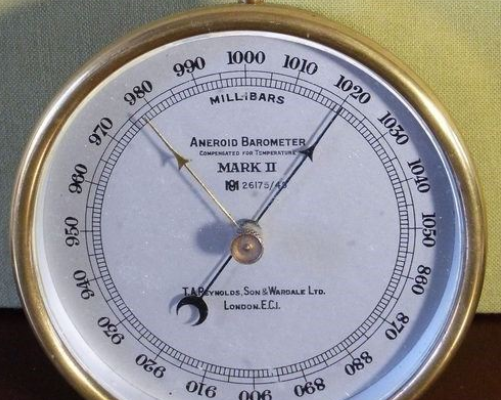
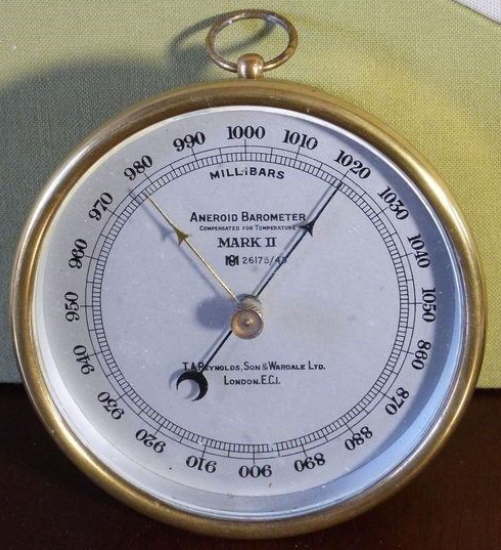
An Aneroid barometer is an instrument used for measuring atmospheric pressure. It uses a small flexible material box called a vaccum chamber (capsule), which is made from an alloy of beryllium and copper.
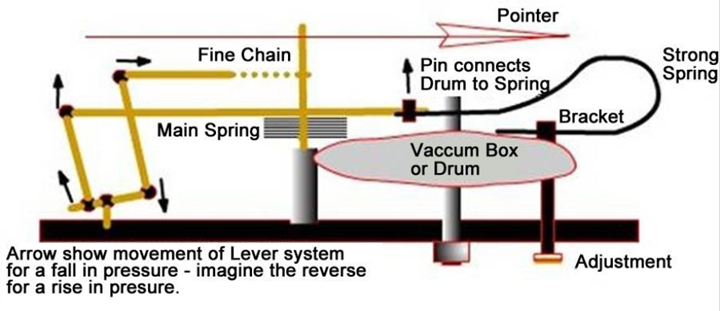
The vacuumed capsules are prevented from collapsing by a strong spring.
Small changes in external air pressure cause the cell to expand or contract. This expansion and contraction drives mechanical levers such that the tiny movements of the capsules are amplified and could be read off from the face of the aneroid barometer.
The face of the aneroid barometer is a circular dial with graduations from 860 millibar to 1050 millibar.
Errors that can affect the reading of a Barometer:
Index Error
Like all other instrument, an Aneroid Barometer can also develop index error.
This error is mainly contributed by the mechanical parts of the Barometer, like tension of the spring, connections between levers etc.
The error can be negative or positive and must be checked once in three months.
It should be noted on a card and hung near the barometer and applied every time a reading is made.
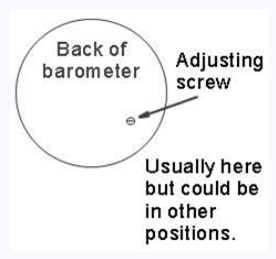
If the error is large, it should be adjusted or reduced by the adjustment screw provided at the back of the instrument.
The barometer is calibrated by a port Meteorology officer who visits the ship on request. He compares the reading of the ship’s barometer with another barometer whose error is know.
Height Error
Atmospheric pressure recorded in various log books must be the one for the sea level at that place. However atmospheric pressure falls with the increase of height.
Hence the reading observed on a ship’s bridge must be corrected for the height of the bridge (more specifically, the barometer) above sea level.
Near the sea level atmospheric pressure falls at a rate of 1 millibar for every 10 meters increase of height.
Hence the correction to be applied can be calculated by:
Correction in millibar = Height above sea level ÷ 10
Needless to say that this correction will always be added to the observed reading.
Location of an Aneroid Barometer:
The instrument should be positioned:
- Away from undue vibrations or sudden jerks.
- Away from draughts of air.
- Away from places liable to experience abnormal or change of temperature
- As close to the center line of the ship as practicable.
- At eye level for ease of observation
Precaution while observation:
Tap the face of the barometer lightly to release any sticky levers or pointers.
In some models the mechanism is made “stiff” so that tapping the barometer reveals whether the pressure is rising or falling as the pointer moves.
Working of Barograph
Description:
Barograph is an instrument to monitor and record atmospheric pressure by way of continuous trace on a recording paper chart.
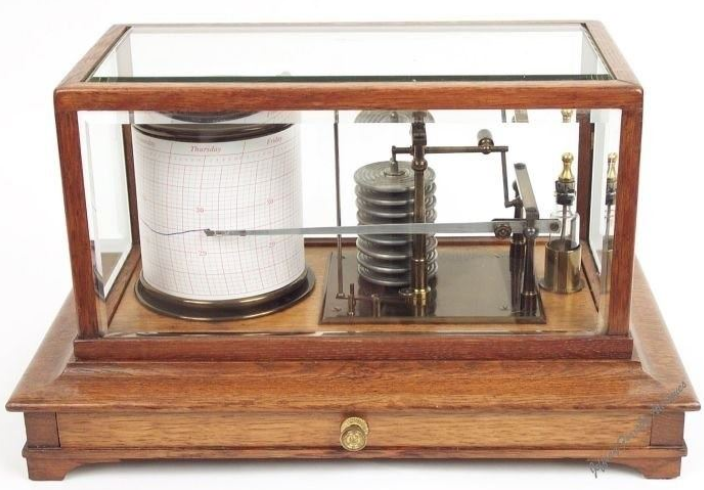
The mechanism of a barograph is similar to that of an Aneroid Barometer.
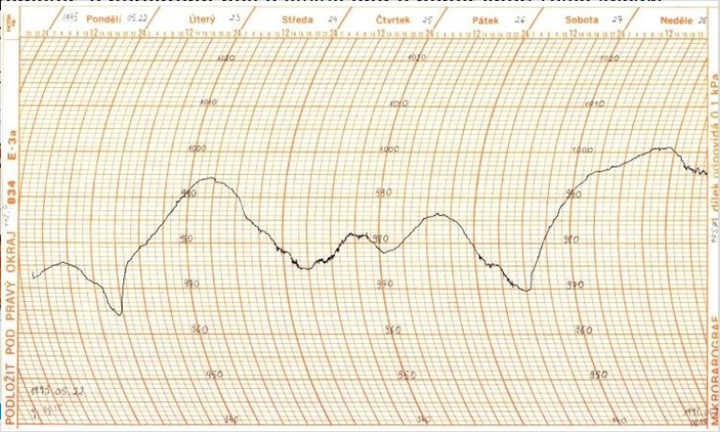
Unlike a barometer, a barograph has a stylus and a paper chart (also known as barogram)
The stylus traces a continuous curve on the Barogram.
The vacuum chamber consists of a series of metal boxes arranged vertically. Change of atmospheric pressure causes the top of the chamber to ascend or descend and this movement is conveyed by a lever system to stylus that moves up or down on the chart.
The barogram is fixed on a cylindrical drum that rotates at a uniform speed of one rotation per wheel. The barogram has seven days graduations on the horizontal axis and atmospheric pressure on the vertical axis. Therefore the barogram will need to replaced every week.
The tip of the stylus has a detachable nib which can hold one drop of concentrated & slow drying ink specially supplied for this purpose.
The pen should be cleaned with methylated spirit or water every week when loading fresh paper.
The index and height errors, which affect the reading of an aneroid barometer, also affect a Barograph.
However, these errors must be adjusted before commencement of recording.
Location of a Barograph & Precautions:
The entire barograph is provided with a hinged glass cover, to keep out gusts of wind and dust. It is also mounted on springs and rubber pads to reduce vibration.
A lever is provided to engage or disengage the stylus from the paper. This lever should be used to disengage the stylus before changing the Barogram on the drum.
Other precautions and location requirement are same as that of an Aneroid Barometer.