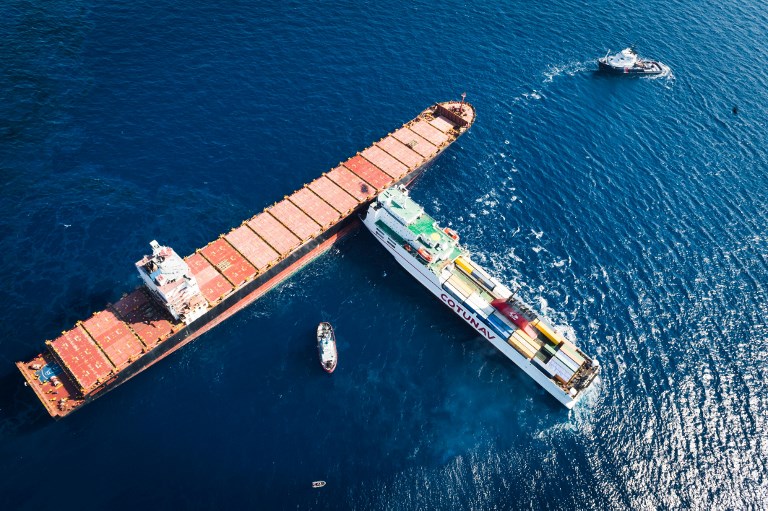
Duties of the master in case of a collision
In case of collision between two ships, it will be the duty of the master of each ship, without endangering his ship, crew and passengers, if any:
• To render to the other ship, its master, crew and passengers (if any) such assistance as may be practicable and necessary to save them from any danger caused by the collision;
• To stand by the other ship till such time it is ascertained that no further assistance is required by her; and
• To give the master of the other ship the name of his own ship, last port of call and to which port it is bound.
The failure to provide the information will not affect the final decision on whose wrongful act caused the collision. However if a master fails to render assistance or standby the other vessel, he will be liable on summary conviction a heavy fine, and if convicted fine and a jail term or both.
A master or a certified officer may have his certificate cancelled or suspended if found guilty of dereliction of duty in the above cases.
Master to send a report to the FSA and preserve all relevant documents as evidences.
Master will make relevant Official Log Book entries.
Besides above the non-statutory duties can be stated as below:
• He must act in the best interest of his ship, crew and cargo;
• He must always obtain the assistance and advice of the P&I club, who would suggest appropriate steps to be taken to safeguard the owner’s interest and limit his liability;
• Inform the owners, charterers and P&I local representatives, who will advise the best course of action to be taken protecting the owner’s interest;
• Never admit any liability;
• Under the advice of the P&I club serve a written notice to the other ship in the following format:
“From: M.V. ABC (Port of registry and flag)
Date:
To: M.V. XYZ (Port of registry and flag)
Dear Sir,
Sub: Collision Damage.
With reference to the collision, which occurred between our respective vessels on (date) at (local mean time), I hereby give you, on behalf of my owners and their underwriters, formal notice holding you and your owners solely responsible for all loss and damage whatever sustained by my owners in consequences of the collision.
Please inform your owners immediately so that they and their underwriters can take steps to carry out a joint survey on my vessel M.V. ABC in order to establish the extent and quantum of damage.
Please let me know the name of your vessel’s agent. My vessel agents are M/s xxx
Please acknowledge receipt of this letter in the enclosed copy.
Yours faithfully
Capt. SPP
Master M.V.ABC
Copy to P&I club, Owner, Charterer.”
The master will receive a similar letter from the other vessel and acknowledge the same denying any liability but accepting any invitation to attend survey on the other vessel “without prejudice”.
The owner, agent or the master should take steps to arrest the other vessel pending payment of security up to the limit of liability. Alternatively the owner may decide to go for arbitration using Lloyd’s Form.
The solicitors will need the following documents:
• Deck and engine logbooks, movement books and notes if any;
• Graphs and printouts from bridge equipments like course recorder, echo sounder and satnav;
• Statements from all witnesses to the collision including where possible pilots, tug masters etc.;
• Full details of both ships including the correct spelt name, port of registry, GRT and call sign;
• Exact location of the collision;
• Exact time of the collision stating whether in UTC (GMT) or local time;
• Differences between bridge and engine room clocks, if any;
• Estimated speed of both the vessels at the time of collision;
• Estimated angle of impact (can be done by a qualified surveyor);
• Charts in use before and up to the time of collision (unaltered and unerased);
• Weather and tide conditions at the time of collision;
• List of all navigational equipments used at the time of collision;
• Records of all signals and communications made between the colliding ships and any other ships in the vicinity prior to collision;
• Names and position of ships in the vicinity at the time of collision; and
• In case of a collision with a moored vessel, details of moorings employed.
All evidence gathered must be stored securely till it is passed on to the company and the P&I club or solicitors. It is normal for the lawyers of the other company to ask for interview with the crewmembers. The master must warn all the crewmembers against giving any statements to any one else except their own lawyers appointed by the P&I club. The master should be able to identify the persons from the P&I club.