Girthing
It is the capsizing moment of the tug due to the sudden movement of ships. The line is usually secured very near to the center of flotation and for this reason the tug is liable to be girded. This phenomenon is known variously as girthing, girding or girting, in differing parts of the world.
It can be caused by one, or both of the following:
• The ship turning independently and too quickly away from the tug.
• Excessive straight line speed with a tug made fast.
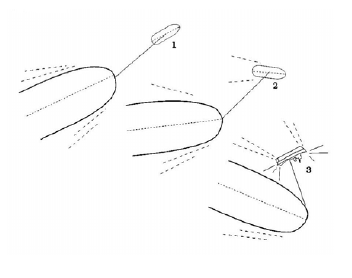
Girting: Forward
Let us look at an example of a common situation, with a conventional tug forward on a long line.
Position‐1:
In this area the tug is relatively safe and regardless of whether the ship’s speed is too high it does not result in any immediate problem, provided it remains within a small angle on the bow.
Position‐2:
If the tug is out in this position broad on the bow the ship could, as a result of too much starboard helm or excessive speed, or both, outrun the tug which may have neither the time nor maneuverability to turn and keep up with the rapidly swinging or accelerating ship.
Position‐3:
This is the worst possible situation where the tug is being pulled around on the radius of the tow line and because of the position of it’s hook, is then dragged along with the tow line out on its beam. Due to the nature of the forces involved, it will also be pulled over to a dangerous angle of heel and unless the tow line breaks, or can be released immediately, the tug which is powerless to respond and already listing heavily, may capsize!
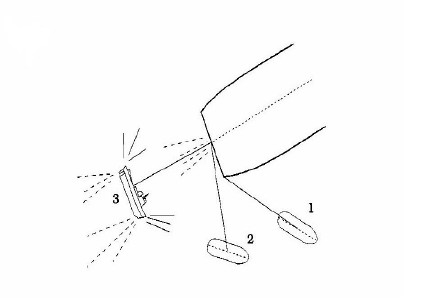
Girting: Aft
A conventional tug working aft, is perhaps more at risk than the forward tug, as its design characteristics frequently oblige it to lay with the tow line much more inclined towards its beam.
Position‐1:
Provided the ship is either stopped or proceeding at extremely low speeds a conventional tug can work quite efficiently with maximum bollard pull in all directions at this and any other position around the stern.
Position‐2:
If the ship’s speed now increases, the tug will have to work around onto a heading which is more in keeping with the ship, not only to keep up with the accelerating ship but also to maintain a safe lead with the tow line. In this situation, if the tug works with the tow line dangerously near the tug’s beam, might result in a substantial loss of bollard pull over what was a previously large useful arc of operation.
Position‐3:
Should the ship’s speed become excessive, or if the stern of the ship is swung rapidly away from the tug, it may be unable to respond quickly enough and could fail to keep the safe station previously illustrated. As a consequence the tug might be dragged around on the radius of the tow line to this dangerous position and capsize with shocking rapidity.
It is also very important to note that a tug attending a ship aft, but in the close confines of a lock, may find itself in a similar situation, but with even less ability to maneuver. Should the tug get caught across the lock with a ship proceeding at too high a speed it will be exposed to a very serious risk of girting.
For those unfortunate enough to have witnessed it, a tug being girted and capsized is an awesome and frightening sight. It frequently happens too quickly to activate quick release gear and allows absolutely no time whatsoever for the evacuation of the crew who may become trapped in the submerged tug.