Over the years, a considerable trade has developed in the bulk carriage of relatively small quantities of cereals, oil seeds and their derivatives. Frequently a number of such products may be shipped simultaneously onboard bulk carriers. It is not uncommon for three or more consignments to be stowed in the same hold using separation material in order to avoid admixtures.
Incidents have arisen where, despite the use of separation cloths, admixtures have taken place and claims made by cargo interests.
The steps necessary to avoid any risk of admixture are not complicated but it may be worthwhile bringing them to the attention of ships’ officers and others responsible for the stowage of such cargoes.
It is suggested that the following measures should be taken:
■ Where it is intended to over-stow one bulk parcel with another, the lower parcel should be trimmed as flat as possible. If the surface is left uneven there is a risk that the separation material may be damaged either as the result of uneven stresses during the sea passage or as a result of contact with the grab or elevator legs and bulldozers which may be used during the discharge of these commodities. Provided this procedure is followed, a single layer of separation material of good quality is considered adequate. Recommended materials include woven polypropylene, polythene sheets or burlap.
■ During loading operations it is essential that the distance between the separation material and either the top of the weather-deck hatch coamings or the deck head of the hold is measured and recorded. In this way it is possible to effectively locate the separations between the parcels during discharge and thus avoid any tearing or damage to the separation material.
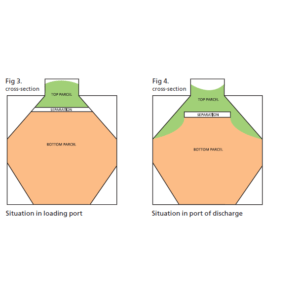
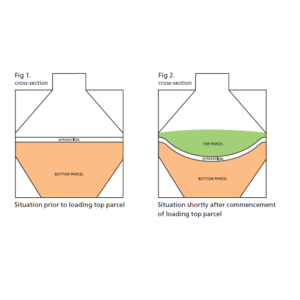
■ The loading of second and third parcels may entail pouring cargo from a considerable height. As a result the surface of the lower stow inevitably becomes depressed; this can be seen clearly on Figs 1 and 2. Because of the need to ensure a relatively even surface between any two parcels it may be wise to plan the stowage so that commodities with a high angle of repose,such as cereals and oil seed derivatives, are loaded below those with a low angle of repose such as canary seed or linseed. Note: Siting the separation material at a level between the slant plating of the upper and lower hopper tanks (Figs 1 and 2) will eliminate any difficulties on account of settling of the cargo, (Figs 3 and 4).
■ Ideally, the level of the separation between any two parcels should not be located in the vicinity of the upper ballast tank hoppers (as in Figs 3 and 4). This will ensure that when the inevitable settling of the cargo occurs, during the course of the voyage, the surface area of the separation material will remain adequate, and prevent admixture; see Figs 1 and 2. This problem, of course, does not arise in the vicinity of the lower hopper tanks.