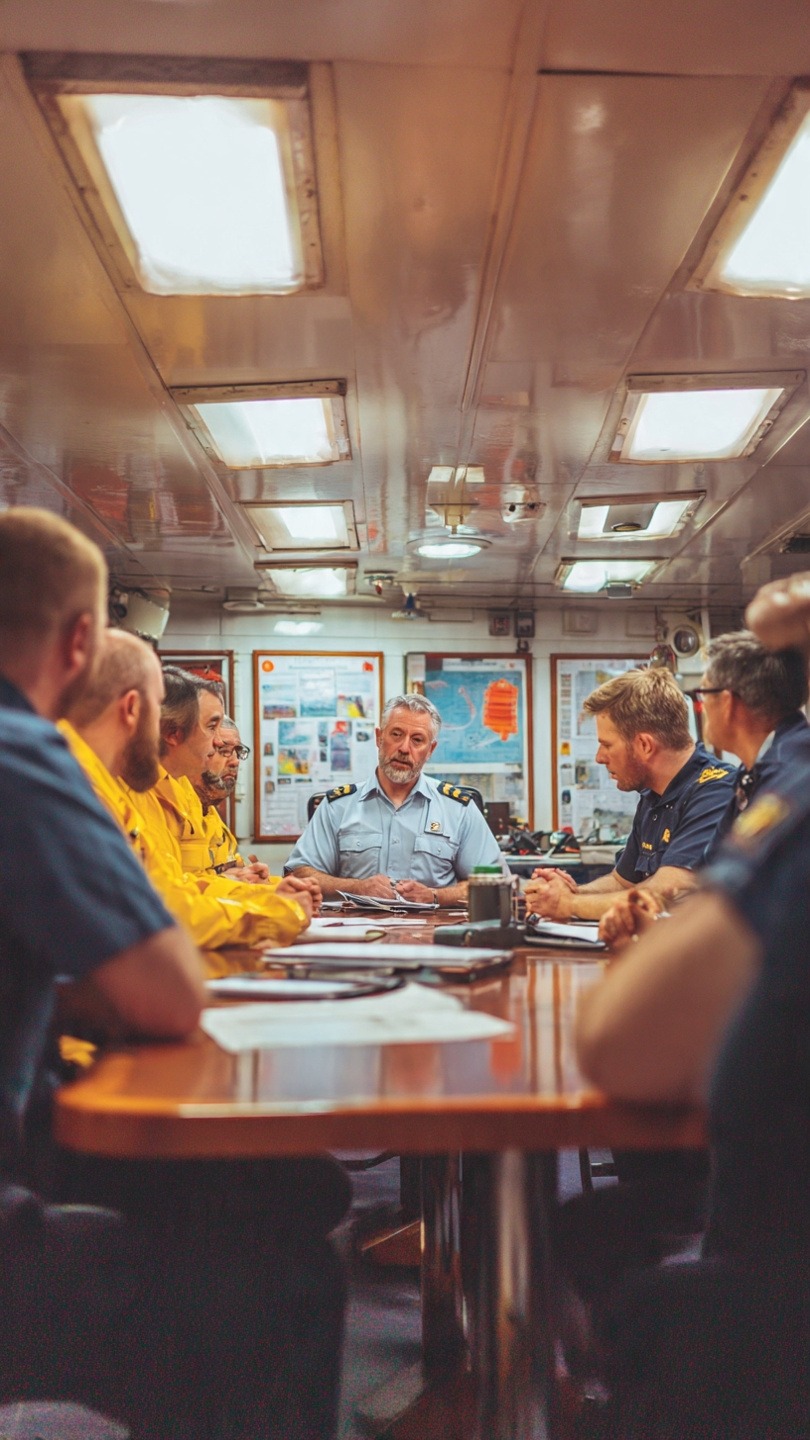
SAFETY OFFICER
The employer or the company appoints the safety officer on board every ship. The person chosen should be interested in occupational safety and in undertaking the appointment. He should have the suitable training and the knowledge. He should be an adviser on board ship and an assistant to management. He should be able to recognize the importance of the safety officer’s job. He should appreciate that the safety officer’s duties are to be performed in addition to his job.
SAFETY COMMITTEE
a) Should be appointed by the company
b) Must include master as Chairman, safety officer and all safety representatives.
c) It is recommended that the safety committee should comprise of Master, Chief Engineer, safety officer, 1 deck officer, 1 engine officer and 2 ratings.
d) The Master in the official Logbook (OLB), or minutes of the Safety Committee Meetings should record the appointment of a safety committee, safety officer and safety representative.
DUTIES OF A SAFETY OFFICER
1. It should be the duty of the safety officer to use his best endeavors to ensure that the provision of the code of safe working practices and safety policies are complied with;
2. He should improve the standard of safety consciousness among the crew.
3. Investigate:-
a) Every accident resulting in death, or in major or serious injury.
b) Every dangerous occurrence and near miss incidents.
c) All potential hazards relating to occupational health and safety.
d) Make recommendations to the master to prevent the recurrence of an accident or to remove the hazard.
4. Investigate all complaints by crew members about occupational health and safety.
5. Carry out occupational health and safety inspections of each accessible part.
6. Make representations and, where appropriate, recommendations to the master and through him to the management about any deficiency in the ship in respect of:-
a) Any requirement relating to occupational health and safety;
b) Any relevant Merchant Shipping Notice; or
c) Any provision of the Code of Safe Working practices.
7. Ensure that safety instructions, rules and guidance are complied with;
8. Maintain a record book describing all the circumstances and detail of all accidents and dangerous occurrences, near miss incidents (including the date, the persons involved and the nature of the injuries suffered).
He should include statements made by witnesses thereof recommendations to prevent future similar
accidents or dangerous occurrences.
9. Safety officer must discuss all his investigations, and his reports in the safety committee meeting before forwarding to DPA.
10. Stop any work which he reasonable believes may cause a serious accident, and immediately to inform the master.
11. Carry out additional health or safety investigation or inspection required by the safety committee.
12. Motivate all crew on board to comply company’s health and safety policy and procedures as per company’s safety management system.
DUTIES OF A SAFETY COMMITTEE
1. It should be the duty of the safety committee to use their best endeavors to ensure that the provisions of the Code of Safe Working Practices are complied with, to improve the standard of safety consciousness among the crew, and to:-
a) Make representations and recommendations on behalf of the crew to the employer on matters affecting the occupational health and safety of the crew;
b) Review the records kept by the safety officer;
c) Ensure the observance of the company’s occupational health and safety policies and to make recommendations for their improvement;
d) Report to the DPA all matters concerning health and safety.
e) Recommendations to the DPA to improve health and safety basis observations by the safety committee and safety officer’s findings.
f) Keep a record of Minutes, conclusions and any representations made to the matter.
g) In performing the duties set out above, a safety committee may require the safety officer to carry out any occupational safety inspection they consider necessary and to report his findings to them.
h) Make all persons on board aware about any changes done in safety management system.
i) Review the safety management system (complete system in one year) forward the same to DPA.
DUTIES OF THE MASTER
It should be the duty of the Master to facilitate the work of the safety officer/representative/committee in carrying out their occupational health and safety functions, and in particular to: –
1. Provide access to necessary information, documents, MS Notices etc.
2. Permit occupational health and safety inspections of the whole or part of the ship.
3. Allow the safety officer and safety representatives such absence from ship duties without loss of pay as may be necessary to enable them to fulfil their functions, or to undertake any necessary training on board in the exercise of their functions as a safety officer of safety representatives;
4. Allow display the Safety Committee Meeting Report on the ship’s notice board.
5. Receive representatives/recommendations from the safety officer, safety representatives, and safety committees that certain work should be suspended for reasons of safety. Discuss these representations, and implement any agreed measures as soon, as may be reasonable and practical.
SAFETY COMMITTEE MEETING
Safety committee meetings can be held as scheduled or unscheduled.
It should normally be scheduled so that all departments can plan their jobs and everybody on board will be ready with their suggestions and views as required.
Unscheduled safety meeting is held in additional to scheduled safety meeting when the Master, safety officer or safety representative feel it is necessary after any near miss incident or after any accident.
Unscheduled meetings also held before any critical operations.
All crew and officers should be encouraged to discuss any safety problems with safety representatives during the meeting.
Any suggestions to enlighten others on board should be welcomed.
It should be well understood that the safety is not a waste of time but it is prevention of accidents.
# Holding of regular meeting is a good method for keeping staff informed and providing liaison matters relating to;
1. the general operation of the ship
2. safety
3. maintenance
# Preferably the safety meeting should be held monthly and people should be allowed to speak freely regarding safety, suggestions should always be welcomed and given importance. It remains the responsibility of the senior officers on board to create such an environment.
# As far as possible the duration of the meeting should be restricted to one hour, should be held at time when it is convenient to people.
# Agenda for the safety meeting should be produced and displayed on notice board well before the meeting.
# The minutes of the safety meeting should be recorded properly.
# Minutes of the meeting should be sent to those persons who attended the meeting and to others as required.
AGENDA OF SAFETY COMMITTEE MEETING OR SCOPE OF SAFETY COMMITTEE MEETING
The safety meeting should be including;
1. Last safety meting reports and the minutes.
2. Safety officer’s report.
3. Safety representative observations.
4. Discussion/instruction on any safety related topic.
5. Any near misses or accidents from the time last meeting held.
6. Circulars from the company to be discussed.
7. Briefing on amendments to SMS, forms, checklists etc.
8. SMS review, proposals if any.
9. Any non-conformity to be discussed and it’s closing date if any.
10. Schedule of next meeting.
If the agenda is short, the meeting may be supplemented by a safety training video or a demonstration of an item of safety equipment like the breathing apparatus, oxygen resuscitator etc.
SAFETY MOTIVATION
CREATING SAFETY AWARENESS ON BOARD
People are motivated, if they have a desire, need, which they feel they can do something about or satisfy. In terms of safety this means that management must try to make employees aware of the need for safety and provide the means and the opportunity for an accident free workforce.
Management Role – to provide the opportunity
In some ways the management role is pre-eminent. Positive management attitudes are the best influence to provide safety conditions. If you have got the best possible commitment from the top management then they can ensure that everyone below them are also adopting the right sort of attitude. In practical terms this means:
a) Board level involvement in safety
b) Acceptance and understanding of safety as part of the organizations objectives- goes beyond just having a safety policy
c) Provision of finance and facilities
d) Personal example by officers
e) Training in safety
f) Safety to be part of officer performance appraisal
Safety Organization – provide the means
The safety organization is in itself a method of creating and maintaining interest in safety. The size of the safety department on shore and its work onboard will of course depend on such things as management interest; legislation, vessel/cargo, nature of accidents but the activities it undertakes can stimulate interest in employees as a group.
a) Safety committee
b) Safety inspections
c) Posters
d) Films
e) Training
f) Publicity
g) Investigation
h) Changing behavior / attitude
i) Example
j) Follow-up