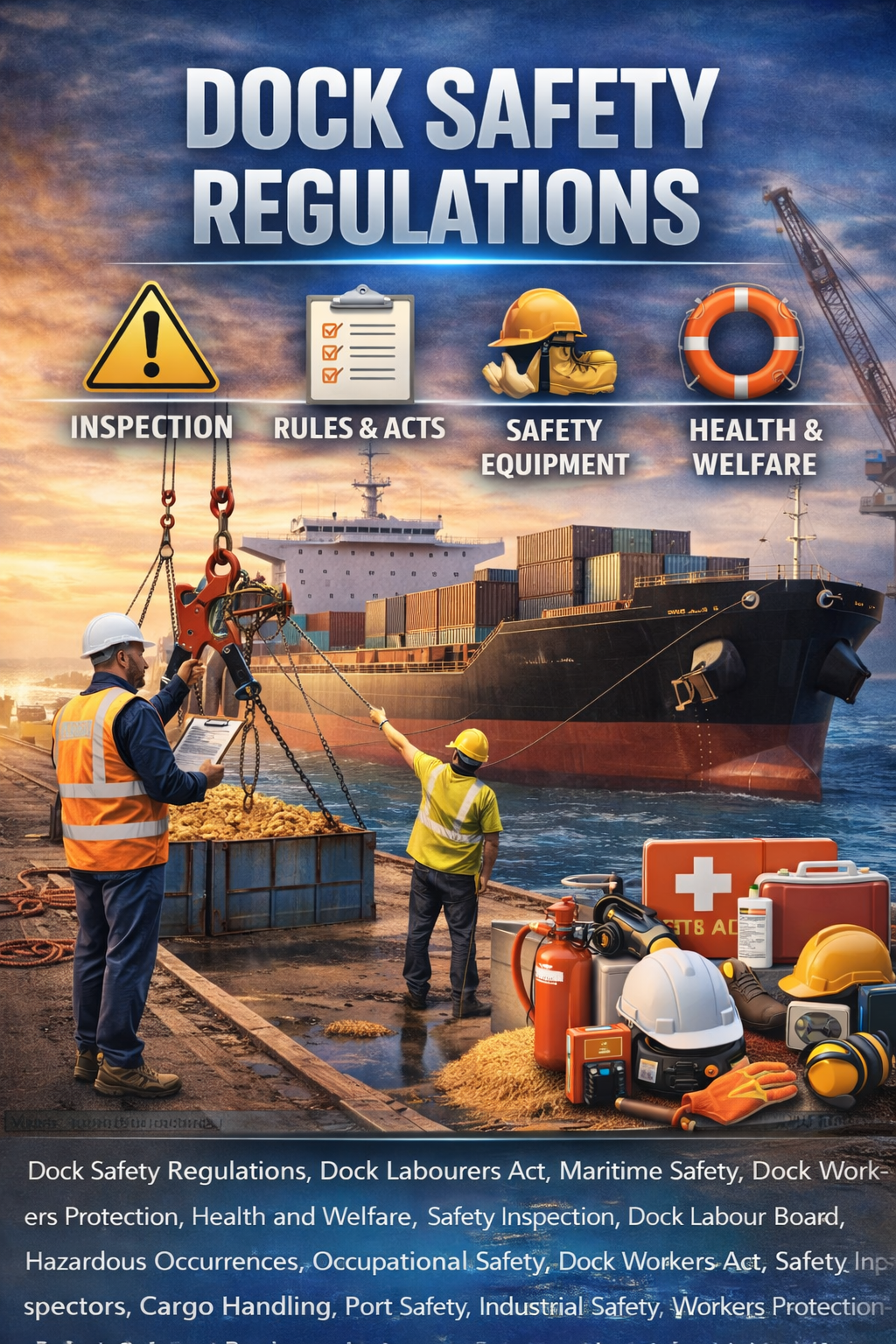
What is Dock Labourers Act?
An Act concerning the protection against accidents of workers employed in loading and unloading ship. Every state has its own Dock Labourer’s Act as per their national rules and regulations. The Indian Dock Labourers Act is based on the Factories Act. UK, Australia, Canada and USA have similar Acts.
Dock Labourers Act
The Indian Dock Labourers Act, 1934, has been replaced by the Dock Workers (Safety, Health and Welfare) Act, 1986 (Act No. 54 of 7 December 1986), and that both the Dock Workers (Safety, Health and Welfare) Regulations, 1948, and the Dock Workers (Safety and Health and Welfare) Scheme, 1961, have been replaced by the Dock Workers (Safety, Health and Welfare) Regulations, 1990.
Dock Labourers Act
Furthermore, “Annual Report on the Working of the Dock Workers (Safety, Health and Welfare) Regulations, 1990”, a reference to the Dock Workers (Safety, Health and Welfare) Rules, 1990, further regulates occupational safety and health of dock workers.
Dock Labourers Act
In India, Dock Safety Inspectorates have been set up at the ten major ports of Mumbai, Kolkata, Chennai, Kandla, Mormugao, New Mangalore, Cochin, Tuticorin, Visakhapatnam and Paradip.
The labour inspectors, besides their enforcement work, also provide training, education and information, and safety centres have been set up by some of the inspectorates, all in collaboration with the port authorities, dock labour board, owners/agents of the ships, stevedoring firms, clearing agents, chipping and painting contractors and the trade unions.
Who appoints the Dock Safety Inspectors?
The Central Government may appoint such persons as it thinks fit to be inspectors for the purposes of this Act within such local limits as it may assign to them respectively. Dock Safety Inspectors have been appointed for the docks and Factory Inspectors, Municipal Inspectors etc. for other industries.
Powers of Dock Safety Inspectors
An Inspector may at any port for which he is appointed:
(i) enter, with such assistance (if any) as he thinks fit, any ship, dock, warehouse or other premises where any dock work is being carried on or where he has reason to believe that any dock work is being carried on;
(ii) make examination of the ship, dock, lifting appliance, loose gear, lifting device, staging, transport equipment, warehouse or other premises used or to be used for any dock work;
(iii) require the production of any testing muster roll or other document relating to the employment of dock workers and examine such document;
(iv) take on the spot or otherwise such evidence of any person which he may deem necessary, provided that no person shall be compelled to answer any question or give any evidence tending to incriminate himself;
(v) take copies of registers, records or other documents or portions thereof as he may consider relevant in respect of any offence which he has reason to believe has been committed or for the purpose of any inquiry;
(vi) take photograph, sketch, sample, weight, measure or record as he may consider necessary for the purpose of any examination or inquiry;
(vii) hold an inquiry into the cause of any accident or dangerous occurrence which he has reason to believe was the result of the collapse or failure of any lifting appliance, loose gear, transport equipment, staging or non-compliance with any provisions of the Act or the regulations;
(viii) issue show-cause notice relating to the safety, health and welfare provisions arising under the Act or the regulations;
(ix) prosecute, conduct or defend before any court any complaint or other proceedings arising under the Act or the regulations;
(x) direct the port authority, dock labour board and other employers of dock workers for getting the dock workers medically examined if considered necessary.
A person having general management and control of the premises or the owner, master, officer-in-charge or agents of the ship shall provide such means as may be required by the Inspector for entry, inspection, examination, inquiry or otherwise for the exercise of his powers under the Act and regulations, including the provision of launch or other means of transport.
Notice of Accidents and Dangerous Occurrences
Notice of any accident in a dock which disables a dock worker from work on which he was employed shall be sent by any reliable means within four hours of the occurrence to the inspector notified for the purpose.
When the accident disables the dock worker from work for more than ten days, the relatives of the dock worker should be informed in addition to the inspector.
In the case of fatal accidents, the officer in charge of the nearest police station and the District Magistrate, in addition to the above-mentioned parties, have to be informed.
In all cases of accidents the injured person shall be given first aid and thereafter immediately conveyed to a hospital or other place of treatment.
Where any accident causing disablement results in the subsequent death of the dock worker disabled, notice in writing of the death shall be sent to the authorities mentioned above.
Dangerous Occurrences to be Reported
The following classes of dangerous occurrences shall be reported to the inspector whether death or disablement is caused or not:
Collapse or failure of lifting machinery used in raising or lowering of persons or goods, and breakage or failure of ropes, chains or other appliances forming part of lifting machinery or the overturning or displacement of a crane.
Collapse or subsidence of any wall, floor, gallery, roof, platform, staging or means of access.
Bursting of a vessel containing steam under pressure greater than atmospheric pressure other than a plant which comes within the scope of the Boilers Act.
Explosion of a receiver or vessel used for storage at pressure greater than atmospheric pressure of any gas or gases or any liquid or solid resulting from compression of gas.
Explosion or fire causing damage to any room or place in which dock workers are employed.
Obligations of Dock Workers
It shall be the duty of every dock worker, if he discovers any defect in the dock, staging, machinery or plant, to report such defect without unreasonable delay to his employer, foreman or other person in authority.
No dock worker shall wilfully interfere with or misuse any means, appliance, convenience or other equipment provided.
No dock worker shall wilfully and without reasonable cause do anything likely to endanger himself or others.
No dock worker shall, unless duly authorised or in case of emergency, remove or interfere with any fencing, plant or machinery, ladder, lifesaving means or appliances, lights, staging or other things required to be provided under this scheme.
If removed, such things shall be restored at the end of the authorised period or emergency by the persons last engaged in the work that necessitated such removal.
Facilities to be Provided to Dock Workers
Under the Dock Workers Act, facilities shall be provided in health, safety and welfare.
Health: Cleanliness, drinking water, latrines and urinals, spittoons, lighting, ventilation and temperature.
Welfare: Washing facilities, first aid appliances, ambulance room, ambulance carriage, notices, canteens, lunch rooms, shelters or rest sheds, welfare officers.
Safety: Walking surfaces, fencing of dangerous places, clearance of passages, gates, construction, floor loading, stairs, openings, and means of escape in case of fire.
Ropes and Wires
No rope or wire shall be used in hoisting or lowering unless it is of suitable quality, free from patent defects and tested and examined by a competent person.
A rope must be condemned if it shows signs of excessive wear and tear or deterioration.
A wire rope is to be condemned if in any length of eight diameters the total number of visible broken wires exceeds 10% of the total number of wires in the wire rope.
Drivers of Cranes
No person under 18 years of age and no person who is not sufficiently competent and reliable shall be employed as a driver of lifting machinery or for giving signals to a driver.
Handling of Cargo
Where stacking, unstacking, stowing or unstowing of cargo cannot be safely carried out unaided, reasonable measures to guard against accident shall be taken by shoring or otherwise.
Cargo shall be stacked on a firm base not liable to settle and the weight of cargo shall not exceed the load density of floors.
Cargo shall not be stacked against partitions or walls unless they are strong enough to withstand pressure.
Cargo shall not be stacked to such height or manner as to render the pile unstable.
Where dock workers work on stacks exceeding 1.5 metres in height, safe means of access shall be provided.
Dock workers handling sharp-edged or dangerous objects shall be provided with suitable protective equipment.
Staging
All staging and planks shall be securely constructed of sound material and inspected regularly by a competent person.
Planks extending 45 cm or more beyond supports shall be fastened to prevent slipping.
All staging above 2 metres shall be not less than 30 cm wide.
Planks supported on ladder rungs shall not be used as staging.
Suspended stages shall be secured to prevent swinging.
Synthetic fibre ropes shall not be used for suspending stages.
Safe access shall be provided to and from stages.
Age Restriction, Precautions Against Falling and Lighting
No person under 18 years of age shall be required to work on a ship on a stage above ground level.
In double banking, adequate measures shall be taken to prevent falling of materials.
All working areas shall be efficiently lighted.
Dangerous Substances and Environment
Dangerous substances shall be handled under supervision of a competent person.
Special precautions shall be taken to prevent breakage or damage.
If dangerous goods are damaged, work shall be stopped and workers moved to a safe place.
Dock workers handling dangerous goods shall be provided with protective equipment.
Machinery
All moving parts of machinery shall be securely guarded.
Machinery shall not be cleaned, examined or repaired while in motion except by competent persons.
Adequate measures shall be taken to prevent accidental restarting during repairs.
Electrical Equipment
Only authorised persons shall handle electrical equipment.
Portable equipment shall be inspected daily.
Equipment exposed to weather shall be protected.
All non-current carrying metal parts shall be earthed.
Ladders
All ladders shall be of sound material and good construction.
Wooden ladders shall not be painted.
Ladders shall extend at least one metre above landing places.
Portable ladders shall be secured and not placed on loose bases.
Defective ladders shall not be used.
Access to and from Ship
Access alongside quay shall be by accommodation ladder properly secured and fenced.
Access alongside other ships shall be provided by the ship with higher freeboard.
Access to holds deeper than five feet shall be by ladder.
Ladders shall provide adequate foothold and handhold.
Hatch Covers
Hatch beams shall have suitable lifting gear and be secured.
Hatch covers shall be properly marked and fitted with hand grips.
Openings to lower holds shall be guarded to a height of three feet when tween deck covers are not in place.
Fire Protection
Adequate fire extinguishing equipment and water supply shall be provided.
Trained personnel shall be available during working hours.
Fire equipment shall be maintained and inspected regularly.
Rescue of Dock Workers
Provisions for rescue from drowning of dock workers shall be made and maintained.
The Dock Labour Board
The Government may establish a Dock Labour Board for a port or group of ports.
The Board shall administer the provisions of the Act and consist of representatives of the Government, dock workers, employers of dock workers and shipping companies.