Skip to content

Knowledge Of Sea

We will keep you updated

  • Home
  • Video
  • Chartering Terms
  • Rule of the Road (COLREG)
    • Nautical Flags
    • Rule of the Roads – CARDS
  • Tanker Definitions
  • Downloads
  • ORAL NOTES
    • ORAL NOTES- 2ND OFFICER
    • ORAL NOTES- CHIEF MATE
    • ASM ORAL NOTES 1
    • ASM ORAL NOTES 2
  • About Me
  • Exit Exam
    • FPFF exit exam questions and answers
    • EFA exit exam questions and answers
    • BST exit exam questions and answers
    • AFF DG Shipping exit exam question and answers
  • Toggle search form

CARGO TANK VAPOUR TIGHTNESS TEST

Posted on September 20, 2025September 20, 2025 By admin No Comments on CARGO TANK VAPOUR TIGHTNESS TEST

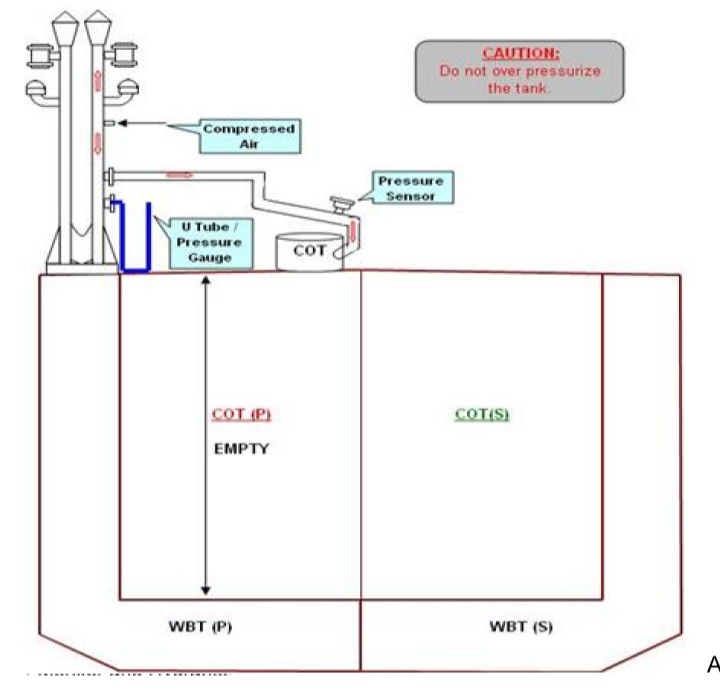
Code of Federal Regulations (CFR) requires tanker vessels to issue a vapour tightness certificate with the code.  This is to be documented using the form “T 3 – Vapour Tightness Certificate”.

Following method should be used for the purpose of carrying out the test:

P/V Valve to be checked for proper functioning prior doing this test.

Keep all openings shut.

Install a U-Tube or a Compound Gauge on the PV Stack

Pressurize tank using Compressed Air or Nitrogen

Let the tank pressure come up to 1250 mm WG but no more than the pressure of the lowest pressure relief valve setting.

Openings to be checked for leakage using Soap solution (Apply soap solution to all openings, flanges and welding seams – leakage will be visible by means of soap bubbles.

Once the pressure is obtained, the dry air or inert gas source shall be shut off.

At the end of one-half hour, the pressure in the Cargo tank and piping shall be measured. The change in pressure shall be calculated using the following formula:

P=Pi-Pf

Where:

P=change in pressure, inches of water.

Pi=pressure in tank when air / gas source is shut off, inches of water.

Pf=pressure in tank at the end of one-half hour after air / gas source is shut off, inches of water.

The change in pressure, P, shall be compared to the pressure drop calculated using the following formula:

PM=0.861 Pi L/V

Where:

PM=maximum allowable pressure change, inches of water.

Pi=pressure in tank when air / gas source is shut off, psi.

L=maximum permitted loading rate of vessel, barrels per hour.

V=total volume of product tank, barrels.

 If P < PM, the vessel is vapour tight.

If P>PM, the vessel is not vapour tight and the source of the leak must be identified and repaired prior to retesting.

In order to maintain vapour tightness the following should be checked and maintained in good condition.

a. Packings on tank domes, butter worth openings, level gauge fittings.

b.Tank securing arrangements.

c.Cargo valve and drain valve  integrity.

d.P/V valves.

e.Vapor locks.

Tanker Tags:cargo tank vapor tightness test

Post navigation

Previous Post: MSMP & LMP
Next Post: PORTABLE SUBMERSIBLE PUMPS

Leave a Reply Cancel reply

Your email address will not be published. Required fields are marked *

Categories

  • Bulk Carrier
  • Cargo handling
  • Engine Room Operations
  • LSA & FFA
  • Maritime Industry
  • Maritime Law
  • Merchant Shipping
  • Navigation
  • Rules and Regulation
  • Ship Construction
  • Shipboard operation
  • Stability
  • Tanker
  • Uncategorized

Blog is primarily for candidates appearing for certificate of competency exams but such is the detail that while being equally suitable for the beginner, it is also reference work for experienced seaman, and the layout and style of blog make it suitable for shipboard training where practical experience can be allied to the theoretical approach.

Recent Comments

  • capt on Radar Best Practice -ARPA
  • admin on Dry Docking (Theory & Numericals)
  • Stelios Karamplakas on Dry Docking (Theory & Numericals)
  • Farid OMARI on Demurrage
  • admin on Tanker Cargo Calculations

Copyright © 2018 knowledge of sea – All Rights Reserved.

If you’re unsure about what type of training will work best for you, just tell us a little more about your needs. We will get back to you as soon as possible with the answers you need!

All answers will be from sailor mouth, who is practically working on board.

January 2026
S M T W T F S
 123
45678910
11121314151617
18192021222324
25262728293031
« Dec    

Copyright © 2026 Knowledge Of Sea.

Powered by PressBook WordPress theme

Go to mobile version