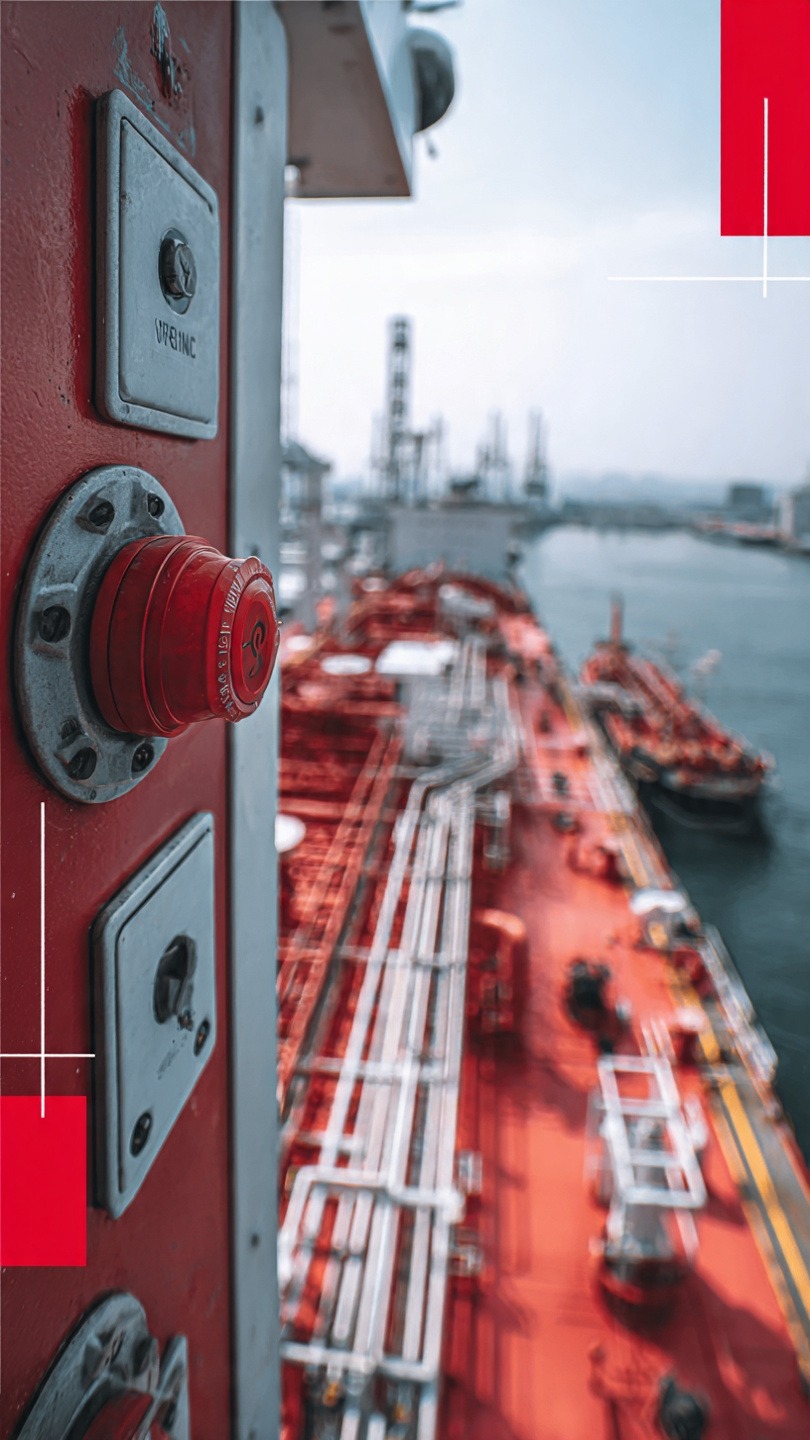
Question :- ESD procedure in LNG?
Answer: ESD will be initiated by one of the following:
– Manual activation by personnel using the ESD pushbuttons
– Blackout of the ship
– Shore activation of their ESD system
– Fusible links around each tank domes, manifold and compressor house in case of fire
– Cargo tank Very High level alarm
– Low tank pressure
– Hold/cargo tank differential pressure
– Low cargo valves hydraulic pressure
– Low control air pressure
– Fire extinguisher system released
The initiation of ESD will lead to the following:
– All ESD manifold loading valves will close
– The gas compressors will trip
– The main discharge and spray pumps will trip
– All shore pumps will trip
– Master gas valve to engine room will close
– Inert gas generator will trip
The ESD system minimizes potential risks during the transfer of liquefied gases between ship and shore loading and unloading installations. It provides a quick and safe means of stopping the transfer of cargo and isolating ship and shore cargo systems in a controlled manner, either manually or automatically, in the event of fault conditions that affect the ability of the operator to control safely the transfer of cargo. Most export terminals, and an increasing number of import terminals, now have a second level of protection providing for the rapid disconnection of the loading arms from the ship. These two levels of cover are known as `ESD-1′ and `ESD-2′. The emergency shutdown (ESD) system is a requirement of the IMO code for the carriage of liquefied gases in bulk and is a recommendation of SIGTTO. It is fitted to protect both the ship and terminal in the event of power loss, cryogenic or fire risks, on either the ship or in the terminal.
The system will stop the flow of LNG liquid and vapour by shutting down the pumps and gas compressors as well as manifold and shipside valves, by the activation of single control. Shut down of the cargo system can be initiated either manually or automatically if certain off-limit conditions occur.
Question . Action in case of blackout during loading on LNG?
Answer: Emergency Shutdown (ESD) will get activated automatically.
The requirement of the cargo Emergency Shutdown (ESD) system are to stop cargo liquid and vapour flow in the event of an emergency and to bring the cargo handling system to a safe, static condition. The earlier method of cargo shut down comprise of manual trip points and automatic fire sensors that can initiate remote closure of emergency shutdown valves “for shutting down liquid and vapour cargo transfer between ship and shore” This emergency trip, when activated, must also stop cargo pumps and compressors. However, these provisions do not necessarily provide adequate protection, particularly against overflow, during other operations involving the transfer of liquid and vapour on board. It must be recognized that operations such as reliquefaction or cargo tank spraying may be routine operations at sea. These deficiencies eliminated by introducing cargo emergency shutdown (ESD).
Question . Daily boil off rate?
Answer: The measure for the boil-off is the amount of vapours per unit time. It can be an absolute measure – kg/h, kg/day or a relative measure – % vaporized from total amount per unit time. The boil-off rate can be used to determine how long you can hold the cryogenic fluid in the specific tank.
Question. How to load propane, temperature? How to keep tanks cool?
Answer:
1. Before the loading operation begins, the pre-operational ship / shore procedures must be thoroughly discussed and subsequently carried out. The appropriate information exchange is required and the relevant ship / shore safety check list must be completed.
2. Particular attention must be paid to the conditions and setting of cargo relief valves, reliquefaction plant, gas detection system, alarms and controls and to the maximum loading rate, taking into account restrictions in ship / shore systems, etc. Lines are to be pressurized to the maximum working pressure, and checked for leaks.
3. The terminal must provide the necessary information on the cargo, including inhibitor certificates where inhibited cargoes are loaded. Any other special precautions for specific cargoes are to be made known to ship personnel, e.g. the lower setting of the compressor discharge temperature cut-out switch required for some chemical cargoes. Variable setting pressure valves and gas detection sample valves must be correctly set.
4. Either the terminal or the shippers will advise the required cargo tank temperatures / pressure which are required for arrival at the load port.
5. Cargo loading can be carried out using either a vapour return line, the ship’s reliquefaction plant, or both. Where loading is carried out with a vapour return facility, liquid is taken on board through the liquid header and directed into the appropriate tanks. Vapours generated are returned ashore via the vapour return line using the compressor or jetty blower. Under these conditions the loading rate is independent of the ship’s reliquefaction plant and governed by the rate at which the terminal can handle the vapour; it may also be constrained by velocity through the ship’s piping system.
6. Where no vapour return is provided then the loading rate is governed by the capacity of the ship’s reliquefaction plant. In most cases the terminal reliquefaction plant capacity will be much larger than that on board the vessel and, as a result, loading rates where vapour return is provided will normally be higher than without vapour return.All unused manifolds are to be blanked.
7. When liquefied gas is being loaded from terminal to ship, it is necessary to consider the location, pressure, temperature and volume of the stored product on shore as well as the pumping requirements of the transfer facility. Ship loading will normally be from fully refrigerated storage where the tanks typically operate at a pressure of approximately 60 mbar; this pressure will allow the propane at the bottom of a full shore tank to sustain a temperature perhaps 1°C above the atmospheric boiling point, i.e. -44°C as against -45°C.
8. When LPG is pumped to the jetty head, the pumping energy required for transfer is dissipated in the liquid as heat, to which must be added the heat flow into the liquid through the pipework. The propane may therefore arrive at the ship’s rail at a temperature of -43.5°C. When loading without vapour return, the vapour which is displaced by the incoming liquid must be liquefied by the reliquefaction plant; the capacity required for this, plus the heat loss through the insulation, may leave little or no capacity for cooling of the cargo during loading.
9. The early stages of loading are critical, particularly where significant distances exist between storage tank and jetty. Ship’s tank pressures must be regularly observed and on no account should relief valves be allowed to lift. Loading rates must be reduced and, if necessary, stopped when difficulties are experienced in maintaining acceptable tank pressures. Ship’s tank pressure rise in the early stages of loading can also be controlled to a certain extent by taking liquid into the cargo tank via the top sprays so condensing part of the cargo vapour.
10. Depending on the efficiency of the purging operation, significant quantities of incondensibles may be present and without vapour return to shore these incondensibles will have to be vented from the condenser. Care must be taken when venting incondensibles to minimise venting of cargo vapours to the atmosphere. As the incondensibles are vented, the condenser pressure will drop and the vent valve should be throttled and eventually closed.
11. A close watch must be kept on ship’s cargo tank pressure, temperatures, liquid levels, inter-barrier space pressures etc., throughout the loading operation. Monitoring of liquid levels may present difficulties when the reliquefaction plant is in operation. This is because the liquid in the tank is boiling and as a result vapour bubbles within the liquid increasing the volume of the liquid, thus giving false reading with floattype ullage gauges. An accurate level monitoring can be achieved by temporarily suppressing boiling, i.e. by closing the vapour suction from the tank.
12. Towards the end of the loading operation, loading rates must be reduced to an appropriate rate as previously agreed with shore staff in order to accurately “top-off” tanks.
13. At this time the vapour suction valve is also to be closed to prevent the surface of the liquid boiling as explained above. This boiling and the resulting increase in liquid volume due to the vapour bubbles may give a false reading on the level gauge and result in a lesser amount of cargo being loaded.
14. On completion of the loading operation, ship’s pipework is to be drained back to the cargo tanks. The liquid remaining can be cleared by blowing ashore with vapour using the ship’s compressor or by nitrogen injected into the loading arm to blow the liquid into the ship’s tanks.
15. Once liquid has been cleared and lines depressurised, manifold valves should be closed and the hose or loading arm disconnected from the manifold flange.
16. The ballast handling arrangements are quite independent of the cargo system. Deballasting can therefore take place simultaneously with loading subject to regulations. Ship stability and stress are of primary importance during loading and deballasting and procedures are in accordance with normal tanker practice.
Question: Loading procedure of LNG?
Answer:
1. Tank Inspection- Clean, no loose object, no free water
2. Drying and Inerting- Introduction of Dry Inert Gas into the tanks to remove water vapours and to remove the flammable gases. O2 content to be less than 5% by volume
3. Gassing-Up- Removal of IG from tanks by introducing cargo vapours & venting the IG through atmosphere.
4. Cool Down- To avoid excessive pressures in tank and thermal stresses, cargo liquid is sprayed into the tank at slow rate. Rate of cool down= 10°C/hour. Cool down should continue until the boil off eases and liquid begins to form in the bottom of the tank. Pump should be rotated frequently to avoid freezing.
5. Loading- Before loading operations begin, the pre-operational ship/shore procedures must be thoroughly discussed and followed.
Appropriate information exchange is required and the relevant parts of the ship/shore safety check list should be completed. LNG is loaded via the loading manifolds to the liquid header and then to each tank filling line. The boil-off and displaced vapour leave each tank via the vapour suction to the vapour header. The vapour is initially free-flowed to shore via vapour crossover manifold and, as tank pressure rises, one compressor is brought into operation to increase the gas flow to shore and limit the vapour main and cargo tank pressure.As the loading rate increases, it is important to monitor the tank pressures and to start one HD compressor. If the compressors are unable to cope with the volume of boil-off and displaced gas, it will be necessary to reduce the loading rate. The following checks and procedures are to be regarded as the minimum before cargo operations can commence.
1. Preparation and approval by the Master of a Cargo plan including valve line up.
2. Calculation of Drafts, Stress and Stability for the vessel throughout the cargo operation and the forthcoming voyage.
3. Cargo lines walked and checked, in correct status, particular attention to be paid to valves and blinds that are not frequently moved. After dry dock or maintenance particular attention is to be paid to blanks, flanges etc that may not have been tightened correctly.
4. Remote and if applicable local valve operation and remote indicators to be verified as in synch with each other.
5. Cargo pumps, spray/stripping pumps and where appropriate compressor motors to be megger tested and the results are logged. Operation of ballast valves and pumps to be verified.
6. Ballast water has been exchanged in line with international, Port State/Terminal and company requirements.
7. Fire-fighting equipment including hoses, dry powder units/guns and other appropriate safety equipment in place and fully operational.
8. HD compressors ready for operation.
9. Sufficient Nitrogen is available for the cargo operation and forthcoming voyage. Nitrogen equipment is operational and correctly lined up.
10. High High Alarms tested and verified as operational.
11. Overflow alarms and activation of the ESD system tested and recorded as operational.
Question. Hazards in LNG ships?
Answer:
1. Flammability- Vapour cloud – Ignite
2. Explosivity – Ignition of vapours in confined spaces
3. Flameless Explosion – Rapid Phase Transition – cold liquefied gas strikes water
4. Cold Temperature Hazard – Steel losses its ductility
5. Spillage – low temperature- brittle fracture
6. Cool Down – System is designed to withstand certain service temperature – may lead to stress and thermal shock
7. Cold Spots- icing – if insulation breakdown
8. Roll Over – rapid mixing in large tanks due to density inversion
9. Pressure Surge – operating pressure should be maintained
10. Respiratory – asphyxia and anesthesia – loss of consciousness
11. Frost Bite – direct contact with cold liquid vapour or pipes and equipments
12. Chemical Burns – contact with skin
13. Toxicity- health damage – irritation, tissue damage
14. Reactivity – with water – hydrates formation – pump seize
Question Rollover in LNG ships.
Answer:
Rollover is the process of spontaneous mixing up of a similar or two different gaseous cargos due to changes in the density of upper and lower layers level in the tank.
This happens because of the boiling off of lighter fractions from the gaseous cargo, resulting in the liquid layer adjacent to the liquid surface to become denser than the layer beneath it. When this situation occurs, stratification develops and the unstable condition relieves itself with spontaneous mixing known as rollover.
Reasons for Rollover
The various reasons for rollover are:
Σ When there is temperature difference within the liquid.
Σ If the cargo is stored for a long time without circulation.
Σ Similar or Compatible cargo stored in one tank
Σ If condensate of two or more tank is returned to one tank
Effect of Rollover
Σ Increase in the boil off rate up to 10 times than the normal condition
Σ Increase or over pressurization of the tank
Σ Lifting of relief valve of the tank
Measures to prevent rollover
Σ Different density cargo to be stored separately
Σ Load tank with equipments such as nozzle ( used for shore tanks ) to promote mixing.
Σ Prolong stoppage to be avoided when loading ship’s tank
Σ Boil off rate to be continuously monitored