
World Scale
- World Scale is the “World Tanker Nominal Freight Scale” and is a schedule of freight rates
applying to tankers carrying Oil in bulk. - Nominal means that the freight rates which world scale provides are intended solely as a
standard of reference. - World Scale is available on a yearly subscription basis. It is the joint endeavour of two nonprofit
making organizations known as World Scale Associations London & World Scale Associations NYK.
- The principal advantage of using World Scale system is that it can greatly simplify regulations of tanker charters. A simple reference in the charter is sufficient to cover all the voyages that are possible within the designated areas of that charter.
- The latest edition of the world scale contains about 80,000 rates in two (2) sections. The first page covers rates for voyages between one loading and one discharging port while the second for multiple ports.
- Basis of calculation: Rates per tonne for a full cargo for the standard vessel are calculated on the basis of a round voyage from loading port/s to discharge port/s and back to the first load port by reference to a vessel of 75,000 DWT with speed of 14.5 knots and bunker consumption of 55 Tonnes / day and in addition for purposes other than steaming 100tonnes per round voyage and 5 tonne / port. This is referred to as the standard vessel.
- The main calculation elements of each rate are:
a) Fixed hire element of USD 12000 /day,
b) Bunker cost based on prices over ‘6’ months ending 31/3 and 30/9,
c) Port time of ‘4’ days for a voyage from one loading port + discharge port + 12 hrs. Each extra port allowed on a voyage and includes lay-time of 72 hrs for the purpose of loading and discharging,
d) Canal transits time @ 24 hrs each transit of Panama Canal and 30 hrs for each transit of the Suez. - Though World Scale facilities swift negotiations can occur, however, it is only a datum and not a substitute for a voyage estimate neither does it offer any protection against financial risk.
- An owner will need to make his own assessment of the likely cost involved on a voyage and decide whether or not the levels of World Scale on offer for a particular piece of business has any attractions. If there are any particular expenses that the owner feels are not dealt with under World Scale, he can negotiate such expenses with the charter. Negotiations are possible from WS 40 to WS 200
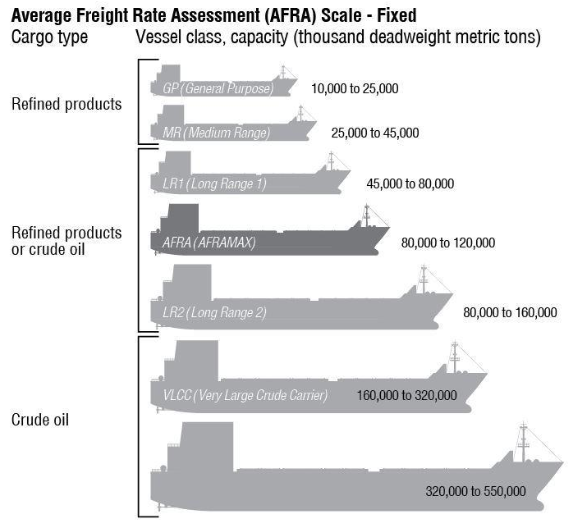
Average Freight Rate Assessment (AFRA)
- This was finally devised and developed by SHELL and later by BP. AFRA became accepted by taxation authorities as a base for assessing Tanker Transportation Costs.
- The AFRA prepared by London Tanker Brokers Panel Ltd., represents the cost of all chartered tonnage actually operating during the calculation period irrespective of fixture rates.
- The result of AFRA is available on the first business day of each month and is provided for ‘6’ different DWT groups as follows:
i) General Purpose 16,500 – 24,999
ii) Medium Range 25,000 – 44,999
iii) Large Range 1 45,000 – 79,999
iv) Large Range 2 80,000 – 1,59,999
v) VLCC 1,60,000 – 3,20,000
vi) ULCC 3,20,000 – 5,49,000 - The calculations are made over a monthly period running from 16th of one month to the 15th of the following month and the assessments represent average cost of commercially chartered tonnage employed in the international transportation of Oil during the charter calculation period.
- In each six-group tonnage is divided into ‘4’ categories:
- Company vessels,
- Vessels on long term charter,
- Vessels on short term charter,
- Vessels engaged in single voyage charter.
- The average freight is determined in US Dollars for per ton and published. These rates are available only on subscription.