Lateral Resistance
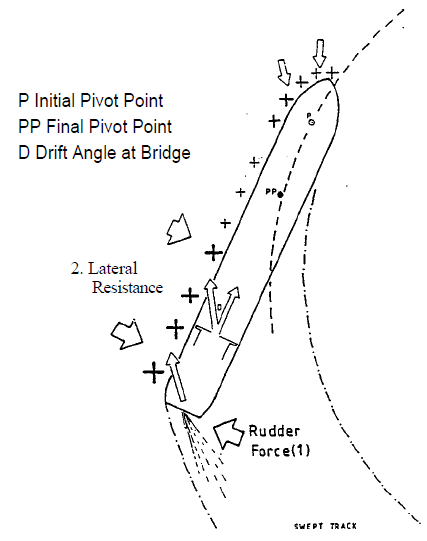
As a ship commences to turn and thereafter for the duration of a turn, the ship is sliding sideways through the water. This results in a large build up of water resistance which continually opposes the rudder force and we can refer to as ‘Lateral Resistance ‘.
The balance between the rudder force and the lateral resistance plays a crucial part in shaping all turning circles.
Normal Turns
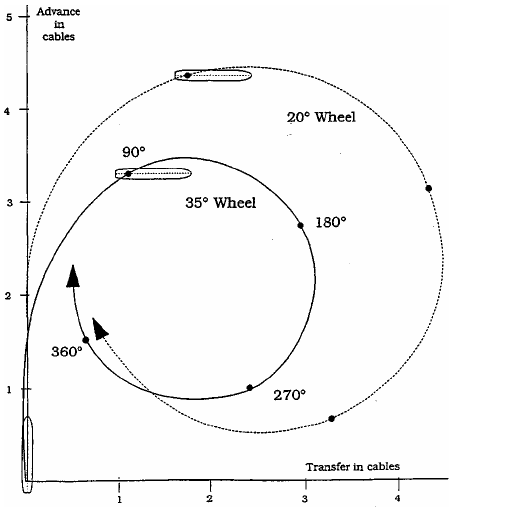
If for example our ship of 67,000 t displacement enters and continues a turn at a constant rpm for slow ahead, both forces balance to give a turning circle as shown .
The advance and transfer can be measured from the scale for both 20° and 35° turns. By comparison, looking at the same ship conducting a turn at a constant rpm for full ahead, it may be surprising to note that the turning circles are virtually identical to the slow ahead turn.
Standing Turns and Kicks Ahead
Standing Turns and Kicks Ahead can only be achieved by altering the balance between lateral resistance and rudder force, reducing the former to a minimum and then exploiting the latter to its full potential. To do this to best effect it is first necessary to take the ship’s speed right down to the equivalent of dead slow or less. With the speed thus reduced, the flow of water along the ships side and therefore lateral resistance is minimal allowing us to use the rudder force to greatest effect.
Speed during a Turn
The speed of a ship during a normal turn is interesting in so much that it suffers a marked reduction. As the ship is sliding sideways and ahead, the exposed side experiences a substantial increase in water resistance, which in turn acts as a brake. The ship may experience a 30 to 50% speed loss and it is a useful feature in many areas of ship handling where a sharp speed reduction is required.
Shallow water
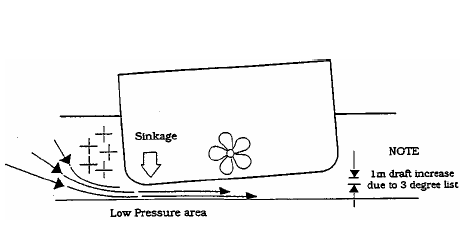
Ship is operating in shallow water it is likely to have considerable effect upon handling, in particular its turning ability. As a rough guide it can be assumed that a ship may experience shallow water effect when the depth of water is less than twice the draft, i.e. the under keel clearance is less than the draft itself. Serious cases of shallow water problems have however been experienced with larger under water clearances, especially at high speeds, sometimes with dire consequences!
To look more closely at the problem we will return to the example ship as shown above, which is fully loaded and on even keel with a draft of 11.6 metres. This vessel is commencing a full starboard rudder turn, with a three metre under keel clearance. Looking at the ship from astern (above figure), it can be seen, as the stern of the ship commences to sweep to port, that water pressure is building up along the port side, abaft of the pivot point due to the restriction under the keel.
Pivot Point (Shallow Water)
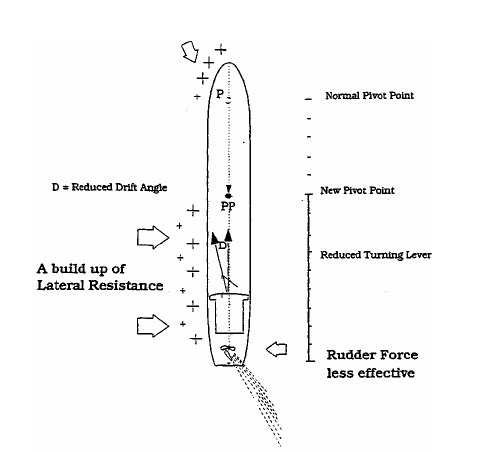
It can be seen that this will seriously upset the previous balance between lateral resistance and rudder force and the position of the pivot point.
In the first instance the rudder force now has to overcome a much larger lateral resistance and is therefore considerably less efficient. A similar thing is happening at the bow, because of the reduced under keel clearance, water which would normally pass under the ship is now restricted and there is a build up of pressure, both ahead of the ship and on the port bow. This now upsets the balance between the ships forward momentum and longitudinal resistance and pushes the pivot point back from P to PP. With the steering, or rudder lever, also reduced the ship is rapidly losing the rudder efficiency enjoyed in deep water.
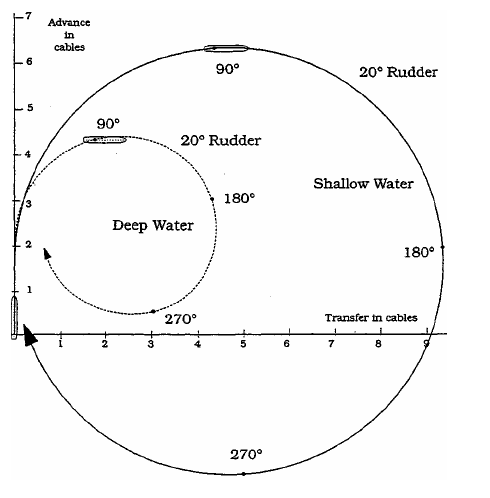
In above figure the deep and shallow water turns are over laid and clearly illustrate the vast differences that exist between the two. If this is encountered without warning, perhaps during a critical turn, it is an experience never forgotten!