Vessel running in shallow water, depth less than twice the draft, an additional obstruction exists which can seriously compound the problem. The ship is running on even keel with a small under keel clearance and, therefore, water which would normally pass under the ship is now severely restricted.
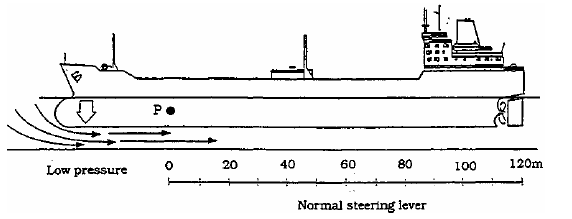
This results in two things, firstly the build of water ahead of the ship, longitudinal resistance pushes, the pivot point back from P to PP and the steering lever is reduced.
Secondly the water being forced under the bow, at a higher speed than normal, creates a low pressure and loss of buoyancy.
The ship will now ‘Squat by the Bow’ which in turn makes the problem even worse. Several cases have been reported of large ships running in shallow water and experiencing bow sinkage of up to 2 metres!
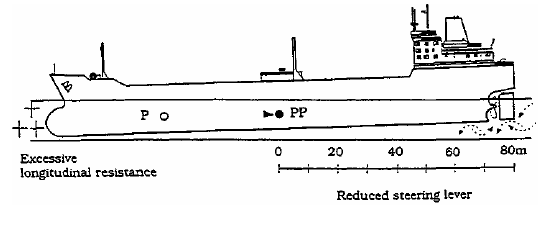
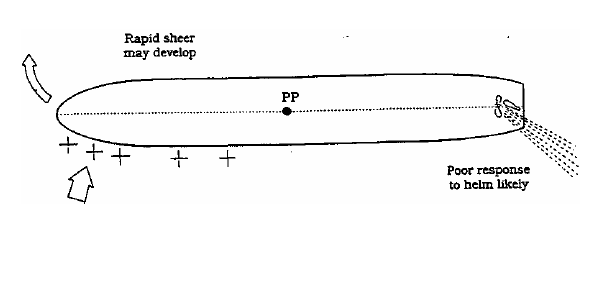
In addition to the possibility of grounding forward there also exists the possibility of losing control and sheering violently out of a channel.
If the helmsman allows a small swing to develop, longitudinal resistance ahead of the ship will be brought round onto the exposed bow, which in turn will encourage a violent swing in the same direction as the helm.
Counter helm to correct the swing may be sluggish because as we have seen, the steering lever is reduced. Once the ship does respond, it may now sheer violently the other way. A chain reaction then sets in, with the ship sheering badly from one side to the other and failing to respond correctly to the helm. The effect can be extremely rapid, with the ship out of the channel and aground in just a few minutes. Excessive speed is the main contributing factor under such circumstance; reduced speeds are essential to avoid such violent forces building up.
Shallow Water
Other problems associated with shallow water effect
It would be wrong to imply that bank effect is only experienced within the domain of canals and rivers with steep sided banks. To a ship running in shallow water, with adjacent but gently shelving mud or sand banks, such as low lying estuarial areas, the effect can be far more insidious and violent.
There are many cases, in the archives of casualty investigation, where groundings and collisions have occurred in such areas, due to drastic loss of control, whilst the ship was under the combined influence of shallow water and bank effect.
One noticeable feature in some of these casualties, is the tendency of the Master to immediately reduce revolutions, or even stop the engine, when faced with the ship sheering the wrong way and apparently failing to respond to progressively larger angles of helm. Whilst this is of paramount importance, if it is evident that grounding or collision is imminent, in other circumstances it is suicide. Hard over rudder and a healthy ‘kick ahead’ are essential to regaining control.
These are of course generalities and every event is dictated by a set of unique circumstances.
It is clear that many ships work daily in shallow water without any problems what so ever, just occasionally however, all the ingredients, shallow water, bank effect, excessive speed, poor trim, come together and combine in an insidious manner to create another casualty.