“The carrier shall properly and carefully load, handle, stow, carry,keep, care for and discharge the goods carried.” Hague Rules, Articles iii, Rule 2
Strength of tank tops, tween decks, hatchcovers and weather-decks
When preparing cargo loading plans, it is important that the ship should be loaded as close as possible to its maximum deadweight or capacity, but it is qually important to consider the implications of loading any high density cargo. In the early stages of planning, it is essential that not only should the physical dimensions of the cargo be established but also the maximum permissible weight which can be loaded into any compartment. I believe that there is a common failure to fully understanding the strength limits of tank tops, tween decks, hatch covers and even weather-decks and that the knowledge of many ship masters in this matter is often superficial.
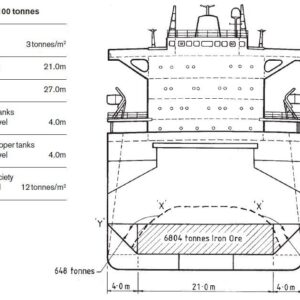
The strength limits which are to be applied to tank tops are calculated and approved by the classification societies. The maximum limits are expressed in tonnes per square metre and are included in the ship’s technical manuals and capacity plans. To calculate the number of tonnes which can be loaded on the tank top without exceeding the limit, the area of the tank top in square metres is simply multiplied by the permissible number of tonnes per square metre. To ensure that the limits are not exceeded the cargo must be spread evenly over the area of the tank top. The volume of the space above the lower hopper tanks should also then be calculated and the figure obtained included in the total quantity to be loaded. A typical calculation might be as follows:
Maximum tonnage to be loaded:
(L)ength x (B)readth x PL (permissible load) = 27 x 21 x 12 tonnes/m2 = 6,804 tonnes
(Where L & B represent the dimensions of the tank top excluding the hopper tanks)
Maximum volume to load:
6,804 tonnes @ 3 tonnes/cubic metre = 2,268 cubic metres
Height of stow:
2,268/567 = 4.0 metres. (n.b. 567 = 27 x 21)
When discrete items are to be loaded such as billets,steel coils, slabs and the like, the committee recommend that the load should not exceed 6,804 tonnes as shown above.
When other homogeneous cargoes are loaded, which may safely be stowed over the hopper tanks, then additional weight may be carried but always with the proviso that the overall height of stow should never exceed the original figure as arrived at above.
In such cases, the amount of weight which can be safely added to the 6,804 tonnes can be calculated by using the formula: 0.5 (l x b x PL) tonnes, where l = the length of hopper tank and b = the horizontal width of tank and PL = permissible load.
Thus if l = 27m and b = 4m then 0.5 (27 x 4 x 12) = 648 tonnes at each side. At 3 tonnes/m3 648 tonnes would occupy 216m3. Over a base area of 108m2 (27 x 4) this would take the height to 2 metres (216/108) or, allowing for the wedge of a 45 degree hopper tank, to 4 metres height.
Thus the final result of the calculation would be that the total weight of cargo to load would be 8,100 tonnes at an overall height of 4 metres.
When making these calculations, masters should consult the Code of Safe Practice for Bulk Cargoes, Section 2.1, pages 7 and 8, Cargo Distribution.
When bulk cargo is poured into a ship’s hold, it tends to form a heap, thereby increasing the load on the tank top towards the centre of the hold. The result is a tendency for the double bottom to sag and for the ship’s sides to be drawn in as indicated in Fig 1.
Such stresses can seriously weaken the ship’s structure. It is possible that the effects of such stowage procedures over a number of years may have contributed to the losses of loaded bulk carriers. During loading, the aim should be to maintain an even distribution of weight both transversely and longitudinally so that the specified tank top limits are not exceeded.
The procedures outlined above are simple, but more complicated situations may arise if breakbulk cargoes are to be loaded where large, heavy pieces of cargo may be offered for shipment. Take for instance, a 200 tonne transformer with base dimensions of 5m x 3m (15 square metres) to be loaded into the hold illustrated in Fig 1. The spot load on the tank top would be 200/15 = 13.3 tonnes per square metre. This load would be excessive if the limit were 12 tonnes per square metre. To spread the load and reduce the pressure to within the specified limits, it is customary to build a grid-like timber frame on the tank top. The timber selected should have its grain running the length of the timber, and be of uniform quality. The area over which to apply the timber can be calculated by dividing the weight of the transformer by the tank top limitation:
i.e. 200 tonnes/12 tonnes per square metre = 16.7 square metres. This would be the minimum area to be covered by the frame. 2″x 2″ and 3″x 3″ timber is commonly used with the loading of many cargoes, especially steel. Square timber of greater cross section is extensively used for supporting heavy lifts.
Fig 1. X = level of surface of stow before trimming Y = level of surface of stow after trimming
Ideally, a complete floor should be constructed with baulks of timber placed next to the steel surface of the tank top having no spaces between the timbers. In practice this would be costly and uneconomical. Whatever procedure is finally adopted is likely to involve compromise, but it is in any case recommended that, with heavy lifts, the baulks used should be of substantial sized timber with cross sectional dimensions of not less than 9 inches (23cm) square. It should be appreciated that there is a possibility that the timber may compress under the applied weight. As an alternative, a steel frame may be used. Before deciding the exact stowage position for a heavy lift it is advisable to check the nature of the hull construction. A heavy lift should be placed with reference to the longitudinal re-inforced structure (longitudinal girders.) The placement of timber baulks should be considered with reference to the internal double bottom structure, always bearing in mind that an important function of dunnage is
to spread the load to the primary structure of the hull.
Where steel cargoes are to be loaded, other complications are likely to arise. When loading steel coils it is usual to load not more than three tiers high with individual coils weighing up to 10 tonnes. If the unit weight is more than 10 tonnes, only two tiers are loaded and if more than 15 tonnes then only one tier is loaded. Usually two lines of double dunnage measuring 6″x 1″ are laid athwartships beween the coil and the tanktop. Applying the formula above, the pressure exerted over the small bearing surface of the lowest coil is about 30 tonnes. Without due care, the customary dunnage may not be sufficient to effectively spread this weight and there is a risk that the tank top will be overloaded beneath each unit. Every possible precaution should be taken to ensure that the spot load does not exceed the limit, bearing in mind that the load spread is improved if the pitch of dunnage is reduced and that the dunnage must be laid across primary structures and must not terminate in between members (i.e. betwee(i.e double bottom longitudinal girders).
The stowage of steel slabs poses similar problems. A typical slab may measure 6 m x 1.25m x 0.25m and weigh 14.75 tonnes. The area of such a slab is 7.5m and when stacked 7 high, there would be 103 tonnes bearing down on the tank top. Assuming the slabs were stowed flat, this would indicate a load of 13.74 tonnes per square metre – 14.5% in excess of a 12 tonne permissible limit. However the lowest slab is likely to be supported by three or four baulks of timber in order to facilitate handling by forklift truck. This means that the entire stack is supported on a maximum of four points, resulting in a tremendous concentration of weight on a small area. Unless larger dunnage is utilised, thereby spreading the load to within satisfactory limits, the tank top is likely to be overloaded when such cargo is loaded in the manner described. Bearing in mind the manner in which steel billets and slabs are usually dunnaged and stowed, it should be realised that little or no weight of that stowage will be distributed to
the sloping tank sides unless special dunnaging arrangements are constructed to do so. It is more likely that the flat tank top area alone, will be supporting the entire cargo weight, even though billet/slab ends/ sides may be touching the plating of the sloping tanks.
Masters are again encouraged to consult the Code of Safe Practice for Bulk Cargoes with particular reference to Section 2.1.2.1 which commences as follows:
“When loading a high density bulk cargo having a stowage factor of about 0.56m3/t or lower, the loaded conditions are different from those found normally and it is important to pay particular attention to the distribution of weights so as to avoid excessive stresses. A general cargo ship is normally constructed to carry materials of about 1.39 to 1.67m3/t when loaded to full bale cubic and deadweight capacity. Because of the high density of some materials, it is possible by improper distribution of loading to stress very highly either the structure locally under the load or the entire hull.”
Within the data provided in that section of the Code, the very densest iron ore has a stowage factor of 0.29m3/t which is considerably lower than the guiding upper limit of 0.56m3/t. Using reported dimensions for billets, their stowage factor may be not greater than 0.25m3/t (allowing for dunnage, margin plate areas, interstitial spacing etc) and on the basis that a mild steel billet will have an inherent density of 7.86t/m3. If it were possible to stow billets without any interstitial spaces, the stowage factor would be 0.127m3/t: thus it can be seen that billets constitute a very heavy cargo which stows denser than the densest iron ore.
In purpose-built container ships the tank tops and double bottoms’ structures are specially strengthened where container corner castings are to be positioned. Here, the guiding principle is the stack weight, where 4, 6 or even 9 units per stack are involved. When containers are carried in the holds of non-purpose built vessels, such as general cargo ships and bulk carriers, great care must be taken to use adequate dunnage to spread the point loading at the corner castings, generated by the stack load. For instance, a single stack of 2 x 20ft x 20 tonne units will exert a down loading of 40 tonnes. Beneath each corner casting, the point loading will be about 345t/m2. Failure to appreciate the magnitude of such stresses has sometimes resulted in tank tops becoming pierced, followed by flooding of the hold by fuel oil or ballast water.
Summary
When loading high density cargoes there is a risk of overloading tank tops and proper precautions should be taken. Provided that the tank top is not overloaded, the pressure on the hopper tanks should be within acceptable limits, but in any case, if the density of the cargo is sufficiently high, the surface level of the stow will be below the upper limits of the sloping sides and no problems should arise. When high density bulk cargoes are loaded, the cargo should be levelled to ensure an even pressure over the tank top. Heavy lifts require plenty of strong, good quality dunnage, laying as much dunnage as feasible on the tank top, in order to spread the load evenly. The tank top limitations are laid down when the ship is built and provided that the structure remains within class specifications, remain unchanged throughout the life of the ship. If through damage or wastage, the structure is reduced, then reduced limitations may well have been imposed as a condition of class.
Masters should be aware that tween decks can collapse even when overloading is marginal. There are no safety factors and all cargo must be carefully trimmed. Where ships are fitted with twin hatchways, (port and starboard) the cargo should be loaded in equal quantities on each side, unless there are specific instructions in shipyard plans which dictate otherwise.
Weather-decks and hatchcovers
Similar caution should be exercised when loading heavy cargo and containers on weather-decks and hatchcovers.
Unless the weather-deck has been specially strengthened, it is unlikely to have a loading limit in excess of 3 tonnes per square metre. Similarly, unless hatchcovers have been specially strengthened, it is unlikely that they would have a limit greater than 1.8 tonnes per square metre; maybe half that value in vessels less than 100m in length. Hence, it is of great importance to consult and confirm the relevant data from the ship’s documentation. When exceptionally heavy cargoes are to be carried, it may be necessary to shore up the weather-deck from below, but in such cases care should be taken to ensure that the load on the tween deck plating is properly spread. It is always prudent not to load up to the maximum permissible limit on weather-decks but to err on the safe side, given that heavy seas may be shipped in these areas. It is good practice to add 5% to the weight to be loaded before calculating the dunnage area.
In line with earlier advice given elsewhere, the Committee is of the general view that containers should be stowed on deck two or more high only on those ships which have securing arrangements specially provided. At no time should the deck-loaded containers overstress the hatchcover or the hatchway structure. In cases of doubt, details of stress limitations should be obtained from the classification society. As mentioned above, where bulk carriers or dry cargo ships are being used for the carriage of containers on the weather-deck and/or the hatchcovers, it should be borne in mind that it is the stack weight and the resultant point loading beneath the corner castings which must be taken into consideration. This criterion addresses not only structural capability but also the ability of the lower tiers of containers to support the superincumbent weight.
Where containers are to be stacked two or more tiers high, on the hatchcovers or weather-deck, the base tier should be provided with permanent footlocks for the lower corner castings. The containers should be secured one above the other by means of twistlocks and/or lockable inter-layer stackers and the upper corner castings of a block of units should be locked into each other transversely by means of screw-bridge fittings and/or tension clamps. Containers so carried must be treated as ‘deck cargo’ and secured in accordance with the deck cargo rules and recommendations. In other words, the total holding power of the lashing arrangements, properly disposed and attached to appropriate terminal points, should be not less than three times the static gross weight of the containers and contents.
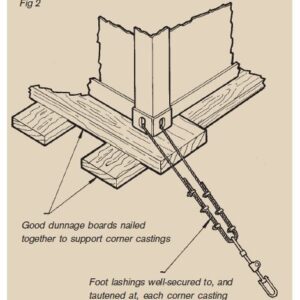
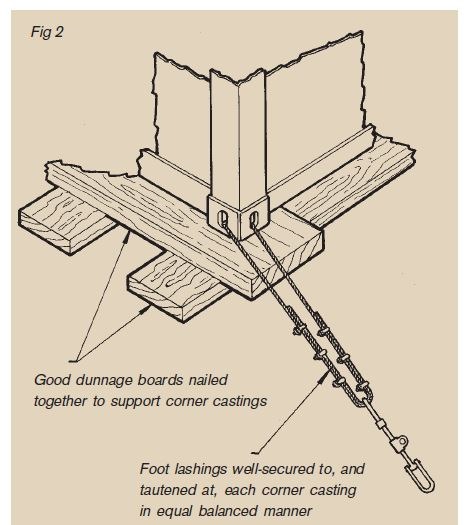
If circumstances demand a twin tier stack in the absence of footlocks or welded restraints, then properly rigged foot lashings should be used. The units must be twist locked together and lashed as indicated above. In such instances, the correct use of dunnage, both as to size and application, beneath the base corner castings, is of paramount importance, as illustrated in Fig 2 for instance.