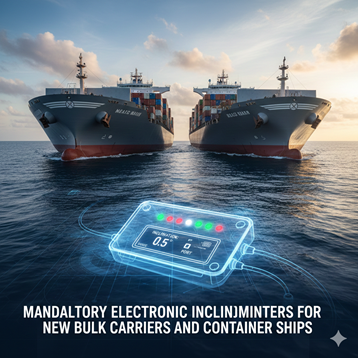
To strengthen ship stability monitoring and improve safety at sea, the International Maritime Organization (IMO) has introduced mandatory requirements for electronic inclinometers on certain new ships. These requirements aim to prevent stability-related accidents and give masters real-time heel and roll information to support decision-making during operations and emergencies.
What Is an Electronic Inclinometer?
An electronic inclinometer is a device that continuously measures a ship’s:
- Heel angle (side-to-side tilt)
- Roll motion (amplitude and period)
- Dynamic stability behavior
Unlike traditional pendulum-type devices, electronic inclinometers provide continuous digital data, which can be displayed on the bridge, recorded, and used for operational safety, incident analysis and compliance.
New IMO Requirement — When Does It Apply?
The requirement forms part of SOLAS Chapter V – Safety of Navigation, introduced through recent amendments.
Mandatory From:
- 1 January 2026
Applies To New:
- Bulk carriers of 20,000 GT and above
- Container ships of 3,000 GT and above
All new ships of these types contracted on or after 1 January 2026 must be fitted with a compliant type-approved electronic inclinometer.
Why Electronic Inclinometers Were Made Mandatory
Stability-related accidents — such as sudden cargo shift, parametric rolling, loss of containers, and structural damage — have highlighted the need for continuous roll and heel monitoring.
Key drivers for the mandate include:
- Increasing parametric rolling incidents in large containerships
- Sudden stability loss in bulk carriers due to cargo liquefaction or asymmetrical flooding
- The need for real-time alerts for dangerous heel or roll
- Better data for voyage planning and storm avoidance
- Improved post-incident analysis
Electronic inclinometers help bridge teams recognize early warning signs of dangerous motion and take corrective action.
What the System Must Provide (Functional Requirements)
Per the SOLAS amendments and associated performance standards, the device must:
1. Measure and Display
- Heel angle
- Maximum roll angles
- Roll period
- Roll amplitude
2. Provide Alarms/Alerts
- Warning when heel or roll exceeds safe preset limits
3. Record and Store Data
- Continuous data logging
- Minimum storage period (set by IMO guidance)
- Download capability for incident analysis
4. Integration Capabilities
- Interface with bridge navigation systems
- Output data to VDR (Voyage Data Recorder)
5. Environmental and Technical Compliance
- Type-approved under IMO performance standards
- Tested for vibration, temperature, humidity, electromagnetic compatibility, etc.
Operational Benefits for Ships and Crew
Installing an electronic inclinometer delivers significant safety and efficiency benefits:
• Early Warning of Unsafe Rolling
Bridge teams can identify abnormal roll motion before it reaches dangerous levels.
• Better Decision-Making in Heavy Weather
Data supports decisions such as altering course, speed, or avoiding parametric roll zones.
• Support for Onboard and Shore-Based Monitoring
Operators can analyze vessel behavior to optimize stability management and hull stresses.
• Compliance with Modern Safety Requirements
Demonstrates a proactive approach to safety management (ISM Code alignment).
• Valuable Data for Problem Cargoes
Useful when carrying liquefaction-prone cargoes (nickel ore, bauxite, iron-ore fines, etc.).
Who Must Take Action Now?
Shipyards / Owners of Newbuildings
- Ensure design specifications include IMO-compliant electronic inclinometers
- Integrate with bridge and VDR systems early in design
Equipment Suppliers
- Confirm type approval according to latest IMO standards
- Provide installation manuals and crew training packages
Class Societies
- Review design submissions
- Verify performance during initial surveys
Conclusion
The mandatory installation of electronic inclinometers marks a major step forward in the IMO’s efforts to reduce stability-related accidents on bulk carriers and container ships. These devices provide vital real-time information, improve situational awareness, and support safer navigation in challenging conditions.
As the 2026 implementation date approaches, shipbuilders, owners and operators should ensure their new vessels are fully compliant and equipped with reliable, type-approved systems.