Bank Effect Introduction
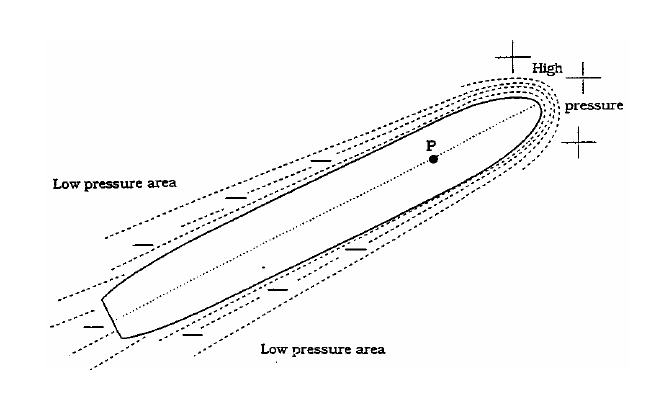
The problem in its most simplistic form is the boundary layer of water that surrounds a ship when it is making headway. Forward of the pivot point a positive pressure area builds up whilst aft of the pivot point the flow of water down the ship’s side, creates a low pressure area.
This area extends out from the ship and in deep open water clear of other traffic is not a problem.
Bank Effect Problem
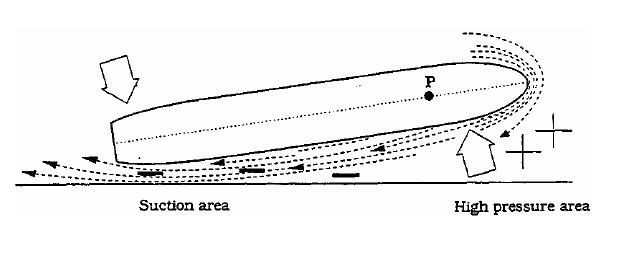
If, however, the ship commences to close a vertical obstruction, such as a shoal or canal bank, the area experiences some degree of restriction and the ship will be influenced by the resultant forces which build up.
It is often thought that the positive pressure at the bow is the main problem, probably because of the tendency to relate most channel work to the bow and heading.
Looking at figure it can be seen that whilst pressure at the bow is important it is only working on a short turning lever forward of the pivot point. The low pressure or suction area is, on the other hand, working well aft of the pivot point and consequently is a very strong force.
Ship to Ship Interaction
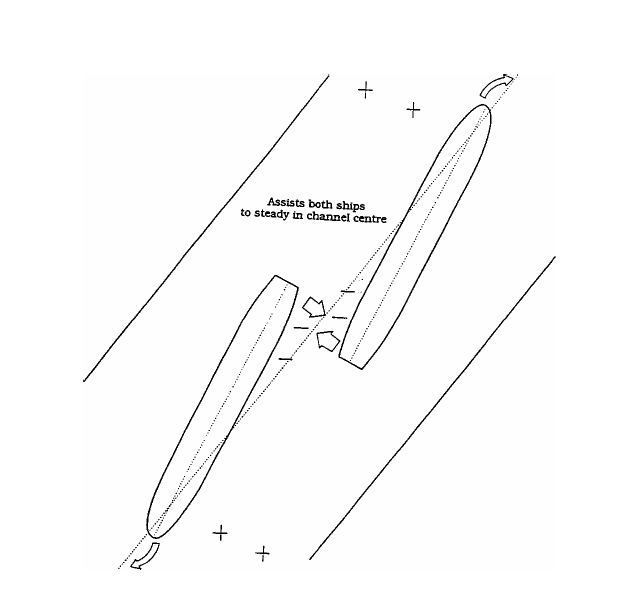
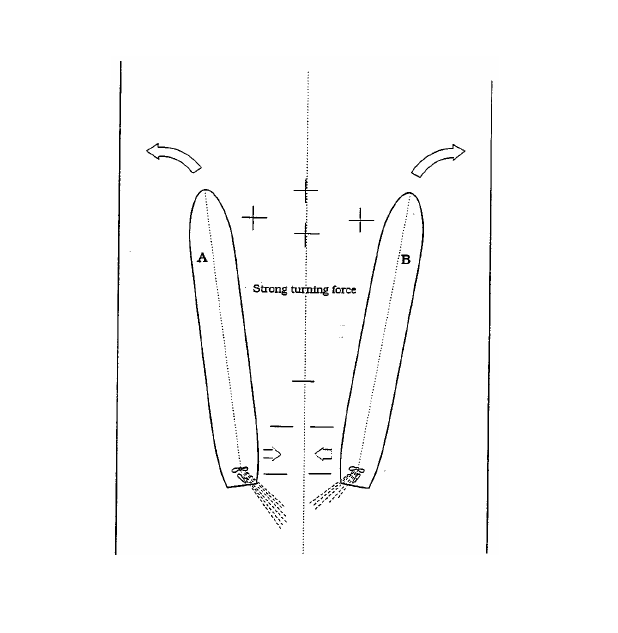
Passing- Stage 1
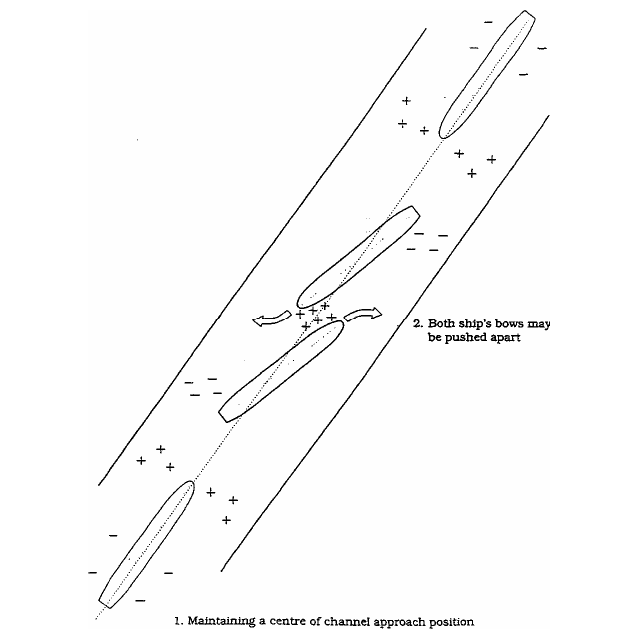
Passing- Stage 2
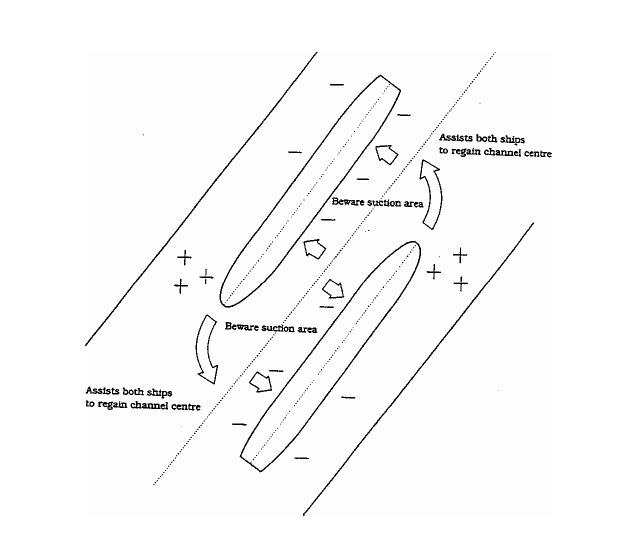
Passing- Stage 3
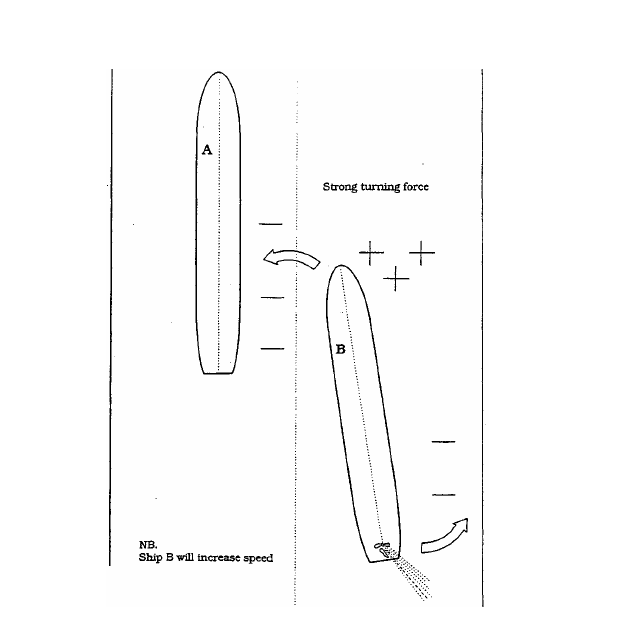
Overtaking- Stage 1
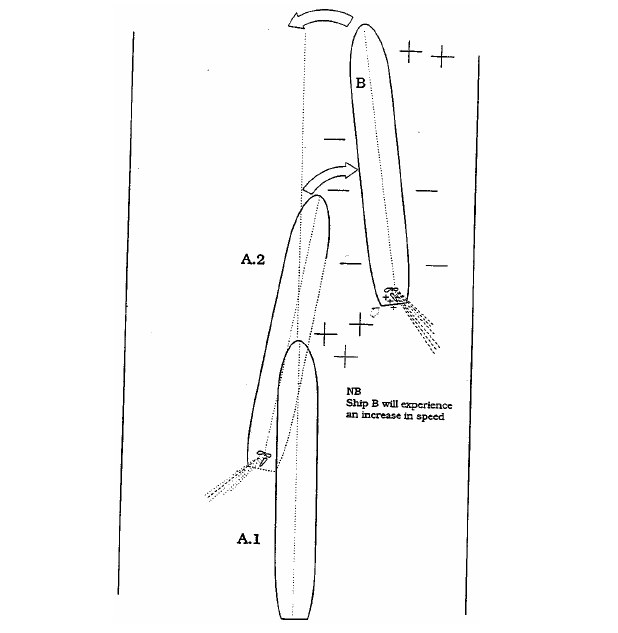
Overtaking- Stage 2
Overtaking- Stage 3
The following general points should be noted.
- Prior to the manoeuvre each ship remains in the centre of the channel for a long as possible. Failure to do so, could expose either ship to bank effect, leading to a sheer across the path of the oncoming ship or grounding.
- Speed should be low to reduce the interactive forces. There is then, plenty of reserve power for corrective ‘kicks ahead’.
- If the ships pass from deep to shallow water, at any time during the manoeuvre, the forces will increase drastically and extreme caution should be exercised.
- The smaller of two ships and tugs, are likely to be the most seriously affected. Large ships should be aware of this and adjust their speed accordingly.
- Figures above illustrate the anticipated sheers that may develop throughout each manoeuvre and the maximum corrective helm that may be required, in this case 35°.
- The engines should be brought to dead slow ahead for the manoeuvre, particularly turbine or fixed pitch propeller ships,so that power is instantly available to control the ship with ‘kicks ahead’.
- On completion of the manoeuvre each ship should regain the centre of the channel as quickly as possible to avoid any furtherance of bank effect.