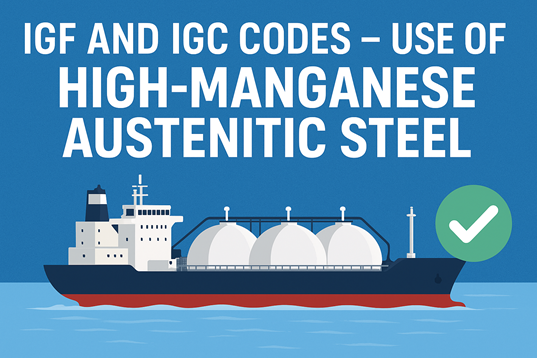
Enhancing Safety and Innovation in Gas-Fuelled and Gas-Carrier Ship Designs
To support the global transition toward cleaner fuels and safer gas cargo transport, the International Maritime Organization (IMO) has updated the IGF Code (International Code of Safety for Ships Using Gases or Other Low-Flashpoint Fuels) and the IGC Code (International Code for the Construction and Equipment of Ships Carrying Liquefied Gases in Bulk).
One of the most notable developments is the formal acceptance of high-manganese austenitic steel as an approved material for cryogenic service.
This breakthrough allows shipbuilders and gas-fuel system designers to adopt a cost-efficient, safe, and high-performance alternative to traditional cryogenic steels such as nickel-alloy steels.
What Is High-Manganese Austenitic Steel?
High-manganese (high-Mn) austenitic steel is an advanced metallurgical material containing:
- 15–30% manganese
- Low carbon content
- Austenitic microstructure, stable at cryogenic temperatures
It offers excellent toughness, ductility, and crack resistance, even at extremely low temperatures such as:
- LNG at −162°C
- LH₂ and LPG temperatures
- Other cryogenic fuel/cargo conditions
Why Did IMO Allow High-Manganese Steel?
Traditionally, cryogenic tanks and piping were dominated by:
- 9% nickel steel
- Aluminum alloys
- Stainless steel grades
Although effective, these materials come with high cost and limited supply.
High-manganese steel offers equivalent or superior performance at a significantly lower cost, while meeting safety standards for:
- Impact resistance
- Fracture toughness
- Corrosion resistance
- Weldability
Key Regulatory Developments
IGF Code Amendments
The IGF Code governs ships using natural gas or low-flashpoint fuels (e.g., LNG-fuelled ships).
Updates now permit high-Mn steel for:
- LNG fuel tanks
- Piping for gas supply systems
- Secondary barriers
- Fuel containment structures
IGC Code Amendments
The IGC Code applies to LNG, LPG, and other liquefied gas carriers.
Revised provisions allow high-Mn steel for:
- Cargo containment systems
- Cargo tanks (Type A, B, C)
- Cargo pipelines
- Refrigerated gas handling systems
Advantages of High-Manganese Austenitic Steel
1. Excellent Cryogenic Toughness
Remains ductile and impact-resistant at -196°C, making it suitable for LNG and other cryogenic cargo.
2. Lower Material Cost
Significantly cheaper than nickel-based cryogenic alloys, reducing shipbuilding costs.
3. High Strength and Fatigue Resistance
Improves long-term structural integrity of tanks and fuel systems.
4. Weldability and Fabrication Efficiency
Easier to weld and fabricate, reducing labour costs and construction complexity.
5. Strong Safety Performance
Tested rigorously for:
- Brittle fracture
- Crack propagation
- Corrosion
- Structural stability
6. Wide Availability
Manganese is more abundant globally than nickel, reducing market volatility.
Approved Applications Under the Codes
Both IGF and IGC Codes now allow high-Mn steel for the following:
✔ Type A, B, C cargo tanks
✔ LNG fuel tanks (membrane or independent tanks)
✔ LNG and LPG cargo pipelines
✔ Secondary barriers for membrane tanks
✔ Components of fuel supply systems
✔ Vacuum-insulated cryogenic systems (case-by-case)
Each application requires:
- Material testing to recognized cryogenic standards
- Welding procedure approvals (WPS/PQR)
- NDE examinations
- Compliance with classification society rules
Industry Impact
The acceptance of high-manganese steel under the IGF and IGC Codes has major implications:
✓ More affordable LNG-fuelled ships
A major boost for decarbonization, enabling wider adoption of LNG as a transitional fuel.
✓ Competitive advantage for shipyards
Lower construction costs and simpler fabrication processes.
✓ Increased demand for high-Mn steel production
Major steel manufacturers are scaling up production globally.
✓ Enhanced safety standards
Comprehensive testing ensures equal or superior safety performance compared to traditional materials.
Challenges and Considerations
Despite its benefits, designers must still address:
- Validation of welding performance
- Compatibility with insulation and barrier materials
- Quality control during plate manufacturing
- Approval from classification societies (ABS, DNV, LR, BV, etc.)
Conclusion
The IMO’s inclusion of high-manganese austenitic steel in both the IGF and IGC Codes marks a major advancement in ship construction and cryogenic fuel/cargo handling.
This material offers a powerful combination of safety, affordability, and performance — supporting global decarbonization and the increasing use of LNG and other cryogenic fuels.
It is expected to become one of the leading materials for next-generation gas-fuelled ships and LNG carriers.