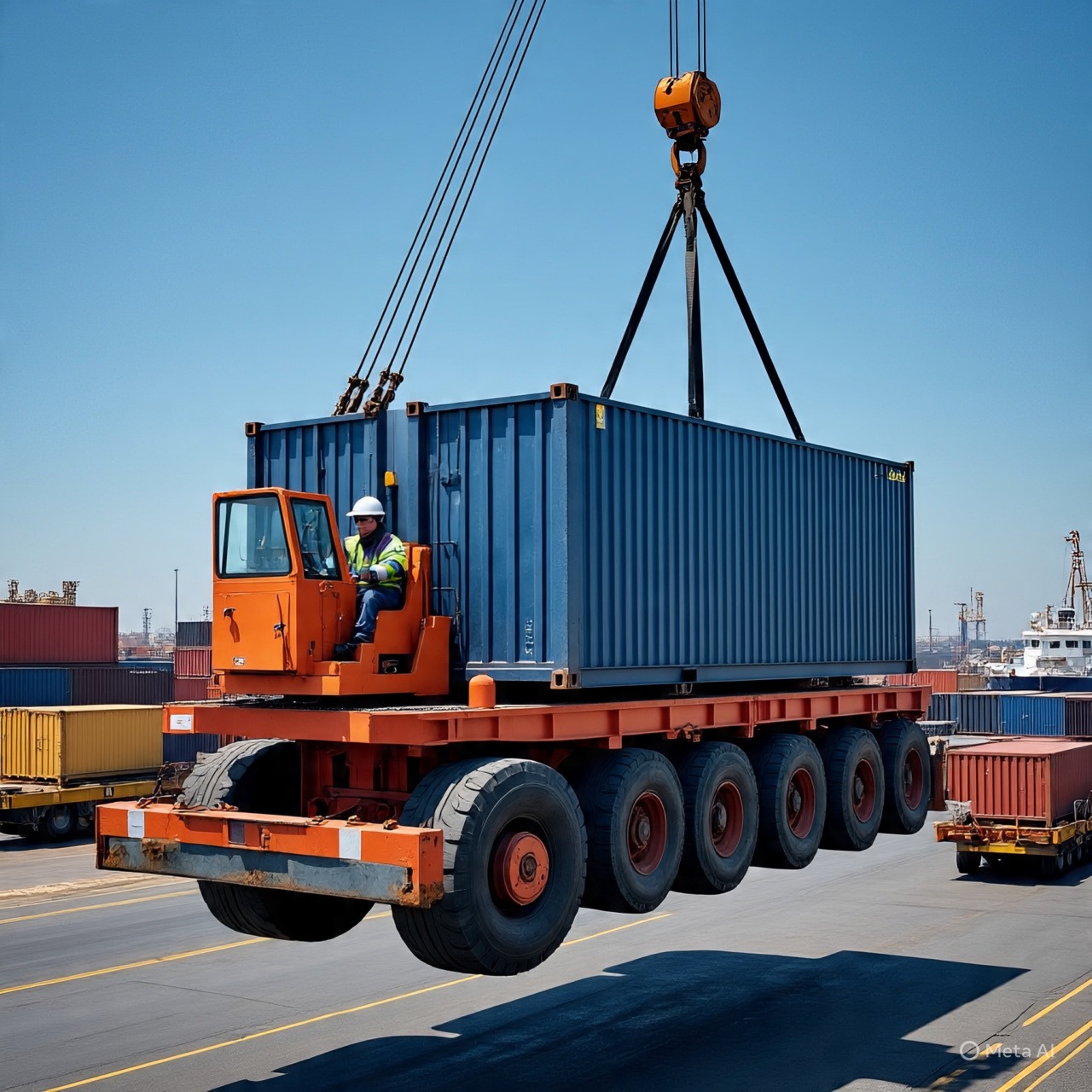
Heavy Lift – Cargo heavier than the SWL of the vessels gear.
It cannot be lifted by the ship’s gear in the normal mode and requires special rigging.
Due care should be exercised during planning the stow, loading and securing so that the safety of the personnel, cargo and vessel is not jeopardized
Planning the stow
Nature of the cargo:
– Stowage can be below deck or on deck, depending on the nature of the cargo.
– If the cargo is unlikely to be damaged due to moisture and weather, then it can be planned to be stowed on deck
– If IMDG cargo, it may have to be stowed on deck
– The dimensions of the cargo becomes a factor to decide if it can be stowed on deck or under deck, as it may not fit under deck.
– If it is decided to stow under deck, it has to be loaded on the square of the hatch, and it cannot be moved to the fore and aft or the sides.
– If the cargo is on wheels it can be loaded on the square of the hatch and then moved to the sides.
Stability of the Vessel
-If loaded on deck, ensure that departure stability condition of the vessel has been calculated and checked to be within permissible limits.
View from the bridge
-Stowage and height of the cargo to be such that it does not obstruct the view from the bridge.
-IMO criteria- View of the sea surface from the bridge should not be obscured by more than 2 ships length or 500 mtrs whichever is lesser, forward of the bow to 10 deg on either side, irrespective of the ship’s draught or trim.
Disport Facilities
-Check if in the disport, has facilities to discharge the cargo. If vessel has loaded with shore crane then it is important to check if the disport has the proper gear to discharge the cargo.
Acceleration
-Heavy lifts to be stowed in the place where the acceleration due to the motion of the vessel is least.
-Pitching and rolling results in change of direction during motion . This is called acceleration.
-Force= Mass X acceleration. Hence the total force acting on the lashings when the ship is in motion is increased.
-Choose a place where there is least acceleration. You will find the details in Chapter 5 of cargo securing manual.
Load density
-The load density of the deck should be such that it will be able to carry the weight of the cargo.
-If load density is not sufficient, the weight can be spread by laying dunnage.
-Allow for 5% weight for heavy seas that may be shipped on deck.
Use of dunnage
-Dunnage can be used to spread the load and create friction between the deck and the cargo.
-Choose dunnage of max width and grains are straight .
-Lay the dunnage such that grains are parallel to the deck.
-3 inch thickness dunnage may be used. If not available achieve the thickness by use 1 inch thick dunnage nailed together.
-There have been instances where the cargo was well secured, but unfortunately the dunnage was laid along the curved grains. During the voyage the dunnage gave way and the lashings got slackened and the cargo was damaged.
Securing Points
-While planning the stowage of heavy lifts, the availability of securing points such as deck eyes and eye pads to be considered.
-Consult the cargo securing manual for designated securing points and strength of the same.
-Also the securing points on the cargo should be identified and checked suitability.
-The eye pads welded on the cargo should not be assumed to be the securing points as they may be for road transportation.
Precautions prior to and during loading of heavy lift
-The vessel must be upright
-The stability of the vessel must be calculated taking into account the weight of the cargo plus slings and the height of the derrick head.
-All ballast tanks to be pressed up
-All the moorings to be tended and tightened and barges alongside to be cast off.
-The chosen place of storage to be cleaned and dried and clear of oil
-Dunnage area calculated taking into account the load density of the deck and the weight of the cargo + 5% of heavy seas.
-Dunnage should be laid making sure that the grains are parallel to the deck
-Ensure rigging is as per rigging plan
-Winch drivers and signal man should be experienced
-The area of operation to be cleared of persons not required for the operation
-Slew the derrick to its full reach and back to ensure that the heel fittings are free and the guy leads are clear
-Check if the sling used is appropriate for the load being lifted
-Verify the slinging points on the cargo
-Connect up the sling to the cargo
-Winches to be put on double gear where appropriate
-Attach a steadying line to the heavy lift.
Importance of securing
-The heavy lift damage and loss overboard is caused due to the following reasons
-Severe adverse weather conditions
-Lack of appreciation of the various forces involved
-Ignorance of the relevant rules and guiding recommendations
-Insufficient time and personnel allowed to complete lashings prior departure
-Dunnage not utilized and laid in proper manner
-Inadequate strength and number of lashings
-Incorrect methods of using bull dog grips
-Taking lashing materials around unprotected sharp edges
-While lashing you must take into consideration the motions of the vessel and the consequent accelerations.
-The rolling period of the vessel is an important indicator to plan the strength of lashing.
-A stiff vessel will have violent roll and the accelerations generated will be enormous.
-The cargo should be secured under the supervision of an experienced and knowledgeable person
-Lashing s to the done assuming that the vessel is going to encounter severe weather on the very night of departure
-Vessels cargo securing manual to be consulted to plan the securing arrangement.
-The lashings should be able to withstand a rolling of 30 deg in a 13 sec rolling period
-The cargo shifts before it lifts. Hence tie it down well.
-The lashings should be short and the tension should be equal in all the lashing wires
-Do not mix different lashing materials for a single cargo.
-Use bull dog grips rather than soft eyes. Ensure correct use of bull dog grips
-Eye splices will be time consuming and the strength of the wire in the tucked area will be reduced upto 80%. Bull dog grips can achieve upto 90% of the holding power.
Bull Dog Grips
-Spacing of bull dog grips should be 6 times the diameter of the wire
-The saddle part of the grip should be on the live ( working / hauling ) part of the wire. In other words, the U bolt should be on the dead end. Refer Code of safe working practice for Merchant seaman.
-The grips should be greased to make it effective.
-While tightening the grips, you should be able to see the visible compression of the wire by the grips
-It is advisable to make an eye and leave it overnight before use
The number of grips should be as per the dia of the wire.
Upto 19 mm – 3 grips
19 mm to 32 mm – 4 grips
32 to 38 mm – 5 grips
38 to 44 mm – 6 grips
Over 44 mm – 7 grips
Strength of Lashings:
-When severe weather conditions of wind force 6 and above and the associated wave heights are encountered at least for the part of the voyage, then
-Lashings used to secure cargo or vehicles should have a breaking load of atleast 3 times the design load.
-The design load = Total weight of cargo + acceleration of
0.7g athwartships
1.0 g vertically
0.3 g longitudinally
HOLDING POWER(S)
Vertical holding power
-The total holding power ( in tones) of all the lashings holding the cargo vertically down on the deck shall be equal to 3 times the static weight of the cargo in tones.
-i,e for a 10 tonne cargo, the total holding power of the lashing shall be 30 tonnes
Athwartships holding power
-The holding power ( in tones) of all the lashings preventing the cargo moving from port to starboard should be equal to 70% of the vertical holding power.
-I,e for 10 tonnes cargo – athwartship lashings shall be 21 tonnes
Longitudinal holding power:
-The holding power ( in tones) of all the lashings preventing the cargo moving fore and aft shall be 30% of the vertical holding power.
-I,e for a 10 tonnes cargo – longitudinal holding power to be 9 tonnes.
Best place to load
-Best place is where extra strengthening is provided by:
-Longitudinals, plate floors.
-Solid floors or transeverses.
-Examples: along longitudinal center girder, lower hold abaft machinery space.
-Load density not to be exceeded.
-In the hatch, in preference to on deck because of larger GM.