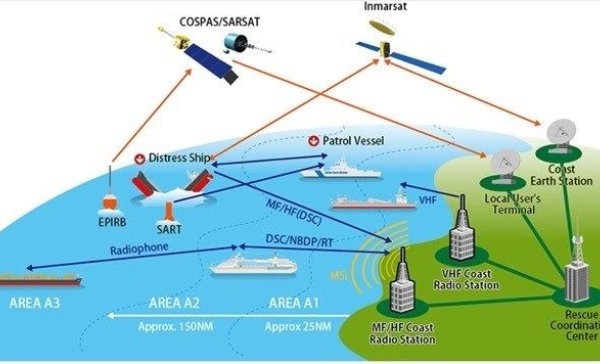
Distress is the most serious form of emergency and means that a vessel, aircraft, person or the environment is in grave and imminent danger and requires immediate assistance.
A distress signal, also known as a distress call, is an internationally recognized means for obtaining help.
Distress signals at sea are defined in the international regulations for preventing collisions at sea and in the international code of signals.
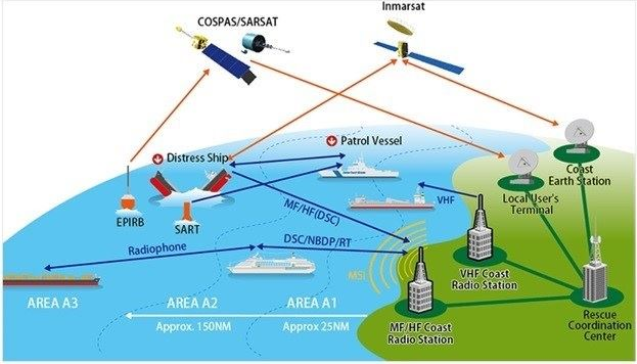
Distress signals are communicated by:
- Transmitting radio signals,
- Displaying a visually observable item for illumination,
- Making a sound audible from a distance.
Lets read and understand about following below module:-
GMDSS : Global Maritime Distress and Safety System
EPIRB: Emergency Position Indicating Radio Beacon
SART: Search and Rescue Transponder
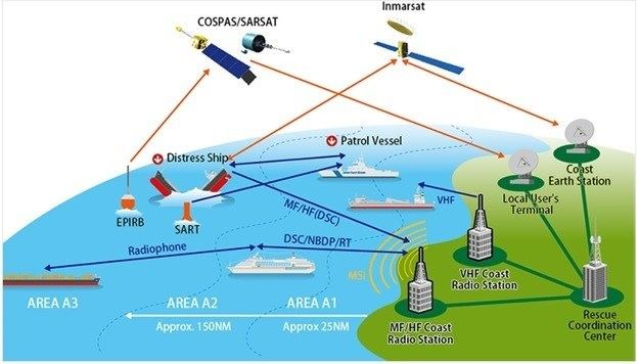
In addition, the system alerts vessel in the immediate vicinity and provides improved means of location survivors.
GMDSS was developed through the International Maritime Organization (IMO) and represent a significant change in the way maritime safety communications are conducted.
GMDSS distress and safety calls using digital selective calling (DSC) frequency is 2187.5 khz.
While it is mandatory for all ships subject to the international convention for the Safety Of Life At Sea (SOLAS) (cargo ships 300 gross tons or greater and all passenger vessels, on international voyages), GMDSS will impact on all radio equipped vessels, regardless of size.
EPIRB: Emergency position indicating radio beacon
An emergency position indicating radio beacon or EPIRB is a safety device carried by a vessel to alert search and rescue services and allow them to quickly locate you in the event of an emergency
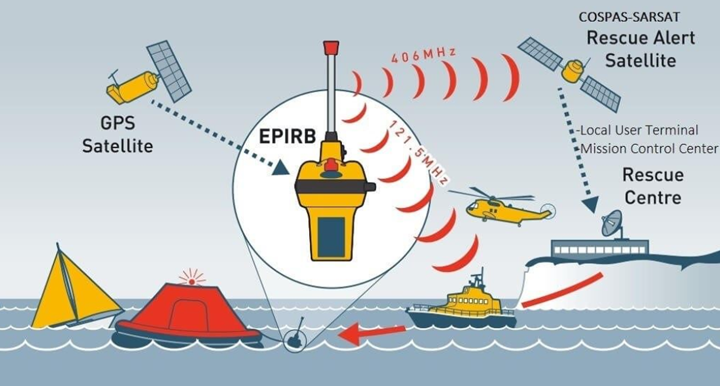
It does this by transmitting a coded message on the 406 MHz distress frequency via satellite and earth stations to the nearest rescue coordination center.
An EPIRB usually works on 406 MHz and can be manually or automatically activated and some models are also water activated.
SART : Search and Rescue Transponder
SART or Search And Rescue Transponder, is an extremely vital equipment on the ship as it perfroms the job of a signal- man.
SART is made of fibre reinforced international orange colour plastic, capable of floating free of the survival craft.
It is a vital machine during distress for it helps in locating the position of the vessel in case it goes off-track.
A SART has a received that detects the signals from X- band radars (9.2-9.5 GHz) from rescue ships.
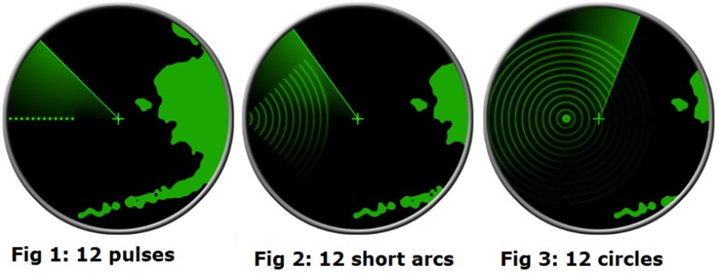
If the SART detects a radar signal it immediately transmits twelve pulses on the same frequency.
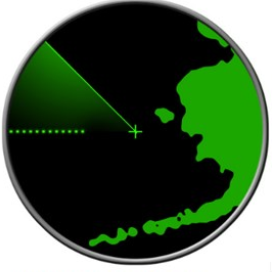
This signal is seen by the radar as “echoes” and will be displayed on the screen of rescue vessel as a series of twelve dots with a gap of 0.6 miles between them.
The first dot is at the position of the SART and the others go in a straight line towards the edge of the screen.
If the rescue vessel approaches the SART, the twelve dots will become short arcs.
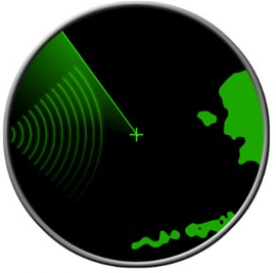
These arcs increase in size if the vessel gets closer. If the rescue vessel is very close, the SART will be activated permanently by the side lobes of the radar antenna.
The signal of the SART will then be visible as twelve complete circles on the radar screen.
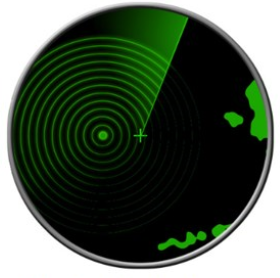
This will tell the search –and –rescue team that they have more or less arrived. On the survival craft SART’s audible tone informs survivors that assistance may be nearby.
All GMDSS vessels carry SART.