Abort point is the final point at which a ship can take action to avoid passing the point of no return. It is the point after which there is insufficient sea room to safely turn the vessel and return back.
Point of no return is the position after which the ship is committed to proceed on voyage.it will be the position where the ship enters water so narrow that there is no room to return or where it is not possible to retrace the track due to a falling tide and insufficient UKC.
Having passed the abort position and point of no return, the bridge team still needs to be aware that events may not go as planned and that the ship may have to take emergency action. Contingency plans such as marking of Contingency anchorage will have been made at the planning stage and clearly shown on the chart, so that the OOW does not have to spend time looking for and planning safe action when his duties require him to be elsewhere.
Where to mark abort point?
We need to mark abort point only when approaching a port, harbour canal or such restricted areas.
For example,while passing Singapore Strait, we do not need to mark abort point anywhere, unless you are in a VLCC/ ULCC. If we need to turn back, we have all the time to assess the situation while we continue towards the general traffic flow in the TSS.
How to mark abort point?
To safely swing the vessel and return back, there are two things to know. If rudder is put hard over, what will be the distance of vessel’s head reach and Side reach on the side of the turn. This area should be clear for the vessel to turn around safely.
Though not exactly but the head reach is quite close to the “advance” of the vessel and side reach is quite close to “tactical diameter“.
Maximum Advance & Tactical Diameter can be found from the Turning circle data provided in manoeuvring booklet or Wheel house poster. As the abort point will most likely be marked in lesser depths, use the data for shallow water.
Take the value of tactical diameter or advance whichever is greater. Double this value to allow for external factors like current and wind which can affect the head reach and side reach. Take the additional distance that the ship would cover in 5 minutes to allow for some time in analysing the traffic around before OOW starts to turn the ship.
In example, if maximum value is of tactical diameter as 0.4 NM. Vessel has planned a speed of 6 knots while approaching a port. In 5 minutes, ship would cover around 0.5 NM. So,it all adds up to be 1.3 NM (2 x 0.4 + 0.5) distance for marking the abort point.
Now mark the abort point at such a position close to the entrance of the port that has 1.3 NM clear distance in the forward as well as on the sides as per diagram.
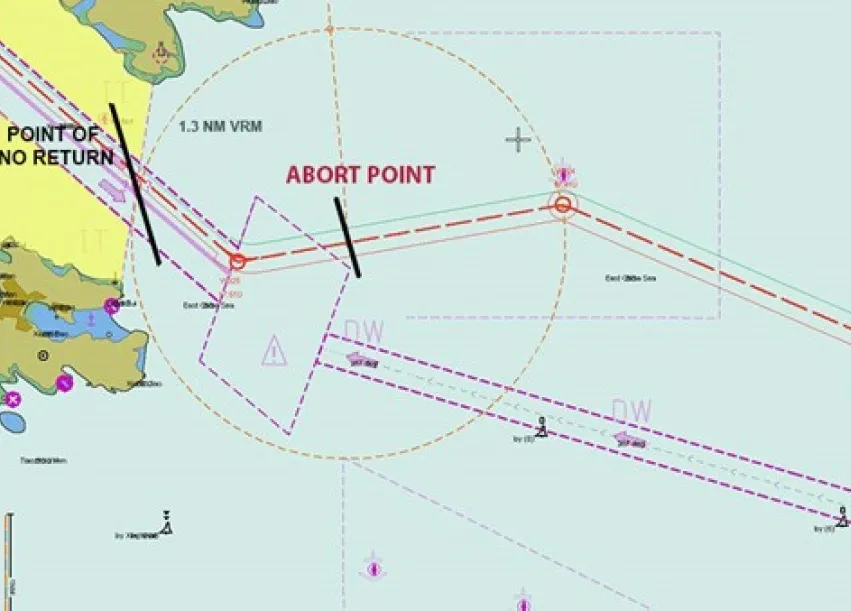
Point of No Return
PONR is the position after which the ship is committed to enter the restricted area and can’t re-track on her passage.
It should be clear that “point of no return” is different from the “abort point”. After Vessel crosses abort point, she still can turn around.
There are number of resources to help such as use of engine, bow thruster or tugs, etc. But after she crosses “point of no return”she cannot return back, even if she uses all these resources.
Two scenarios of PONR:
1. – Mouth of narrow channels –Point after the Abort point marked before; as once vessel reaches there, she will have insufficient sea room to turn back at all even after using resources.
2. – Moving in a falling tide.Vessel may have crossed a point after which if she can’t immediately proceed back due to tidal window.
COMMON ISSUES WITH ABORT POINT
(A) Marking Abort point after Pilot boarding Ground
Abort point should be marked as per calculations irrespective of location of Pilot boarding Ground (PBG). However, if Abort point is before PBG, to pick up the pilot, vessel will need to cross the abort point. What if after vessel crosses abort point, port control informs that the pilot is cancelled for the day? Vessel cannot safely turn around as she has already crossed abort point. Hence, if vessel ever needs to cross the abort point to pick up pilot, she should be ready for any situation as mentioned above and should have steps ready to mitigate that.These steps could include:
· Waiting at or before ship’s abort point position and asking the pilot to come to your position; or
· Proceed at a very low speed so that you can use astern movement to stop the ship and turn around
· Have the bow thruster ready if that is fitted on board.
(B) Not used as reference point
Can vessel turn after passing abort point?
– Yes. There area number of ways such as with judicious use of engines and bow thruster, etc.to reduce the turning circle.
Can OOW be sure of sufficient sea room at abort point?
– No, thought here will be no shallow patch, there could be a number of ships on both sides of your vessel and you may not be able to achieve the turn at that point.
The idea of the abort point is to have an indication as to when vessel can or cannot turn back just by putting the rudder hard over.It is to be used as useful information and not as a blind fact that vessel can surely turn or cannot turn before or after abort point. This is where,professional acumen of the navigator comes into play. Abort point is an important information that along with other information helps the navigator take wise decisions.
(C)The abort point marked too close to the danger:
There may not be sufficient sea room to swing may provide false senses of safety and lead to vessel running aground in emergency.
(D) The abort point marked too far from danger:
This information is of no use to OOW as even after passing Abort point vessel will have sufficient sea room for safe turning.
(E) Marking abort line instead of abort point:
If we draw a line marking the abort point position, it can give the wrong impression. when the vessel is off- track. It will look like Vessel is still behind the abort point and may make turn safely, while it may not be the case. So, OOW needs to mark abort point the way a point should be marked such as showing this position by a very small dotted line or by pointing to that position by an arrow.
What aviation documents describe PONR?