Method for Using Bollards
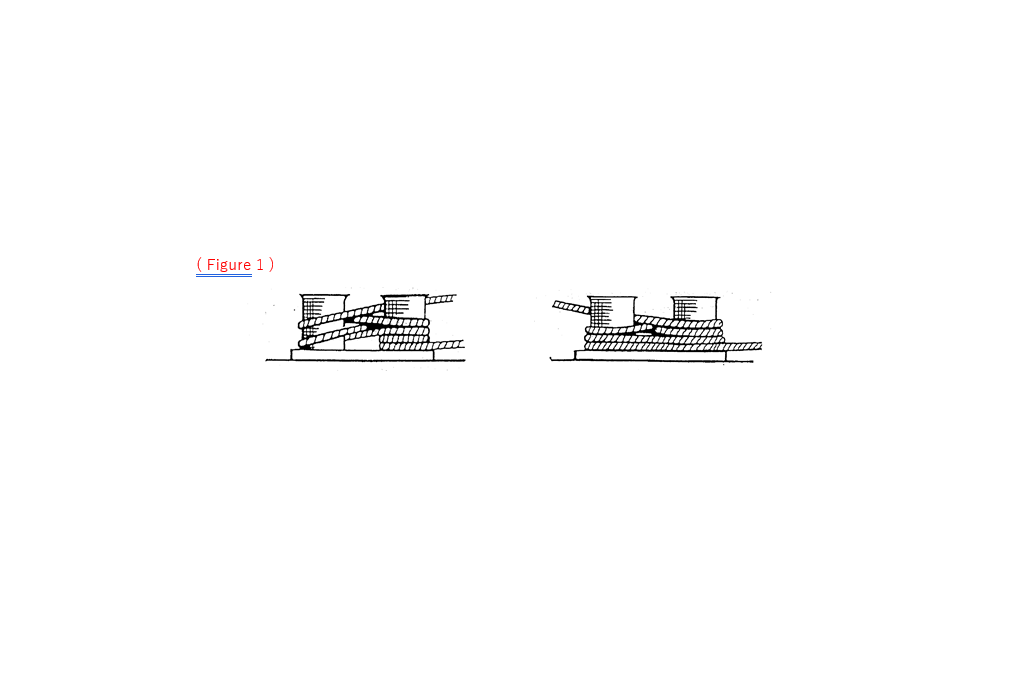
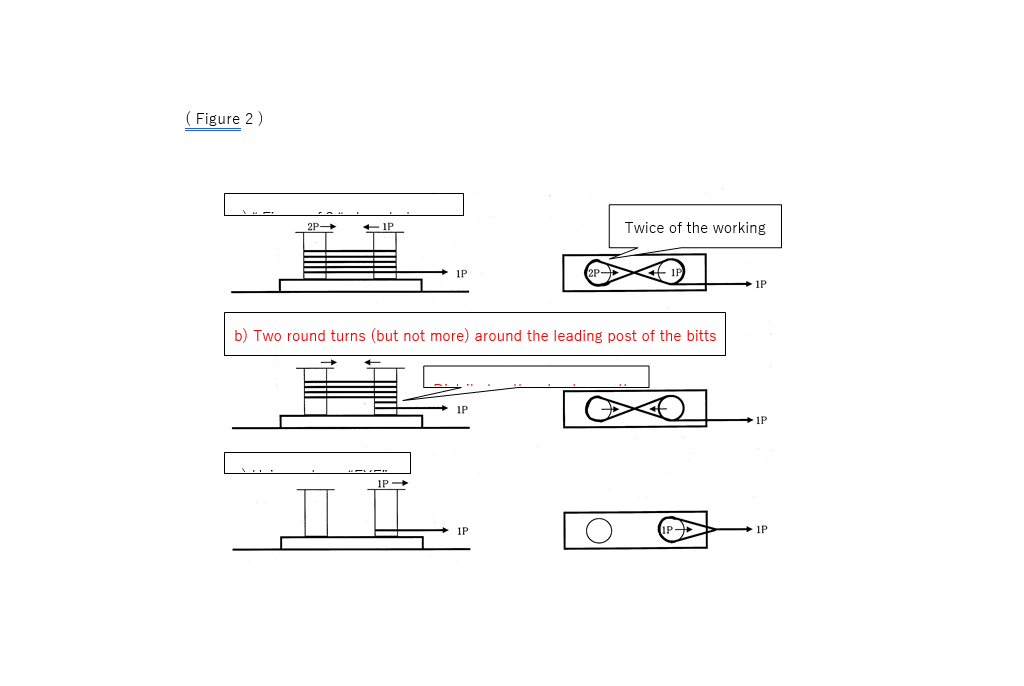
When making synthetic fiber ropes fast to bollards, a “figure of 8” should not be initially used. First you should make two round turns (but not more) around the leading post of the bollard before figure of eighting for large size bollards, or alternatively make two round turns around both posts before figure of eighting for bollards with smaller circumference posts. This method can control synthetic fiber ropes successfully, and it is easy to use and safe.
The working load of the bollard will change depending on the method used for belaying the synthetic fiber ropes on the bollard. When using only a “figure of 8” (figure 2-a), twice the working load will be on the bollard compared with using only an “eye” (figure 2-c).
Because of the high load, we do not recommend using a “figure of 8” for belaying. Rather, it is desirable to distribute the load on the bollard by using the above mentioned methods (figure 1 and figure 2-b)
The gypsy heads (drum ends) which are installed in the mooring winch should not be used to belay the mooring line. Therefore, in case of taking additional mooring lines, belaying those mooring line on gypsy heads (drum ends) must not be done.
Method for Using Rope Stoppers
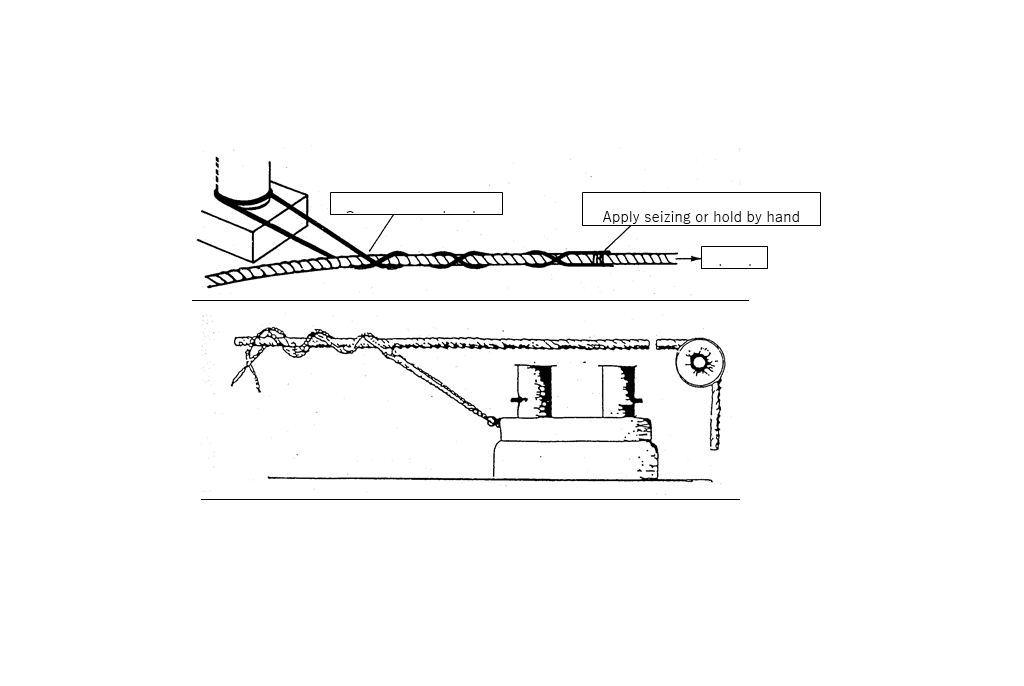
When hanging a big sized tag line on a bollard, it is essential that the right rope stopper is used and the correct method for “stopping off” a big sized tag line is employed.
The rope for the stopper should:
- be of synthetic fiber rope.
- be used “on the double”.
- be of low stretch material.
The following figure shows the correct method for stopping off a tug’s line.
Items to note concerning Mooring Equipment
At a minimum, the person who operates the mooring equipment must determine beforehand the following information:
(Mooring Winch)
- Type of winch
- Type of brake mechanism
- Heaving capacity (rated pull) and stall heaving capacity (render value) of the mooring winch
- Brake holding capacity of the mooring winch
(Synthetic Fiber Hawser)
- Diameter / length / type of hawser
- Condition of the hawser
- Manufacturers “Standard Strength”
Mooring Winch
“Heaving Capacity (Rated Pull)” and “Stall Heaving Capacity (Render Value)”
“Stall Heaving Capacity (Render Value)” is defined as the force required to turn the winch in the opposite direction when set to heave with the driving force applied.
It should be remembered that the “Heaving Capacity (Rated Pull)” is always smaller than “Stall Heaving Capacity (Render Value)”, and once a winch starts to turn in the opposite direction it is impossible to heave in unless the forces causing the turn are reduced.
Brake Holding Capacity
The strength of the hawser must exceed the brake holding capacity. In other words, the brake should slip before there is a danger of the hawser breaking. According to the “Mooring Equipment Guidelines” which is published by OCIMF, it is recommended to use a brake holding capacity for mooring winches which is 60% of MBL (Minimum Breaking Load) of hawser.
It should be remembered that the brake holding capacity is always greater than the heaving capacity, and that once the brake starts to slip (render) it is impossible to heave in unless the forces causing the slippage are reduced.
Brake Condition
Oil, moisture or heavy rust on the brake linings and the drum seriously reduce the brake holding capacity. Oil impregnation cannot be removed so linings should, if so affected, be replaced. Whenever brakes are opened up for any reason, the brake drum should be examined for build-up of rust or worn brake material and should be de-scaled as necessary. The link mechanism of the brake must be free up and greased. (Remove the old grease and the extra grease when applying new grease)
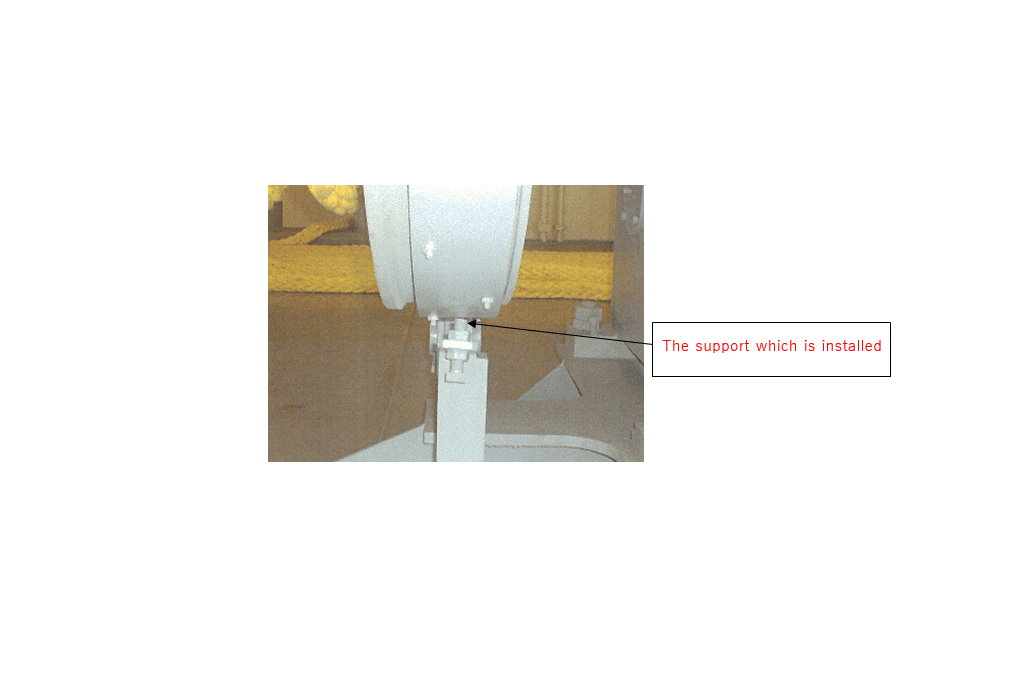
You should always be aware of the abrasion state of the brake band, brake drum, and the hole and pin of the brake link. Also, the support (see photograph below) which is installed in the lower part of the brake band to prevent early abrasion in the upper part of the brake band should be adjusted appropriately, following the mooring winch instructions.
(Generally the opening is 5mm-8 mm. After a lining change, adjusting the support is sometimes forgotten.)
Number of Hawser Layers on Mooring Winch Drums
The force at which a winch brake will slip will vary, depending on the number of layers of synthetic hawser left on the drum. The more layers of synthetic hawser on the drum, the greater will be the reduction of brake holding capacity.
The following table shows a typical loss of brake holding capacity for each layer, with 100% for the first layer:
No. of Layers Brake Holding Capacity
1st Layer 100 %
2nd Layer 88 %
3rd Layer 80 %
4th Layer 73 %
5th Layer 67 %
As mentioned above, the brake holding capacity is always shown with a specific number of layers. In order to minimize any reduction of brake holding capacity, the hawser should always be reeled on to the drum in a symmetrical pattern and not allowed to pile up on one side or in the centre.
Correct Reeling
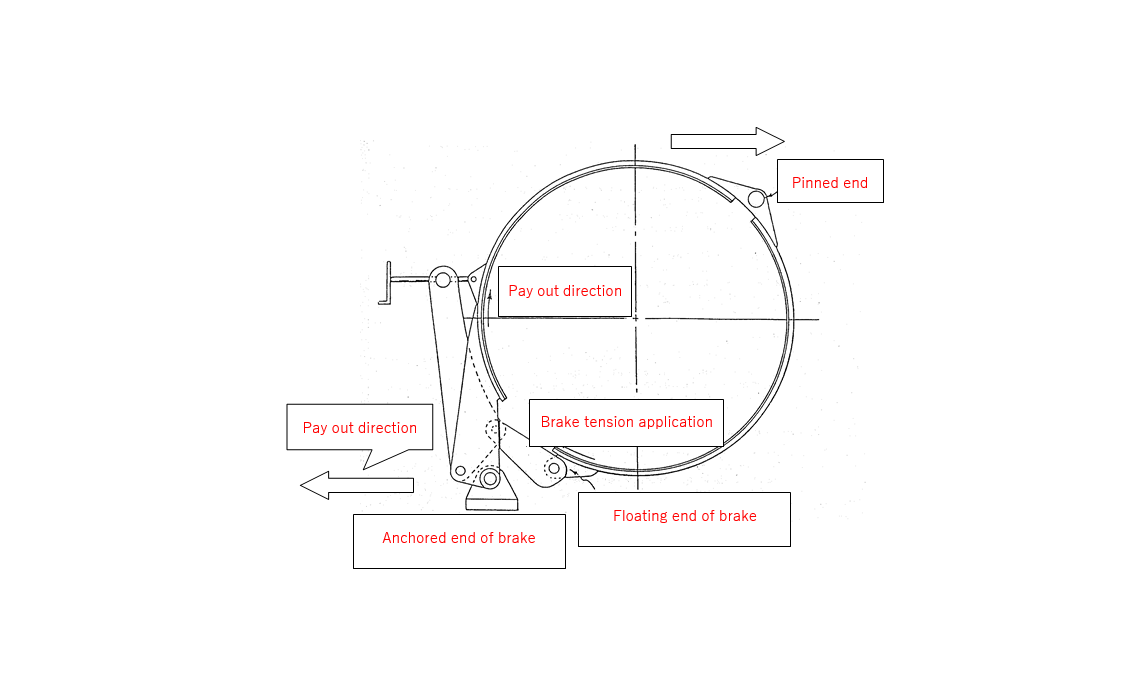
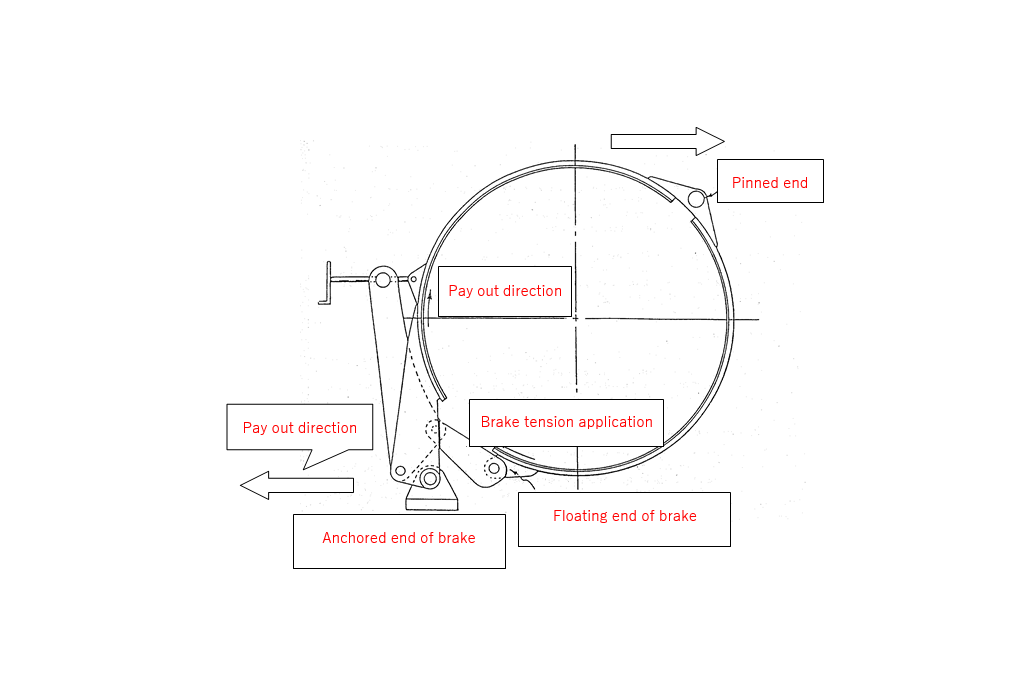
A band brake is designed to work in one direction only. Therefore the hawser must always be reeled correctly onto the drum. The line is properly reeled if it is pulling against the fixed end of the brake strap. Reeling the hawser on to the drum in the wrong direction may reduce the brake holding capacity by up to 50%.
Others
When mooring winches are not in use, make sure the clutch is disengaged (as there is a danger the motor will become damaged), and also make sure the stopper and the clutch pin of the control handle are used.