Maximum outturn of a crude oil cargo at the discharge port can only be achieved by the correct implementation of a properly prepared crude oil washing (COW), plan. Each tanker which is fitted with a COW system must also have:
1.A crude oil washing operations and equipment manual and
2.Personnel appropriately trained to assume overall charge of crude oil washing operations
The publication Crude oil washing systems (Revised edition 1983) by the International Maritime Organization provides a concise summary of the various IMO conventions and resolutions affecting the implementation of COW operations. The COW installation on a tanker will have passed both a design review and a practical demonstration test before receiving certification. If properly maintained and operated, it is capable of delivering the performance required by IMO Resolution A.446(XI).
COW operations are carried out for:
1. Cleaning for shipyard – COW all tanks followed by water wash.
2. Cleaning for arrivals, heavy weather ballast and tank entry -(MARPOL 73/78 Protocol Annex 1, Regulation 13(2) (a) – (c)), COW selected tanks followed by a short water rinse.
3. Cleaning for sludge control – COW only normally 1/4 of all cargo tanks on a rotational basis. All tanks should be COWed once every four months. More frequent COWing will maintain best tank cleanliness and minimise the potential for blocking of the limber holes or tank suctions
The number of COW operations a ship conducts and the amount of experience (and skill), acquired by its officers varies considerably with its trade. On a VLCC from Europe to the Arabian Gulf, an officer may only conduct two COW operations in a five month assignment.
On a vessel engaged in the US Gulf lightering trade, twenty COW operations may be conducted in the same time five month period
COW training
Resolution 10 of the International convention on standards of training, certification and watchkeeping for seafarers, 1978 includes the requirement for COW training of officers and ratings of oil tankers. The requirements for COW training are included in appendix 11 of IMO resolution A.446(XI), Revised specifications for the design, operation and control of crude oil washing systems. It should be obvious to any owner that employment of officers well trained and experienced in the procedures for COW will yield dividends through reduced ROB claims, reduced exposure to pollution claims and reduction in extra berth time caused by less-than-optimum washing procedures. The subject of correct COW procedures is also high on the list of inspection items by prospective charterers. If a charterer’s inspection team is on hand during the discharge, poor preparation and implementation of a COW programme will disqualify a ship from consideration for future charters.
Crude oil washing operations and equipment manual
The COW operating procedures for any tanker are set out in its Crude oil washing operations and equipment manual. This manual must be prepared for each tanker and is a ‘required reading’ document for each deck officer who joins the ship. It is recommended that the manual be re-read by each officer during the loaded passage so that the procedures will be refreshed in his mind prior to arrival at the discharge port. The objective of a defined COW operations procedure is to duplicate the conditions under which the ship’s installed COW system was tested and approved for compliance with MARPOL requirements.
The manual begins with the text of the revised IMO specifications, followed by a description of the physical installations on the ship for COWing.
The remaining sections deal with the most important operational considerations for COW operations, including:
1. Pressure testing of COW systems before use and requirements for system observation to provide early detection of leakage.
Use of the inert gas system, including requirements for oxygen content, pressure maintenance and actions following IGS failure.
2. Precautions against electrostatic hazards, particularly measures to eliminate water from crude oil used for COW.
3. Requirements for manning of the COW operation, including experience requirements of officers and duties of ratings.
4. Provision of hand-held portable radios for communications between CCR and the deck
5. List of crude oils which are not suitable for crude oil washing, usually due to high pour point or high viscosity.
6. Checklists to be used in each phase of the COW operation from before arrival to drainage of all lines after washing.
7. Approved methods and programmes for crude oil washing, including all details necessary to formulate a COW programme.
8. Example crude oil washing programmes for typical conditions of discharging which the ship can be expected to encounter.
9. Procedures and methods for draining cargo tanks including the indicators of the tank being empty of pumpable cargo
10. Procedures and methods of draining the cargo, COW and stripping lines and the cargo pumps using the small diameter line (MARPOL line).
11. Example procedures for ballasting the ship, including precautions for minimising the emission of hydrocarbon vapours.
12. Procedures for water washing, ballast changing and slops decanting within the requirements of MARPOL Regulation 9.
13. Preventive maintenance programmes to be used for equipment and piping of the COW system.
14. Procedures for changing from crude oil trading to refined product trading (for tankers with dual certificates).
COW checklists
Each step of the COW operation must be set out in the crude oil wash operation plan. This plan should be formatted so that it can be used as a checklist by the cargo watch officer and other personnel responsible for the COW operation.
In addition to the port specific COW operation plan, the cargo watch officer must refer to and follow the checklists included in the operations manual. The following are example checklists for a conventional pipeline tanker, taken from the IMO booklet Crude oil washing systems:
Before crude oil wash operation
1 Are all pre-arrival checks and conditions in order?
2 Has discharge/crude oil wash operation been discussed with both ship and shore staff and is agreed plan readily available for easy reference?
3 Has communication link between deck/control station and control station/shore been set up and is it working properly?
4 Have crude oil wash abort condition and procedures been discussed and agreed by both ship and shore staff?
5 Have fixed and portable oxygen analysers been checked and are they working properly?
6 Is inert gas system working properly and is the oxygen content of inert gas being delivered below 5%5
7 Is oxygen content of tank(s) to be crude oil washed below 8% by volume (measured as 8% Oxygen or less at one meter below the deck and at mid tank level)? In tanks with swash bulkheads, readings must be taken on both sides of the tank.%
y8 Have all cargo tanks positive inert gas pressure?
9 Has a responsible person been assigned to check all deck lines for leaks as soon as washing starts?
10 Are the fixed machines set for the required washing method (programme) and are portable drive units, if fitted, mounted and set?
11 Have valves and lines both in pumproom and on deck been checked?
During crude oil wash operation
12 Is quality of inert gas being delivered frequently checked and recorded?
13 Area all deck lines and machines being frequently checked for leaks?
14 Is crude oil washing in progress in designated cargo tanks only?u
15 Is the pressure in the tank wash line as specified in this manual?
16 Are cycle times of tank washing machines as specified in this manual?
17 Are the washing machines in operation, together with their drive units if applicable, frequently checked and are they working properly?
18 Is a responsible person stationed continuously on deck?
19 Will trim be satisfactory when bottom washing is in progress as
specified in this manual.
20 Will recommended tank draining method be followed?
21 Have ullage gauge floats been raised and housed in tanks being crude oil washed ?
22 Is level in holding tank for tank washings frequently checked toe? prevent any possibility of an overflow?
COW must be interrupted immediately if:
a) There is a failure of the inert gas plant or the oxygen content exceeds the allowed limit, or
b) The pressure in the cargo tank drops below the ambient air pressure or some required minimum (usually 200 mm water gauge).
After crude oil wash operation.
23 Are all valves between discharge line and tank wash line closed?
24 Has tank wash line been drained of crude oil?
25 Are all valves to washing machines closed?
26 Are cargo pumps, tanks and pipelines properly drained as specified in this manual?
The checklist items are reminders for competent personnel, who depend on a background of experience and training to understand all of the details to be considered before each question can be answered.
Sludge and Sediment control
Under certain conditions, significant sludge can form in a vessel’s tanks even with crude oils (Gulf of Suez mix, Flotta, Iranian Heavy), which are not normally associated with such accumulations. Investigations of the incidents of large sludge accumulation indicates that there are specific critical temperatures at which a crude oil will begin to precipitate sludge forming hydrocarbon species. This temperature, the Cloud Point, is the temperature at which a crude oil’s waxes change from their liquid phase to become suspended, quasi-solid particles, with associated oil components. These phase-separated particles settle to the bottom of the tank, forming sludge..
Parafinic crude oil sludge, once formed, is exceptionally difficult to return to a liquid phase by heating alone. Even an effective COW programme which removes it from the ship’s tanks will only have succeeded in moving the problem to the shore tanks.
An effective COW programme for sludge accumulation removal requires:
1. A crude oil suitable for COWing.
2. COWing oil heated to the higher of: The temperature required to reduce the oil’s kinematic viscosity to 60 Centistokes, or 40°C or
The oil’s cloud point plus 10°C for severely sludged tanks. The next lower temperature (of the three) may be adequate for moderate sludge conditions.
3. Adequate washing pressure to produce washing machine jets/
streams with the necessary energy/force.
4. Maximum, acceptable trim (about 8 meters).
5. No recirculation of the COW oil.
6. Adequate time for the COW machines to move the sludge to the pump suctions.
Temperature is important. The oil must have effective solvent action. COWing a cold tank bottom with oil which is below its cloud point will have no significant benefit. With COW oil at ambient temperature, a single pass of the COW gun jet will penetrate some depth of sludge. In the case of a 15 cm accumulation of sludge, the COW stream will penetrate the sludge to full depth, but will slurrify, rather than liquefy the sludge. The remainder will be pushed to one side, creating a furrowing effect. COWing with crude oil at ambient temperature would require four or five complete cycles of the COW gun to produce an acceptable ROB volume, ie. less than 0.1%.
The washing pressure at the COW machine in use must be monitored to ensure that the required pressure is being provided at all machines.
Do not recirculate wax-rich parifinic washing oil. COW oil should be heated to desired temperature in one slop tank and the COW strippings/drainings transferred to a second slop tank.
Sufficient COW time must be allowed for the programme to be effective. Various tank bottom parafinic sludges as tested suggest that they are composed of 33% to 54% wax, combined with entrapped oils, precipitated asphaltene/polycyclic aromatic species, water and other foreign material (rust, sand, etc.). They have pour point temperatures between 42°C and 50°C and dynamic viscosities of 2,227,000 centipoise (mPa s) at shear rates of 0.128 s^(-1) and shear stress of 2.85 x 10^(5) mPa.
Heated COW oil is required to remove such material with a single machine cycle. If the COW liquid is at ambient temperature, four or five cycles may be required to remove significant sludge accumulations.
That would require 60 hours of COW time rather than the allowed 12!
COWing for parafinic sludge control should begin when about 0.5 meters of cargo remains in the tank. Draining and stripping of the tank(s) must begin at the same time. This ensures a continuous flow toward the tank suction and an efficient removal of all sludge. Sufficient trim must be maintained that the tank bottom remains well drained as the COW operation is concluded.
Electrostatic hazards
Crude oil used for COWing should be free of suspended water to minimise the formation of electrostatic charge by the high pressure jets. To ensure that the COW oil supply is dry, the cargo tank to be used must be partly discharged ashore before COWing begins. At least one meter of cargo must be discharged. This will remove any water bottoms from the tank before COWing begins. COW procedures which either take the washing medium from the discharge stream, or use a slop tank which is discharged then refilled with clean oil, avoid this problem.
COW problems
Many items on the COW checklist have been put there based on experience in the form of accidents or incidents experienced while crude oil washing. Requirement 19, for a competent person to be continuously on deck is a result of COW pipeline and valve failures causing oil spills. The requirement for frequent checking of the holding (slop), tank is because these tanks have overflowed many times during COW operations Requirement 14, indicating the need to check that only the desired COW machines are operating is a clear indication that some time in the past the machines have been turned on in full or empty tanks, both with undesirable results! It is important that the valve handles of COW machines not in use be lashed closed. Those which will not be used at all in the discharge port may be blinded or sealed closed to prevent accidental opening. All COW valves must be clearly marked with their identification number and the deck watch must advise the cargo watch officer of the number of the valve they are opening whenever he instructs them to open a valve.
The crude oil washing process is demanding of crew time and difficult to monitor effectively. It is therefore essential for the owner to ensure the highest standard of dedication, training and effort on the part of his crew.
On completion of discharge, the master should advise ship’s agents which tanks have been COWed so that charterers may make outturn checks and anticipate COW intentions for the following voyage. If the planned COW programme was not accomplished, the master should advise the reasons. All COW operations must be entered in the oil record book.
The effectiveness of the COW programme can be determined by the cleanliness of the ballast surface of any COWed tank ballasted after water rinsing
Charter party considerations
Almost all charter parties require discharge to be undertaken in not more than 24 hours, or at a pumping pressure of not less than 100 psi (or some other figure), at the ship’s rail. At the end of the cargo discharge, the vessel will be expected to have discharged ashore:
a) All tank residues which are liquid or should have been movable by an effective cargo heating programme or by an efficient crude oil washing programme.
b) All residues which are reachable by the vessel’s pumps, that is: they will flow to the vessel’s tank suctions due to adequate ship trim and suitably clear drainage openings.
c) All residues which the ship’s pumping equipment (centrifugal, rotary, reciprocating, or eductor), are capable of pumping.
Any such liquid residue (in excess of the amount provided for in section 4.4.4 of the vessel’s COW manual), which has not been removed at the end of the cargo discharge becomes the Financial responsibility of vessel owners.
Extra time is allowed in order to conduct crude oil washing operations if instructed to COW by the charterer. Unfortunately, masters are usually unaware of how much additional time is allowed. Six hours of additional time is the typical COWing allowance, but it may be as much as twelve hours. The owner’s must ensure that adequate COW time is included in the charter according to the nature of the cargo and the anticipated sludge accumulation and that the master is advised of the COW time available to him. If COWing is not provided for in the charter and the receiving terminal refuses allow the vessel to COW (contrary to the MARPOL requirements), then the vessel will be subject to penalties under the cargo retention clause for oil which COWing would have removed!
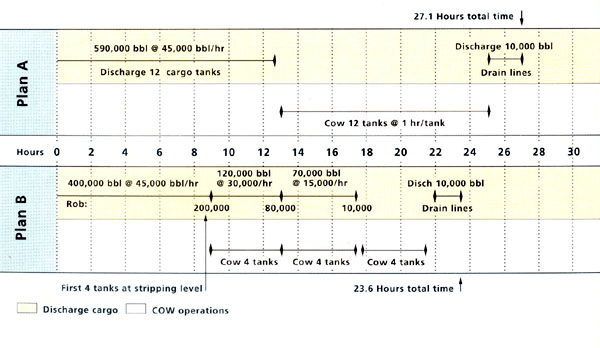
Most charter COWing clauses also require COWing to be conducted ‘concurrent’ or ‘simultaneous’ with discharge operations. This actually is a time saving procedure and it has additional advantages. As an example, figure 5.27.7 represents two discharge and COW programmes for a 600,000 bbl crude oil cargo. The ship is capable of discharging a cargo of 600,000 barrels of crude oil from 12 cargo tanks with three cargo pumps each rated at 15,000 barrels per hour using three cargo systems. The COW bottom wash cycle takes sixty minutes. This example assumes that top washing of the tanks is not required
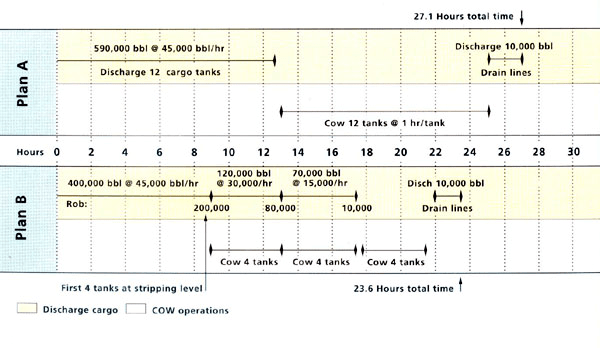
Discharge plan (B) conducts COW operations concurrent with cargo discharge and completes all operations 1.5 hours earlier than a plan (A) where COW follows the discharge.
The upper, serial or ‘closed cycle’, programme requires 27.1 hours to complete. The lower schedule takes longer to discharge the cargo with the main pumps, but the concurrent COW operation shortens the overall offloading time to 23.6 hours, a saving of 3.5 hours. The concurrent system offers other advantages where heated or high-pour point cargoes are involved. The sequential procedure leaves bottom residues in cargo tanks for extended periods before COWing. This may cause serious draining difficulties after COWing begins, with extended discharge time and higher ROB quantities. Those problems are avoided by the concurrent process, which begins bottom washing shortly after each tank has been emptied by the MCP
Unable to crude oil wash
If charterers have requested the vessel to COW during discharge, but the ship is unable to do so due to equipment malfunction, the master should be aware of the consequences under the charter party.
Several standard COW charter party clauses stipulate that, should the vessel fail to COW for any reason, any measured cargo retains whether pumpable or not shall be for the owner’s account. Other clauses may require the vessel to remain at the berth for a period of time for clingage rundown before re-stripping tanks ashore.
If the charterer’s instructions to the vessel require COWing and the terminal refuses permission for any reason, the master should issue a letter of protest declining responsibility for any ROB quantities found after discharge or for any loss or claims due to undetected clingage