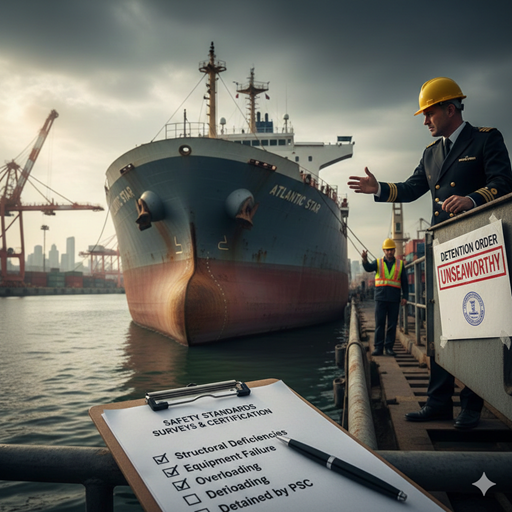
Introduction
One of the core objectives of the Merchant Shipping Act, 1958 is to ensure that ships operating under the Indian flag are safe for navigation and do not endanger human life, property, or the marine environment. To achieve this, the Act lays down strict provisions regarding seaworthiness, surveys, detention of unsafe ships, and certification.
Meaning of Seaworthiness
A ship is considered seaworthy when it is fit in all respects to undertake the intended voyage. This includes the ship’s construction, hull strength, machinery, equipment, stability, crew competence, loading condition, and compliance with safety regulations.
Seaworthiness is not limited to the beginning of the voyage. The ship must remain seaworthy throughout the voyage, and the owner and master are legally responsible for maintaining this condition at all times.
Unseaworthy Ships
A ship is deemed unseaworthy if, due to defective construction, poor condition of machinery or equipment, improper loading, insufficient crew, or any other reason, it is unfit to proceed to sea without danger to human life.
Sending or attempting to send an unseaworthy ship to sea is a punishable offence. However, the owner or master may avoid liability if they can prove that all reasonable means were taken to ensure seaworthiness before departure.
Unsafe Ships
An unsafe ship is one that presents serious and imminent danger to life. This may result from structural defects, inadequate safety equipment, serious stability issues, or failure to comply with statutory safety requirements.
The Central Government has the authority to take immediate action in respect of unsafe ships. This includes inspection, detention, and restriction of movement until the ship is made safe for navigation.
Power to Detain Unsafe Ships
If a ship is found to be unsafe, an authorized officer may detain it until necessary repairs or corrective measures are carried out. Detention may also occur if the ship lacks valid statutory certificates or fails to comply with safety rules.
A detained ship cannot proceed to sea without permission. If the owner or master is dissatisfied with the detention order, an appeal may be made to the Central Government, but the ship remains detained until a final decision is reached.
Survey of Ships
Surveys are conducted to assess a ship’s condition and compliance with safety standards. Surveys may be routine, special, or casualty-related. When a ship suffers damage affecting her seaworthiness, the master must arrange for a survey at the next port of call.
Surveys are carried out by government-appointed surveyors or recognized classification societies. The survey report forms the basis for decisions regarding repairs, detention, or certification.
Certificates of Seaworthiness
Upon satisfactory completion of a survey, a certificate of seaworthiness may be issued. This certificate confirms that the ship is fit to proceed on the intended voyage, subject to any conditions specified.
In cases where permanent repairs cannot be completed immediately, an interim or conditional certificate may be issued, allowing the ship to proceed to a specified port for repairs.
Certificates of Class
Ships classed with a recognized classification society must maintain a valid certificate of class. This certificate confirms that the ship meets the technical standards of the classification society.
If a ship suffers damage or undergoes significant repairs or alterations, the classification society must be informed. Failure to maintain class may invalidate insurance coverage and charter party agreements.
Obligation to Report Damage
When a ship sustains damage affecting hull, machinery, or essential equipment, the master must report the incident to the owner, classification society, and relevant authorities. A note of protest should be made to preserve legal rights, especially in cases involving heavy weather or collision.
Failure to report damage or obtain necessary certification can expose the owner and master to penalties and liability.
Load Line and Stability Compliance
Compliance with load line and stability requirements is a key aspect of seaworthiness. A ship must not be overloaded beyond her assigned load line marks, and cargo must be properly distributed to ensure adequate stability.
Violation of load line regulations is treated as a serious offence, as it directly endangers the ship and those on board.
Safety Equipment and Emergency Preparedness
Ships must be properly equipped with life-saving appliances, fire-fighting equipment, navigation lights, radio communication systems, and emergency alarms. Regular inspections and drills are required to ensure equipment remains operational and crew are familiar with emergency procedures.
Failure to maintain safety equipment or conduct drills may lead to detention and prosecution.