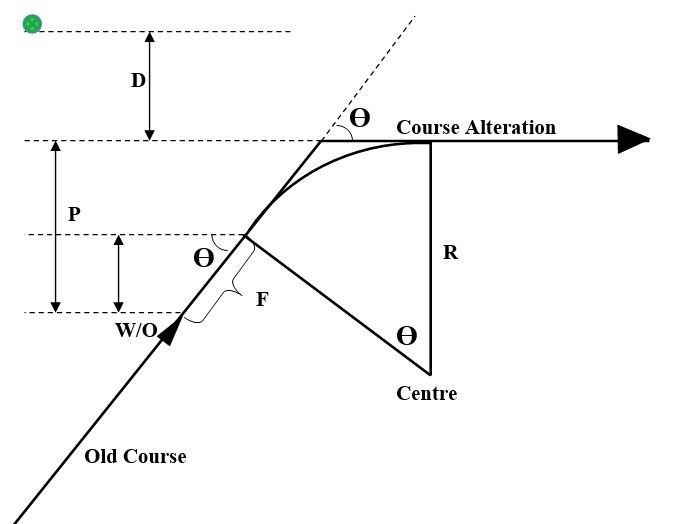
Wheel over positions should be determined from the ship’s manoeuvring data and marked on the chart. Suitable visual & radar cues should then be chosen to determine when the ship is at the wheel over position.
The best cues for large alterations of course consist of Parallel Indexes or visual bearings parallel to the new track, whereas for small alterations a near beam bearing is often better. Even when the pilot has the con the wheel over position should be shown on the chart so that the OOW will be aware of its imminence & importance. It is also part of the ship’s officer’s monitoring of the pilot.
FACTORS THAT AFFECT A TURN:
– Structural design & length of the vessel.
– Draught & trim of the vessel.
– Size & motive power of the main machinery.
– Amount of helm used.
– Available depth of water.
A vessel trimmed by stern will steer more easily, but the tactical diameter of the turn is increased.
Trim by head will decrease the diameter of the turning circle but it will be difficult to steer the vessel.
Listed vessel will be subject to delay in turn. A larger turn will be experienced when turning into the list.
External forces, wind & current will affect the turn.
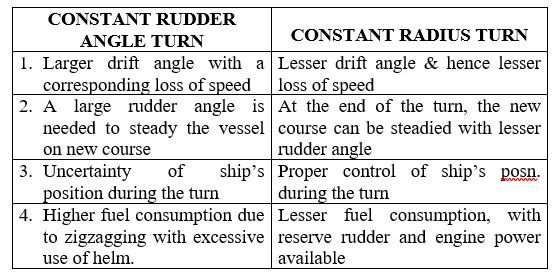
Constant radius turn technique is based on the following formula:

where
V= Ship’s speed over ground, in knots and,
R= Radius of the turn in nautical miles.
The distance of wheel over point from the point where the turn is to become effective is usually taken as one ship’s length but it is recommended to find it out by some practice turns on the type of ship one is serving.
The distance of wheel over point from the point where the turn is to become effective is usually taken as one ship’s length but it is recommended to find it out by some practice turns on the type of ship one is serving.
Following formula can be used to find the distance of wheel over line from the new course line and the same can be used to set the parallel indexing line or the line of turn for giving the wheel over order:
Distance of wheel over line from the new course line
= F sin q + R (1 – cos q) where,
F = one ship’s length (usually),
R = Radius of the turn
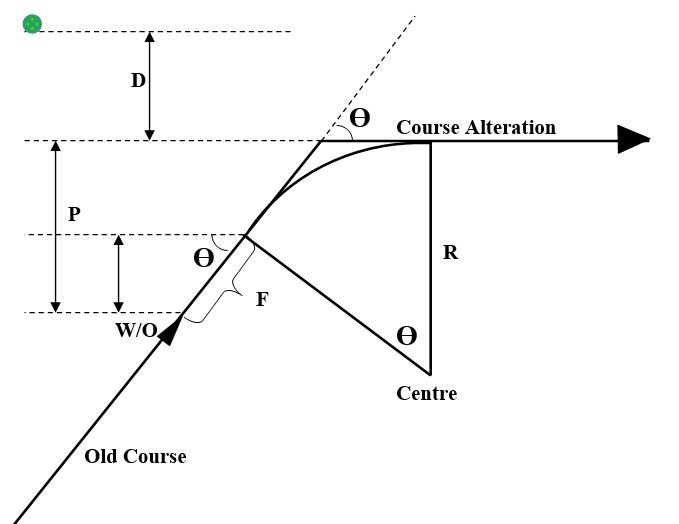
F = Head Reach – Distance traveled by vessel after giving wheel over & before commencing turn, i.e. distance to overcome inertia.
P = Perpendicular distance from wheel over point to new course extension.
D + P = Parallel Index distance at W/O position.
D = Parallel Index distance from new course, as obtained from chart.
R = Radius of turn.
Ө = Change of course angle.
TO FIND & MARK APPROX. W/O POSITION:
F = 0.1 to 0.15 NM
P = R(1-Cos Ө) = F Sin Ө
Rate of turn = (V / R) x 0.96 where V = speed of vessel
Distance to new course = Radius x Tan Ө/2
First the Master of the vessel has to decide the radius of turn required, depending on the manoeuvring characteristics of the vessel & available sea room.
A reference point such as an island, buoy, etc. can be also used to decide the radius of turn.
Wheel over point = F + Distance to new course
Distance to new course can be found by the above formula.
Once the Master has decided on the radius of turn, a tabular ready reconer may be prepared for various course change angles.