Skip to content

Knowledge Of Sea

We will keep you updated

  • Home
  • Video
  • Chartering Terms
  • Rule of the Road (COLREG)
    • Nautical Flags
    • Rule of the Roads – CARDS
  • Tanker Definitions
  • Downloads
  • ORAL NOTES
    • ORAL NOTES- 2ND OFFICER
    • ORAL NOTES- CHIEF MATE
    • ASM ORAL NOTES 1
    • ASM ORAL NOTES 2
    • ASM ORAL NOTES 3
  • About Me
  • Toggle search form

Turning Levers and Moments

Posted on December 2, 2019December 2, 2019 By admin No Comments on Turning Levers and Moments

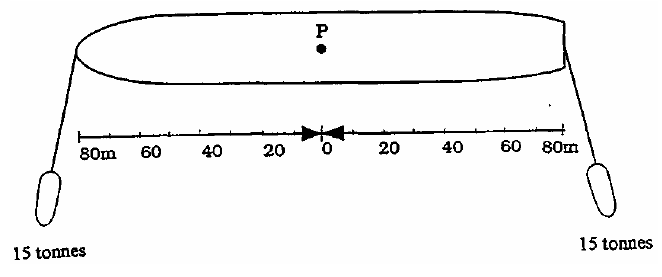
Vessel Stopped

turning lever of vessel

If the tugs apply the same bollard pull of say 15 tonnes each, it is to a position 80m fore and aft of the pivot point. Thus two equal turning levers and moments of 80m x 15t (1200tm) are created resulting in even lateral motion and no rate of turn.

Making Headway
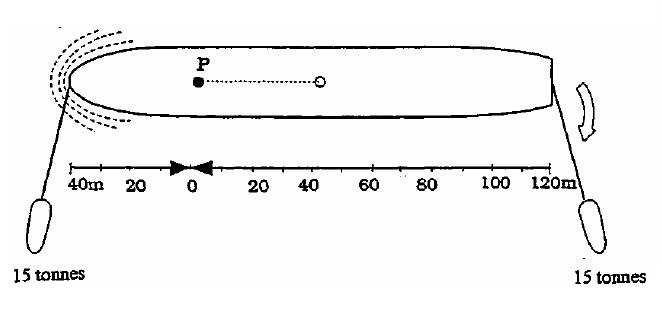
turning lever of vessel

With the ship making steady headway, however, the pivot point has shifted to a position 40m from the bow. The forward tug is now working on a very poor turning lever of 40m x 15t(600tm), whilst the after tug is working on an extremely good turning lever of 120m x 15 t (1800tm).

This results in a swing of the bow to starboard.

Making Sternway
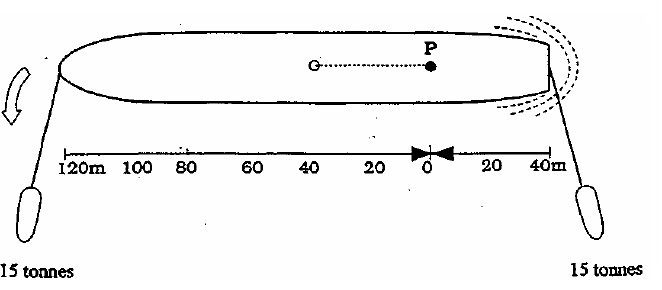
turning lever of vessel

The efficiency of the tugs will change totally when the ship by contrast makes sternway. Now the pivot point has moved aft to a position 40m from the stern. The forward tug is working on an excellent turning lever of 120m x 15t(1800tm) whilst the after tug has lost its efficiency to a reduced turning lever of 40m x 15t(600tm).

This now results in a swing of the bow to port.

Navigation Tags:TURNING LEVER WHEN VESSEL IS MAKING HEADWAY, TURNING LEVER WHEN VESSEL IS MAKING STERNWAY, TURNING LEVER WHEN VESSEL IS STOPPED, TURNING LEVERS AND MOMENTS

Post navigation

Previous Post: Grounding “Actions to be taken”
Next Post: Slow Speed Control

Leave a Reply Cancel reply

Your email address will not be published. Required fields are marked *

Categories

  • Bulk Carrier
  • Cargo handling
  • Engine Room Operations
  • LSA & FFA
  • Maritime Industry
  • Maritime Law
  • Merchant Shipping
  • Navigation
  • Rules and Regulation
  • Ship Construction
  • Shipboard operation
  • Stability
  • Tanker
  • Uncategorized

Blog is primarily for candidates appearing for certificate of competency exams but such is the detail that while being equally suitable for the beginner, it is also reference work for experienced seaman, and the layout and style of blog make it suitable for shipboard training where practical experience can be allied to the theoretical approach.

Recent Comments

  • capt on Radar Best Practice -ARPA
  • admin on Dry Docking (Theory & Numericals)
  • Stelios Karamplakas on Dry Docking (Theory & Numericals)
  • Farid OMARI on Demurrage
  • admin on Tanker Cargo Calculations

Copyright © 2018 knowledge of sea – All Rights Reserved.

If you’re unsure about what type of training will work best for you, just tell us a little more about your needs. We will get back to you as soon as possible with the answers you need!

All answers will be from sailor mouth, who is practically working on board.

February 2026
S M T W T F S
1234567
891011121314
15161718192021
22232425262728
« Jan    

Copyright © 2026 Knowledge Of Sea.

Powered by PressBook WordPress theme