Many of us are quite scared of solving the tide problems especially calculations involving Secondary Ports
Lets first handle calculation of tide at Standard Ports
1.Find height of tide at Bombay at 1200 hrs on 15th Aug 1999
| Bombay 15th August 1999 | TIDE | TIME | HEIGHT |
| HW | 0212 | 4.0 | |
| LW | 0720 | 1.0 | |
| HW | 1438 | 4.4 | |
| LW | 2051 | 1.0 |
Ht of tide required at 1200 hrs, which falls between LW 0720 and HW 1438.
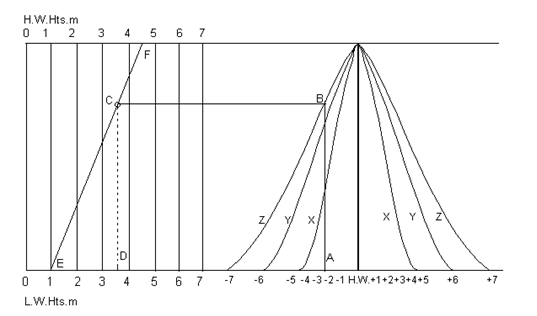
Duration between HW and LW = 07hrs 18mts. We have to follow the tide curve Z of 7 hrs.
Find the difference between 1200 hrs and HW. HW is at 1438 hrs. Required time 1200 hrs is 2 hrs 38 minutes before HW
Range of tide is difference of height of tide between HW and LW Range of tide = 3.4 m
LW = 1.0 m and HW = 4.4 m. Mark the LW height at E and HW height at F in the left side of tide diagram. Join EF. The line EF represents LW and HW heights.
Required time is 1200 hrs, which is 2 hrs 38 minutes before HW. Mark A in the diagram as 2 hrs 38 minutes before HW.
Draw vertical line AB where it cuts the tide graph Z of 7 hrs at B. From B draw a horizontal line BC, which cuts line EF at C. Drop perpendicular CD to the base and read out the required height of tide at 1200 hrs. It should be approximately 3.5 meters.
On 26th January 1999, find the earliest time in afternoon to cross a sand bar, where the charted depth is 7.0 meters. Ship’s draft 9.0 meters, under keel clearance required 0.3 meters.
Ship’s draft 9.0 M
Clearance 0.3 M
Total depth 9.3 M
Charted depth 7.0 M
Required height of tide = 9.3 – 7.0 = 2.3 meters
| Bombay 26th August 1999 | TIDE | TIME | HEIGHT |
| LW | 0015 | 2.0 | |
| HW | 0550 | 3.7 | |
| LW | 1309 | 1.1 | |
| HW | 1954 | 3.6 |
Earliest time in afternoon, when the height of tide is 2.3 meters is between LW 1309 hrs (1.1 M) and HW 1954 hrs. (3.6 M)
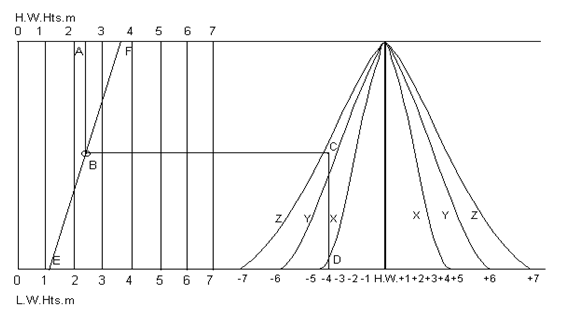
As in earlier example join E and F denoting LW 1.1 M and HW 3.6 M in the left hand side of the tide graph.
Mark 2.3 M at A at top left hand corner of the graph.
Draw AB perpendicular, where it cuts EF at B.
Draw BC parallel to base line. Duration of tide is 6 hrs 45 minutes. Hence select in between tide graph Z (7 hrs) and Y (6 hrs).
Drop a perpendicular CD on the base line. At D read the time difference from HW, which is around – 4 hrs (i.e. before HW)
Hence earliest time to cross the bar = (HW time) 1954 – 4 hrs = 1554 hrs.
At 1554 hrs the height of tide will be 2.3 M, this added to the sounding of 7.0 M gives 9.3 M sounding.
Secondary Ports
Predictions for Secondary ports are made by applying time and height differences to predictions at a selected Standard Port or by using the harmonic constants and the simplified harmonic Method of Tidal Prediction.
See Admiralty Tide Table for explanation and guidance on how to calculate heights and times of tide for Standard Port and for Secondary Port in the” Introduction”
One example is solved for you here.
Required to find the ht of high water and low water at Mora (Karanja) India on 15th August 1999.
Look in ATT Vol III Geographical Index and find Mora. Its number is 4362.
Look in part II of ATT Vol 3. 4362 Mora. Bombay is the standard port for Mora.
Note down the time differences and height differences for secondary port w.r.t. standard port.
| Bombay 15th August 1999 | TIDE | TIME | HEIGHT |
| HW | 0212 | 4.0 | |
| LW | 0807 | 1.0 | |
| HW | 1438 | 4.4 | |
| LW | 2051 | 1.0 |
| Secondary Port | Time difference | Height differences | |||||
| MHW + 0010 | MLW + 0000 | MHWS | MHWN | MLWN | MLWS | ||
| 4.4 0.0 | 3.3 +0.1 | 1.9 -0.1 | 0.8 +0.1 | ||||
| TIME | HEIGHT | |||
| Standard Port | HW | LW | HW | LW |
| 0212 | 0807 | 4.0 | 1.0 | |
| 1438 | 2051 | 4.4 | 1.0 | |
| Seasonal change | Standard port | nil | ||
| Differences | + 0010 | 0000 | 0.0 | 0.0 |
| Interpolate between HW and LW heights for height differences between Standard and Secondary ports | 0.0 | 0.0 | ||
| Seasonal changes | Secondary port | nil | ||
| Secondary port | 0222 | 0807 | 4.0 | 1.0 |
| 1448 | 2051 | 4.4 | 1.0 | |