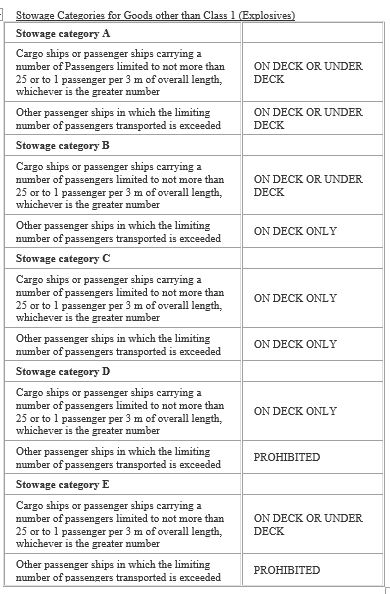
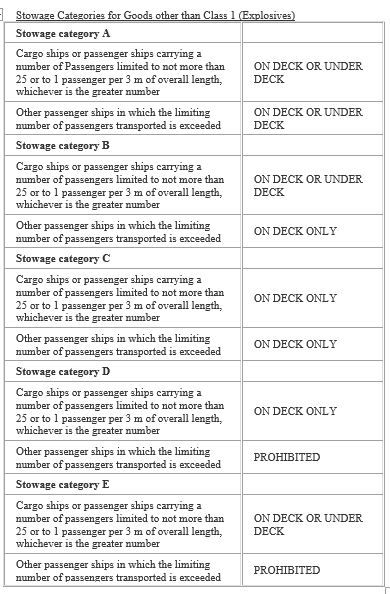
For the purpose of stowage of dangerous goods IMDG Code divides the ships into two groups
1. cargo ships or passenger ships carrying a number of passengers limited to not more than 25 or to 1 passenger per 3 m of overall length, whichever is the greater number;
2. other passenger ships in which the limiting number of passengers transported is exceeded.
Passenger ships are categorized as
“passenger ships carrying a number of passengers limited to not more than 25 or to 1 passenger per 3 m of overall length, whichever is the greater number
Or
“Other passenger ships in which the limiting number of passengers transported is exceeded”
Individual dangerous goods are assigned with stowage categories A, B, C, D, or E in the Dangerous Goods List in IMDG Code and these are specifically assigned for On Deck, Under Deck or whether prohibited on passenger ships.
See stowage categories of IMDG Code
Stowage categories A to E are for goods other than Class 1 (Explosives).
For Class 1 explosives there is another set of stowage categories as shown in below images.
Section 7.1.7.5 of IMDG Code describes in full the conditions of stowage of explosives in passenger ships.
Below is quoted from IMDG Code
7.1.7.5 Transport of goods of class 1 on passenger ships
7.1.7.5.1 For the purpose of stowage in this class, the terms “passenger ship” and “cargo ship” are used as in SOLAS 1974, as amended.
7.1.7.5.2 Explosives in division 1.4, compatibility group S, may be transported in any amount on passenger ships. No other explosives may be transported on passenger ships except any one of the following:
1.explosive articles for life-saving purposes listed in the Dangerous Goods List, if the total net explosives mass of such articles does not exceed 50 kg per ship; or
2.goods in compatibility groups C, D and E, if the net explosives mass does not exceed 10 kg per ship; or
3.articles in compatibility group G other than those requiring special stowage, if the total net explosives mass does not exceed 10 kg per ship; or
4.articles in compatibility group B, if the total net explosives mass does not exceed 10 kg per ship.
7.1.7.5.3 Notwithstanding the provisions of 7.1.7.5.2, additional quantities or types of goods of class 1 may be transported in passenger ships in which there are special safety measures approved by the competent authority.
7.1.7.5.4 Articles in compatibility group N shall only be allowed in passenger ships if the total net explosives mass does not exceed 50 kg per ship and no other explosives apart from Division 1.4, compatibility group S, are transported.
7.1.7.5.5 Goods of class 1 which may be transported in passenger ships are identified in the Dangerous Goods List. They shall be stowed in accordance with the following table:
Positioning of dangerous goods containers on board vessels are categorised by ‘stowage categories’ to ensure safety. Many points are considered by IMDG Code for safe carriage of dangerous goods by sea-going vessels.
On ships there are two different types of stowage (1) On deck and (2) Under Deck. When we look at a container vessel all those containers we see outside are stowed on deck. The containers stowed below the hatch covers are under-deck stowed units.
For other than class 1 ( explosives ) ships are divided into two groups for this purpose
1) cargo ships or passenger ships carrying a number of passengers limited to not more than 25 or to 1 passenger per 3 m of overall length, whichever is the greater number;
2) other passenger ships in which the limiting number of passengers transported is exceeded.
For every dangerous goods listed in IMDG Code Dangerous Goods List column 16 specifies stowage requirement. This is indicated by Category A, B , C, D or E.
On Deck only stowage is always prescribed for cases where:
.1 constant supervision is required; or
.2 accessibility is particularly required; or
.3 there is a substantial risk of formation of explosive gas mixtures, development of
highly toxic vapours, or unobserved corrosion of the ship
Below is the entry for UN 2076 Class 6.1 CRESOLS, LIQUID, you can see in column 16 it is written Category B. Substances, Materials or Articles assigned with stowage Category B can be loaded on deck or under deck on a cargo ship but on a passenger ship where limitng number of passengers are exceeded Category B must be loaded on deck only!
Stowage Categories for Goods other than Class 1 (Explosives)
Need to monitor Atmosphere in RO RO ship cargo spaces
Exhaust gases from motor vehicles contain hazardous substances. Carbon monoxide from petrol engines and nitric oxide (NO) & nitrogen dioxide (NO2) from diesel engines are released in the cargo spaces
These hazardous substances can effect people in many different way. Certain substances have a tangible, immediate effect, others only show injurious effects after a person has been exposed to them for some time.
Carbon monoxide is a colourless and odourless gas which, to a lesser or greater extent, inhibits the ability of the blood to absorb and transport oxygen. Inhalation of the gas can cause headaches, dizziness, and nausea and in extreme cases causes weakness, rapid breathing, unconsciousness and death.
Nitric oxide (NO) and nitrogen dioxide (NO2) are compounds of nitrogen and oxygen, together commonly referred to as oxides of nitrogen or NOx. NO itself is not of great concern as regards health effects; however a proportion of the NO formed will combine with oxygen to form NO2, which is of concern from the point of view of human health.
NO2 is a brown gas which has a stinging, suffocating odour. It exerts a detrimental effect on the human respiratory system. Asthmatics in particular are susceptible to exposure.
Measures
Therefore measures should be considered to minimize the health hazards. Such measures could include :
1. A reduction in exhaust gas emissions.
2. Provision of an adequate ventilation system
3. Prevention of exposure to the gases
To ensure the effectiveness of above recommended measures, it is essential that the atmosphere in the RO RO vessels is monitored.
Additional Information
Ventilation system for ro ro cargo spaces on board ship generally operate according to the principle of dilution ventilation, where by the supply air flow to the area is sufficient for the exhaust gases to mix thoroughly with the air and be removed.
There are two main types of dilution ventilation: exhaust air ventilation and supply air ventilation.
In exhaust air ventilation, fans remove air from a ro-ro cargo space and this is then replaced by outdoor air entering through open ramps, doors and other openings.
Exhaust air ventilation is employed when sub-atmospheric pressure is required in the ro-ro cargo space. The sub-atmospheric pressure prevents the pollution from spreading to adjacent areas.
Supply air ventilation works in the opposite way. Fans deliver outdoor air into the ro-ro cargo space and the air is then exhausted through ramps and other openings.
Supply air ventilation usually creates slight pressurisation of the ro-ro cargo space. If supply air ventilation is used exclusively, pollutants may mix with the supply air, be pushed up the internal ramps and contaminate other decks. However, if sufficient mixing with supply air does not occur, contaminants may remain on the deck in question.