Vessel Head to Wind with Headway
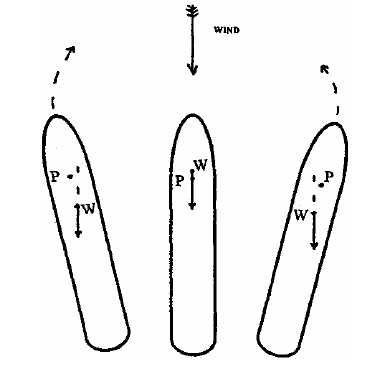
Vessel making Headway through the water, and Heading directly into the Wind. W is now well forward of amidships, and in fact very close to P; the wind is exerting no turning moment, or sideways force, on the vessel.
A comparatively small change in relative wind direction (either by alteration of course, or wind fluctuation), will place the wind on the vessel’s bow; the whole of one side of the vessel will now be exposed to the wind, and W will move aft .
The following effects will now be experienced:-
a) The Turning Force will now develop a turning moment about P, tending to turn the vessel into the wind again.
b) The Wind Force will also develop a sideways force on the vessel, away from the exposed side.
Head to Wind therefore, the vessel is “course stable”, provided that she maintains Headway through the water.
If the ship has a large Trim by the stern W will be further forward, with a reduction, or even loss, of “course stability”. This can sometimes result in a rapid and violent loss of control.
Vessel Head to Wind with Sternway
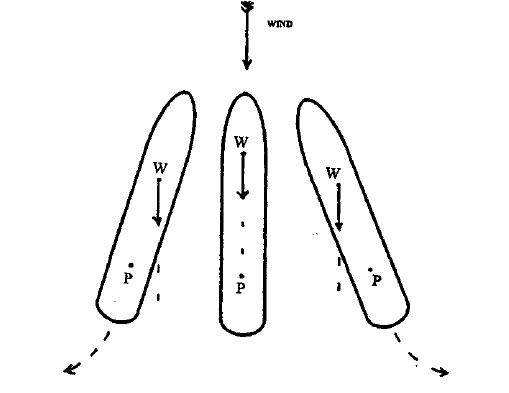
Vessel remains Head to Wind, but now starts to make Sternway through the water. W remains forward, whilst P has moved aft, the wind is exerting no turning moment, or sideways force.
A comparatively small change in the relative direction of the wind will move W aft, however P remains aft of W.
The following effects will now be experienced:-
a) The Wind Force will develop a strong turning moment about P, tending to turn the vessel’s bow further away from the wind.
b) The Wind Force will develop a sideways force on the vessel, away from the exposed side.
Head to Wind, as soon as the vessel starts to make Sternway through the water, she loses “course stability” and the bow will pay off away from the wind, sometimes quite rapidly.
If the ship has a large Trim by the stern W may move further forward, perhaps quickly, and the loss of “courses stability” is even more pronounced. This can sometimes result in a rapid and violent loss of control.
Vessel Stern to Wind with Headway
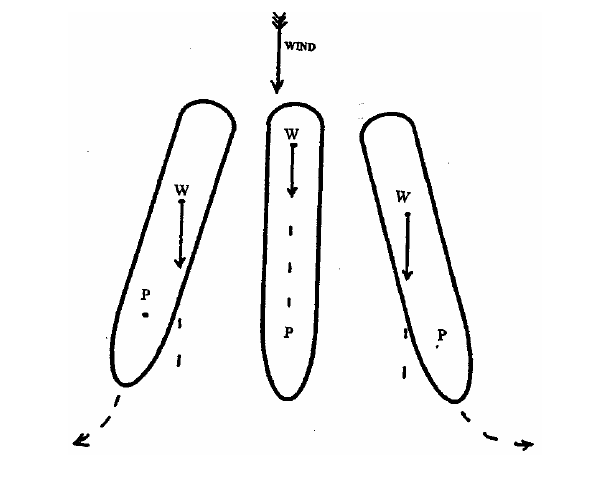
Vessel making Headway through the water, and with the Wind directly Astern. P is forward, a long distance from W, which is well aft. A comparatively small change in relative wind direction will move W forwards, however W is still some distance abaft P.
The following effects will now be experienced:-
a) The Wind Force will develop a strong turning moment about P, tending to turn the vessel’s Stern further away from the Wind.
b) The Wind Force will develop a sideways force on the vessel, away from the exposed side.
Making Headway with Stern to Wind, the vessel loses “course stability” and is difficult to steer, this effect is greater when there is also a following Sea or Swell.
If the ship has a large Trim by the Stern, W may move further forward, and loss of “course stability” may be generally less pronounced, but still a potential danger.
Vessel Stern to Wind making Sternway
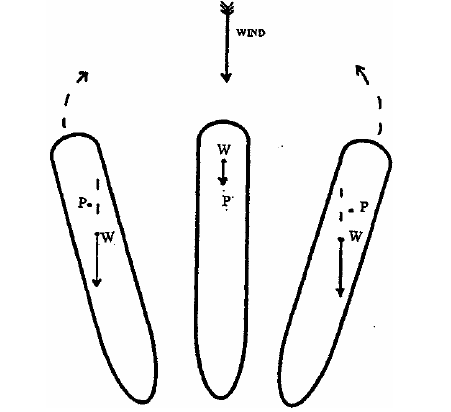
Vessel making Sternway through the water, and with the Wind directly Astern. P has moved aft, fairly close to W, which remains even further aft. A change in relative wind direction will eventually move W forward of P.
Following effects will be experienced :-
a) The Wind Force will develop a turning moment about P, tending to turn the vessel’s Stern back into the Wind.
b) The Wind Force will develop a sideways force on the vessel, away from the exposed side.
Making Sternway through the water, with Stern to Wind, the vessel is again “course stable”.
If the ship has a large Trim by the Stern W may move further forward, generally improving “course stability”; however with such a Trim there is always the possibility of unpredictable loss of control. Calculations
Good job