Cargoes in chemical tankers
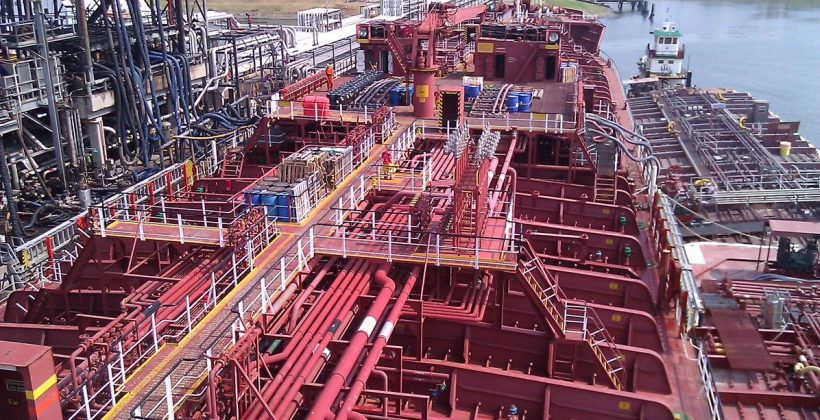
A chemical tanker is primarily designed for the carriage of dangerous chemicals in bulk. These chemicals are listed in the IMO Bulk Chemical Codes.
In addition to the cargoes listed in the Codes, chemical tankers may carry a variety of other liquid products. Some chemical tankers carry a wide range of products, which would normally are considered as unrelated to chemicals. Examples of such cargoes are fruit juice, water, molasses, animal and vegetable oils, clean petroleum products and lubricating oils.
Chemical cargoes
Chemical tankers are divided into four groups by the cargoes they carry:
- Petrochemicals
- Alcohol
- Vegetable and animal oils and fats
- Acids and inorganic chemicals
Petrochemicals’ is the collective name for organic chemicals derived from crude oil, natural gas or coal
Alcohol may be derived from hydrocarbons or produced by fermentation.
Vegetable and animal oils and fats are products derived from seeds of plants and from fat of animals and fish.
Acids may be organic or inorganic
Did you know?
There are over 25000 known inorganic compounds.
Lavoisier obtained acidic solution by dissolving the oxides of many non-metals in water. From this, he wrongly concluded that Oxygen was the essential element in all acids. Later Davy, proved that hydrogen was the essential constituents of acids
Production and use of liquid chemicals
The number of liquid chemicals suitable for bulk transport in chemical tankers has increased gradually over the years and is now counted by the hundreds.
Most of the products shipped in chemical tankers are petrochemicals, which constitute the feedstock for plastics, synthetic rubber, synthetic fibres, agricultural chemicals and detergents
The main sources of petrochemicals are the light gaseous hydrocarbons obtained from processing crude oil in refineries and natural gas. Ethylene, propylene and butadiene are some of the basic petrochemicals.
Gases from crude oils and from natural gas are obtained through processes. Some petrochemicals may be derived from coal.
Methanol is the most common alcohol carried as cargo in chemical tankers
Hazards
Hazard evaluation of chemicals is a complex problem stemming from the combination of the flammability and toxicity characteristics of the chemicals as well as from design and operation hazards.
Flammability hazard
Vapour given off by a flammable liquid will burn when ignited provided it is mixed with certain proportions of air. The limiting proportions expressed as a percentage by volume of flammable vapour in air, are known as the LFL and UFL. In addition a flammable liquid must itself be at or above a temperature high enough for it to give off sufficient vapours for ignition to occur. This temperature is called flash point. Some cargoes evolve vapour at ambient temperatures others only when heated.
Safe handling procedures depend upon the flammability characteristics of a product. As mentioned above the flammable cargo presents a fire risk when mixed with a certain proportion of oxygen. By filling the ullage space with an inert gas such as nitrogen or the output of a inert gas generator, the oxygen levels can be reduced to a level at which atmosphere cannot lead to combustion of the flammable mixture. It is important to note here that in an inerted tank the atmosphere may become flammable if air is admitted.
Warning
It must also be noted that an inert atmosphere does not sustain life and any person entering such an atmosphere must follow strict procedures for entry into enclosed spaces.
Health hazard
Many chemicals are highly poisonous, either in the form of liquid or vapour or both. The problem is sometimes made worse by the fact that toxicity can be increased when vapours from one substance come into contact with those from another.
Toxicity- is the ability of a substance to damage, destroy and kill living cells and tissues
Asphyxia- is caused by the ability of a substance to reduce the oxygen content of air
Anaesthesia- is caused due to the effect of vapours of certain cargoes on the body’s nervous system causing loss of consciousness.
Corrosivity – the ability of a substance to destroy the tissues of the skin.
Toxic chemicals may enter the body by:
• Inhalation
• Ingestion
• Skin contact
The harmful effect of a cargo depends on both its physical and its chemical properties.
The inhalation hazard depends primarily on the volatility of the liquid. If swallowed, all poisons are dangerous.
Some cargoes are irritants on human tissues, strongly corrosive liquids destroy human tissue and less corrosive liquids may only be irritating to the skin, but may cause serious damage to eyes or to mucous membrane.
Absorption- of a cargo or of its vapour through the skin depends on the solvent nature of the cargo.
Cargo or cargo vapours may absorb oxygen and entry in such space may cause asphyxia
Some chemicals may evolve toxic vapours if they are in contact with other cargoes or reactive agents
Toxic vapours may be generated when certain chemicals are on fire
Some inhibitors are toxic and when handling them on board if the period of the inhibitor has expired (due to an extended voyage), the handling of inhibitors should be done with proper and extensive care with the use of adequate personal protective equipment.
Toxic gases: Inert gas is toxic. The Nitrogen oxides, Sulphur oxides, Carbon monoxides are also toxic and under the new Marpol Annex VI (air pollution) regulations will undergo stricter control on discharging these gases into air.
Poisoning
A poison is a substance which when absorbed into the human body, produces a fatal effect. Regardless of the route by which a poison enters the body, following precautions are necessary when handling poisons
Segregation of poisons from other cargoes
Tanks adjoining those which contain edible cargoes should not be loaded with poisons, unless the tanks are separated by another empty tank, cofferdam, pump-room, or a tank containing non-edible cargo (which in turn should not react dangerously with the poison).
Segregation of poisons from the sea
Double skin vessels should generally be used for cargoes whose escape into the sea may cause a severe environmental hazard. However, ships having three or more transverse tanks but no double bottom can be used, but only the inner tanks should carry such cargo.
Segregation of cargo pumps, cargo piping and cargo venting systems
Cargo pumps, piping and venting systems used for tanks containing poisons should be segregated from other such equipment. For piping systems, this implies that there should be no connection between the two. Valves, blank flanges, etc. should not be accepted, but removable pipe sections are suitable.
Cargo piping for tanks containing poisons should not be led through other cargo tanks or through tanks containing bunkers unless encased
Segregation of poisons from accommodation, machinery and other working spaces outside the cargo section
Poisons should be stored in tanks, which lie as far away as possible from accommodation, machinery and other working spaces, and should not be stored adjacent to bunker tanks.
Cargo heating and cooling systems for poisons
Precautions should be taken so that poisons do not enter other cargo tanks, dry cargo spaces, piping systems or machinery spaces by way of heating or cooling systems.
Venting tanks containing poison
Vent outlets from tanks containing poison should have an unimpeded vertical discharge well above the upper deck level, using temporary extensions if required. There should not be any fitting in the outlet, which deflects escaping vapours from moving vertically upwards. The outlets should be as far away from the accommodation as possible, and if possible a closed ullage arrangement should be made so that escape of vapour, liquid spray or mist during ullaging is minimised.
Additional pump-room precautions for poisons
Strict pump-room precautions are required to safeguard personnel who enter the space, and to minimise the amount of vapour, which is released from ventilation outlets into the vicinity of the living quarters.
Natural ventilation of pump rooms is not enough; and if pump-room fans are not permanently installed, a temporary arrangement should be made.
Ventilation fans must be started from outside prior to cargo handling operations and should be kept running throughout.
Ventilator outlets must be trimmed away from doors and accommodation.
Poisons should not be allowed to collect in the bilges, and in case of poisons heavier than water, any water in the bilges should be checked for a poisonous layer beneath.
Personnel wearing breathing apparatus should periodically check all valves, joints, etc. for any leakage, and if found, all operations should be stopped till the leak is controlled.
Vapour from toxic chemicals is heavier than air. Pump-room bottoms and the vicinity of pumps where chemicals may spill onto hot steam lines are therefore the danger areas.
Spillage of poisons
Pipelines and hose connections should be frequently checked for leaks and spillage, and joints repaired immediately if a leak is found.
Before disconnecting hoses, the pipelines and hoses should be cleared of cargo, and the pressure must be slowly released.
If a big leak or spillage occurs, the operations should be paused, and shore authorities notified.
All personnel working on the leaks should wear proper breathing gear and protective clothing, and no one should be allowed into the region without such equipment.
Cleaning the tanks after carrying poisons
If at sea, the ship should be in such a position that the wind does not blow vapour into the accommodation region.
On shore, the authorities should first be notified and such operations should only be done when the wind blows the vapour away from shore.
The gas freeing system used should dispel the vapour vertically upwards with sufficient speed.
Water alone is not enough for tank washing unless the cleaning acids react with the poison. Hand hoses should not be used.
Disposals should be as per regulations.
Fires involving poisons
Fire causes more vaporisation of poisons or helps the poison to decompose resulting in toxic products. This results in greater danger from the poisons.
Toxic cargoes should not be stowed in tanks adjacent to tanks containing edible cargoes, and should be as far as possible from accommodation and from machinery spaces.
Reactivity: Reaction to other substances
Some chemicals react to water, to air or to other products. Measures therefore have to be taken to protect them. Apart from the fact that an accident can lead to a dangerous reaction (such as the emission of a poisonous gas) many chemicals can be ruined if they are contaminated by other substances. Methanol, lubricating oil additives and alcohols can be spoiled by even a slight amount of water contamination. Too much oxygen can lead to a rapid deterioration in the quality of some vegetable oils. Other products can change into a different product completely. A chemical cargo may react in a number of ways, such as with:
• Itself
• Air
• Water
• Another cargo
• Other materials
• Self-reaction
Special consideration has to be given to the possibility of chemicals undergoing a chemical or physical reaction during cargo handling and transport conditions thereby creating additional hazard.
Chemical reaction may produce heat, which in turn may accelerate the reaction. This may cause the release of large volume of vapour and/or a pressure rise, or cause the formation of flammable and/or harmful vapours that otherwise should not be allowed.
In principle, the, dangers arising from chemical reaction are those of increased fire and health hazard.
Main types of reactions
• Self-reaction and reaction with air where only the particular chemical itself is involved. Small amounts of other chemicals or contact with certain metals may promote reaction. Polymerisation is a common type of self-reaction. Cargo, which is self-reactive, may also react with other cargoes
• Reaction because of mixing one chemical with another. Neutralisation of an acid with an alkali is a typical example of one chemical reacting with another.
• Reaction because of mixing with water. A cargo, which is self-reactive as in (a) or reacts with others as (b) may also react with water.
Self-reaction and reaction with air
Self-reaction or reaction with air can occur in the Liquid, in the vapour or in both.
Control of temperature and the avoidance of unsuitable materials in the cargo system and contamination by even small amounts of other cargoes all contribute to the safe carriage of self-reactive cargoes.
Polymerization
Some substances, such as petrochemicals, do not need to come into contact with another chemical before undergoing a chemical change – they are self reactive and liable to polymerization unless protected by an inhibitor. This is a process whereby the molecules of a substance combine to produce a new compound. The process can be accelerated by catalytic factors such as heat, light and the presence of rust, acids or other compounds. Styrene, methyl methacrylate and vinyl acetate monomer are examples. Propylene oxide and butylene oxide are also liable to polymerization.
Reaction may be promoted by heat and by the presence of certain metals and other cargoes in small amounts.
Reaction in the liquid can be retarded by inerting or by adding to it a small amount of a specific chemical known as an inhibitor. Those cargoes, which, in pure form, can undergo a vigorous self-reaction (usually resulting in polymerisation), may only be transported with an added inhibitor.
Inhibitor is a generic term for a compound which, when added to the cargo has the effect of slowing down or stopping a chemical change, i.e. Polymerisation, Oxidation or Corrosion
An inhibitor added to the liquid generally will not retard reaction in the vapour or condensed vapour in the ullage space. Displacing air (oxygen) from the ullage space with inert gas will retard reaction of the vapour therein and inerting may be an additional requirement, even if the cargo contains an inhibitor.
The disintegration of molecules (decomposition)
Where decomposition could occur, negative catalysts slow down a reaction. Thus they can be used to prevent polymerisation and decomposition during the voyage. Cargo temperature should be measured regularly and cooling systems put into operation when necessary. Loading should be stopped if the temperature of the cargo being received exceeds the limit.
Even if temperature control is not a specific requirement it is recommended that self-reactive chemicals be never stowed in tanks directly adjacent to heated cargoes nor handled through pipelines, which pass through tanks containing heated cargoes. In addition, it is recommended that cargo tank tops are kept cool by water spray. When ambient temperatures are high, this tends to retard reaction in the vapour space.
Before loading, the cargo tanks and cargo handling system should be thoroughly cleaned to remove other cargoes that may promote self-reaction of the cargo to be loaded.
Special precautions for inhibited cargoes
When the cargo requires to be inhibited as a condition of safe transport, the following additional precautions should be taken:
• The Master should verify with the shore representative that the cargo would be correctly inhibited before loading, otherwise loading should be refused.
• The Master should also verify that the concentration of inhibitor would be sufficient to prevent dangerous reaction during the voyage taking into account its duration and the expected or required maximum cargo temperature. The Master should ensure that sufficient stock of inhibitor is put on board before sailing, for addition to the cargo as necessary together with instructions for introducing it. Additional stocks of inhibitors be ordered if the inhibitor is likely to be consumed or if regular checking of the cargo for inhibitor concentration during the voyage is advised,
• If regular analysis is necessary instructions should be obtained from the shore representative on the method of analysis.
• Care should be taken during the handling of the inhibitor, which may present a health hazard.
• Special attention should be given during the voyage to the cargo tank vent system, which may become blocked by solid reaction products.
• Special Precautions for Cargoes which Require Exclusion of Air: When inerting to exclude air from the cargo system it is essential that the following additional precautions should be taken for safe carriage: –
• The cargo handling system for the tanks should be independent of all others and cross-connection by accident should not be possible.
• The cargo should be handled in a closed system, with a closed ullaging or other arrangement to minimise the escape of vapour or ingress of air. Vapour or air as displaced during loading preferably should be returned ashore by vent line.
• Before loading, the oxygen concentration in the cargo tank(s) and associated handling system should be reduced below the permitted maximum by purging with inert gas.
• The inert gas supplied by ship or shore should be of high purity. Preferably nitrogen’ should be used although other gases or vapours could also be considered. Inerting of the cargo spaces only at the loading port may not be sufficient. A quantity of additional inert gas should be carried on board in order to maintain a proper inert atmosphere in the event of normal loss or leakage from the cargo space.
• The Master should ascertain the maximum oxygen concentration permitted in the cargo space at any time during cargo handling and on voyage and that means are available for measuring it. When it is a requirement, the oxygen content in the space should be reduced below the limit before loading starts.
• Pumps may discharge the cargo but inert gas and/or cargo vapour should be supplied to the tank during cargo discharge. Alternatively, the cargo may be discharged by inert gas pressure but only if the working pressure of the cargo tank and handling system is not exceeded. Air pressure should never be used for cargo discharge or to assist in cargo discharge.
• On completion of cargo discharge, the ship/shore hose connection should be cleared of cargo with inert gas before disconnecting. The tanks should be closed and kept inert unless they are to be gas-freed for any purpose.
• A water supply should be ready for immediate use during cargo handling to wash away spillage,
• If gas freeing is necessary after cargo discharge the operation should be conducted preferably alongside with the displaced vapour being returned ashore for venting. If this is not possible vapour should be released through vents terminating well above deck level.
• If a tank has to be washed first for cleaning, the washing operation should be carried out when the tank is still inert. Then the tank should be gas-freed by purging with inert gas until cargo vapour has been largely removed, followed by air until the tank is free of vapour and the oxygen content restored -to normal atmospheric level (21%).
Reactivity with other cargoes
To establish whether two cargoes will react dangerously together, the data sheets for both cargoes should be consulted.
When the data sheet indicates that a dangerous reaction may result by mixing the cargo in question with another, “double” separation should be provided as greater security against accidental mixing.
“Double” separation involves
A pump-room, cofferdam or similar void space (which may be an empty cargo compartment) between tanks or compartments containing incompatible cargoes,
or
At least one compartment loaded with a cargo compatible with each, and separating, the incompatible cargoes,
and
Independent cargo pipelines to each compartment containing incompatible chemicals and which do not pass through any compartment containing other incompatible cargoes unless the pipeline is in a tunnel or similar arrangement,
and
Independent vents systems on each compartment, containing incompatible cargoes.
Guidance when sufficient reactivity data is not available
Those responsible for soliciting, booking and scheduling parcel cargoes of chemicals normally satisfy themselves that the various parcels scheduled for any given voyage of a ship are mutually compatible and can be safely loaded and carried within the normal segregation of the ship.
Since the ultimate responsibility for safety of the vessel lies with the Master, he should assure himself by inspection of the data sheets that the cargo distribution proposed for any voyage provides proper segregation of all parcels from the standpoint of compatibility.
If the data sheets do not provide the necessary information, the Master should defer loading of the cargo until he has been able to consult with his owner, and receive satisfactory assurance that the cargoes to be loaded and the proposed plan of segregation are indeed compatible and safe.
It cannot be emphasised too strongly that parcels of chemicals should not be accepted for shipment or loaded on a vessel unless assurance is available that the various chemicals are compatible within the basic pattern of segregation of the vessel itself.
Reaction with water
The data sheet indicates if a dangerous reaction is possible between a chemical and water. If such a reaction is possible “double” separation between the chemical and water is recommended.
“Double” separation involves
Double skin as provided by a double bottom and side cofferdam between the cargo and the sea,
and / or
a cofferdam or similar void space (which may be an empty cargo compartment) to separate the tank containing the cargo from tanks containing water, or, at least one compartment loaded with a cargo, which is compatible with the cargo in question and with water,
and
Pipelines serving the cargo tank should be independent from lines serving any tank containing water and should not pass through any tank containing water, or vice versa unless the pipeline is in a tunnel or similar arrangement,
and
Vents systems serving the tanks containing the cargo should be independent from vent systems serving tanks containing water.
Environmental hazards (Pollution)
While many of the factors present problems for the ship and crew, a considerable number of chemicals are extremely dangerous to marine and other forms of life. Although crude oil is probably the best-known pollutant of the sea, many chemicals are in fact far more poisonous and present a much greater threat – a threat which can be more long lasting, since some of the chemicals concerned can enter the food chain and ultimately threaten humans as well as marine life. Marine pollution by chemicals may be caused by accidental or intentional discharge into the sea of cargo, such as through:
• Collisions and stranding
• Lightening operations
• Tank washing and line flushing
• Deballasting
• Overflow from tanks
• Leaking hoses or loading arms
• Equipment failure
Pollution prevention
Cargoes, which present a major pollution hazard, should not be stowed in contact with the ship’s shell plating. International regulations for the control of marine pollution by cargoes from chemical tankers are set out in Annex II of MARPOL 73/78.
The revised Annex II Regulations for the control of pollution by noxious liquid substances in bulk includes a new four-category categorization system for noxious and liquid substances. The revised annex has entered into force on 1 January 2007 and the details are given in the previous modules.
Other operational Hazards
Cargo density
The specific gravity of chemicals carried at sea varies greatly. Some are lighter than water. Others are twice as dense. Those substances have especially high density include inorganic acids, caustic soda and some halogenated hydrocarbons.
High viscosity
Some lubricating oil additives, molasses and other products are very viscous, especially at low temperatures. As a result they are sticky and move very slowly, causing problems in cargo-handling and cleaning.
Low boiling point
Some chemicals vaporize at a relatively low temperature. This can causes containment problems as when a liquid turns into a gas it expands thus increasing pressure. It is necessary, therefore, to provide either a cooling system or to carry the chemical in specially-designed pressure vessels.
Solidification
Some substances have to be kept at a high temperature; otherwise they solidify or become so viscous that they cannot easily be moved. Examples are some petrochemicals, molasses, waxes and vegetable oils and animal fats.