Reg. 25 Ch II – 1 of SOLAS deals with subdivision & damage stability of Cargo Ships.
Reg.25-8: Master shall be supplied with such reliable information so as to have raid & simple means to obtain accurate guidance as to stability under varying conditions of service.
Information to include
1. Minimum operational GM Vs Draft maximum allowable KG Vs Draft
2. Instructions regarding ‘Cross-flooding Arrangements’.
3. Data & aids necessary to maintain ‘Stability after Damage’
4. On the bridge following to be available
- Details of W/T compartments
- Closing arrangements/controls
- Control of list due to flooding
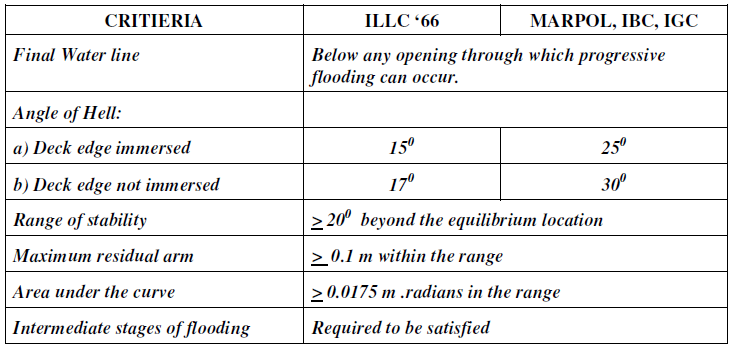
Other statutory instruments viz MARPOL. LL rules etc also talk about damage stability & survivability. Reg. 25-1 of SOLAS states, ‘If any ship complies with damage stability requirements of any other instrument (under Organisation) then she need not comply to SOLAS requirements.
Annex 1 MARPOL
Master of every new oil tanker & in – charge of new self propelled oil tanker to which annex applies should be supplied with
- Data on ability of ship to comply with criteria as determined by this reg. Including the effect of relaxations that may have been allowed under 1 (c).
Effect of Damage (bilging):
- Loss of buoyancy & hence reserve buoyancy
- Reduction of freeboard
- Change in transverse stability (may increase, decrease or remain same).
- List (development or change in)
- More exposure to weather & hence more free surface on exposed decks.
- Loss of longitudinal strength (Loss is more if damage is on DK on Bottom and less when on ship side)
Analysis of Damaged Condition (Box Shape)
Collisions of 3 types
High energy – Foundering may be instant or over a period of time
Moderate Energy – May allow lot of time to repair, assess proceed to port of shelter
Low energy –hit by barge, wharf etc.
Where lot of time is available like is Moderate Energy Collisions knowledge of Master regarding “Analysis of Damaged Condition” is most important.
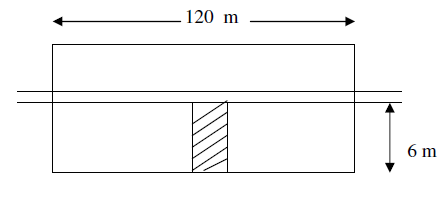
Lost Buoyancy calculations Box ship
In the figure Damage compartment length is 18 m, Breadth 15 m. Vertical extension unrestricted
Intact condition
KB =6/2 = 3m
(120×15³)/12
BM=I/V= —————— = 3.125 m
120 x 6 x 15
KM = KB + BM = 3 + 3.125 = 6.125 m
Where KG = 4.2 m
GM = 6.125 – 4.2
GM = 1.925 M
Damage Condition
Lost buoyancy = 18 x 15 x 6 = 1620 m3
Lost buoyancy – Sinkage x Intact water plane
LB 1620
Singkage = ——- = ——– = 1.059 m
LWPA (120-18)15
New Draft 7.059 m
…. Uniformly damaged and Box vessel KB = draft/2
KB = 3.529 m……….(2)
New BM (reduces as WPA is lost)
(120-18) x 15¹/12
———————-
120 x 6 x 15
After damage the displacement. U/w intact volume and KG are unchanged
BM = 2.656 m …………….. ( 3 )
KM = (2) + (3) = 6.185 m ….. KG = 4.2 m. GM = 1.985 m ……….. (4)
(Note GM is increased)
Analysis of Damaged Condition (Vessel)
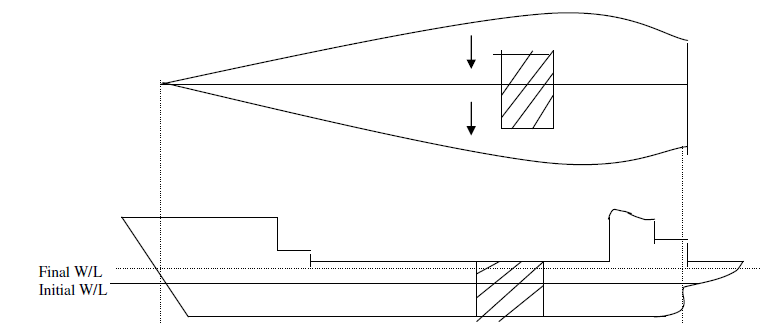
Real ship to understand let us assume the bilged compartment to be rectangle and amidships.
KG and underwater volume does not change with damage hence calculate for initial conditions.
To find KM in final condition
KM = KB + KB
To find new KB
Use GA plan to find volume of lost compartment below water level (original draft) say draft was 8 m
LB = I x b x 8 = 8 1b ( If permeability is 70% then. 7 x 8 I b is lost )
WPA can be found as follows
At required draft check TPC from tables
WPA = (TPC X 100)/1.025
Thus if TPC was 22 then WPA = (22 x 100)/1.025 = 2146.3 m2
Lost water plane = Ib ( .7 Ib if permeability = 70%)
Sinkage = LB/ Intact water plane = g Ib / (2146.3 Ib)
If I = 14m b = I g m
New draft = g + 1.064 = 9.064 m
Note KB for draft 9.0654 m say it is = 4.96 m
For new draft find gross underwater volume as follows:
Read displacement from tables against new draft.
Find gross u/w volume (disregarding the damage) as equal to displacement / 1.025
The gross u/w vol = 14000 t/1.025 = 13658.5m3
Damaged compartment = 14 x18 x 9.064 /2 = 2284m3 x 4.532m above keel.
(13658.5 X 4.98) – (2284 X 4.532)
New KB =——————————————– (A)
Original u/w vol (11374.5)
= 5.046m
To find BM For new draft 9.064m check KM from table
For new draft check KB from table
KM = KB = BM = MI/ Vol at new draft (Displacment/1.025)
Thus MI of undamaged intact WPA is found for the new draft.
Loss of M2 = 14 x 18 3/12 = 6804 m3
New BM = MI of intact area at new draft – 6804 / original vol ……..(B)
(A) + (B) – KG = new GM
To Find Trim
Take moments of lost buoyancy wrt new centre of floatation
Moment + v x d ………………..(d measured in fore & aft direction )
V x d/ UW V (intact) = [ BB’ is horizontal shift of b in fore & aft direction ]
BB’/GM’ = t/LBP or trim or ‘t’ = BB’ x LBP / GM’ ( thus trimean be found )
IMPORTANT TIPS
Approximate determination of transverse stability without doing detailed calculations.
1. GMT is very low if with small transfer of fluid from one side to other changes the list.
2. Ship develops excessive heel when a weight is lifted using ship’s gear at an offcentre position or from the wharf.
3. GMO = ( f x B/T )2 …. f varies between 0.7 & 0.9, B is moulded breadth & T is true rolling period.
4. Sine Heel = W x (Velocity in m/s)2 x ( KG – half draft) / 50 Length w –line .
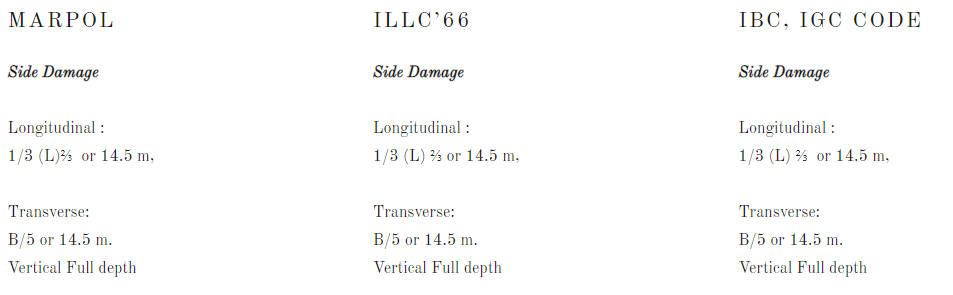
IMO REGULATIONS – EXTENT OF DAMAGE