1. Heat is a form of energy and is measured in JOULES(j)
N= Kg.m N = Unit for force(Newton)
S²Kg=Unit for mass(Kilograms)
J=N.m
m = Unit for length(metres)
J= Kg.m .m
s =Unit for time(seconds)
S²j = Unit for heat (joules)
work and energy
1 Joules = 0.239 calories.
The quantity heat capacity ( C ) tells us how much heat expressed in Joules is needed to raise the temperature in a body from temperature T1 to temperature T2.
C = Q
‾‾‾‾‾‾‾‾‾‾
T2 – T1
Q = heat applied(J)
T2 – T1 =temperature difference(K)
C =heat capacity (J/K)
Specific heat capacity (C) for a material is the amount of heat applied (in joules) to raise the temperature by 1 degree K for every 1 Kg of material. Concerned.
The formula for specific heat capcity ( c ) is:
c = C/m
Specific heat capacity for water is 4180 J/Kg.K
Energy which is used to evaporate a material is called evaporation energy.
It is defined as follows.If the heat quantity (Q) is needed to trafer a liquid with mass (m) to a gas with the same temperature, then the specific heat of evaporation ( r ) is:
r = Q/m
Avogadro’s law
States that “Equal volumes off different gases contain the same number of molecules at the same pressure and temperature.
The volume of 1 mole of gas ( 6.02 x 10²³ gas molecules) is called molar volume of the gas.
The molar volume can be found for the so- called “ideal gas” at 0°C and at atmospheric pressure the molar volume is 22.414 litre/mol.
Example:
For 1 mole of oxygen molecules (O2) has a mass of 32g(rounded off)
In short 22.414 litres contains 32g of O2.
The density is 32g/mol
_________
22.414litre/mol
Dalton’s Law
Dalton’s law is relevant when we mix two different gases The sum of the pressures of the two gases is equal to he total pressure.
Each gas will behave as though it was alone The larger portion of the partial pressure the gas exerts. The larger its effect will be on the density
Dalton’s Law is as follows
PT = PA + PB = (nA + nB) . R . T
____________________
v
PT = total pressure
PA+PB = partial pressure
nA = no. of moles of gas A
Nb = no. of moles of gas B
R = the gas constant = 8.314J/K.mol
T = temperature of gas in K(Kelvin)
V = volume of gas in m³
GENERAL GAS EQUATION IS
PV = nRT
P = pressure of gas in Pa (Pascal)
V = volume of gas in m³
n = number of moles of gas
R = gas constant 8.31434J/K.mol
T = temperature of the gas in K (Kelvin)
Vapor calculation on gas carriers.
There are basically two formulae for calculation of vapor, its depended on the gauge fitted to the tanks whether its in Bar or Kg/cm².
The basic formula is the same.
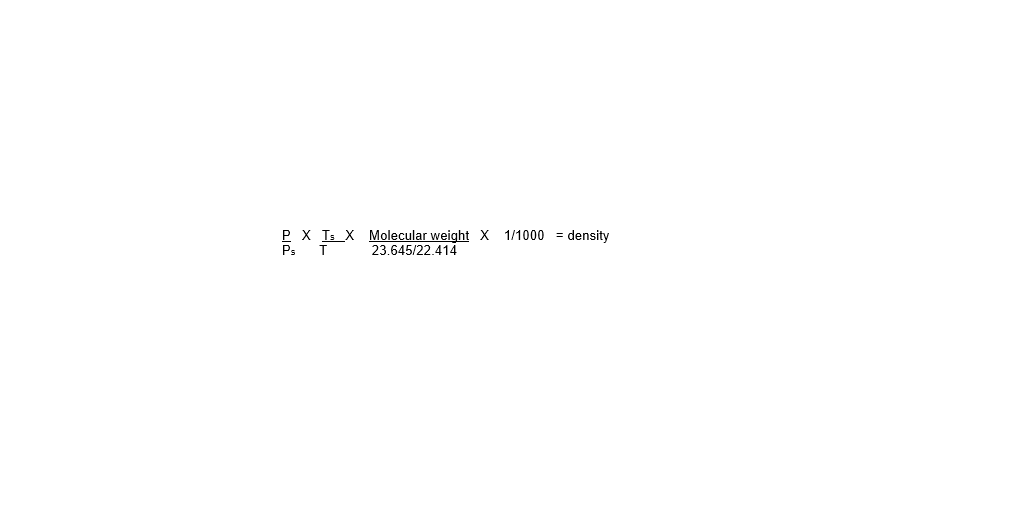
1) When ship’s gauge is in Bar
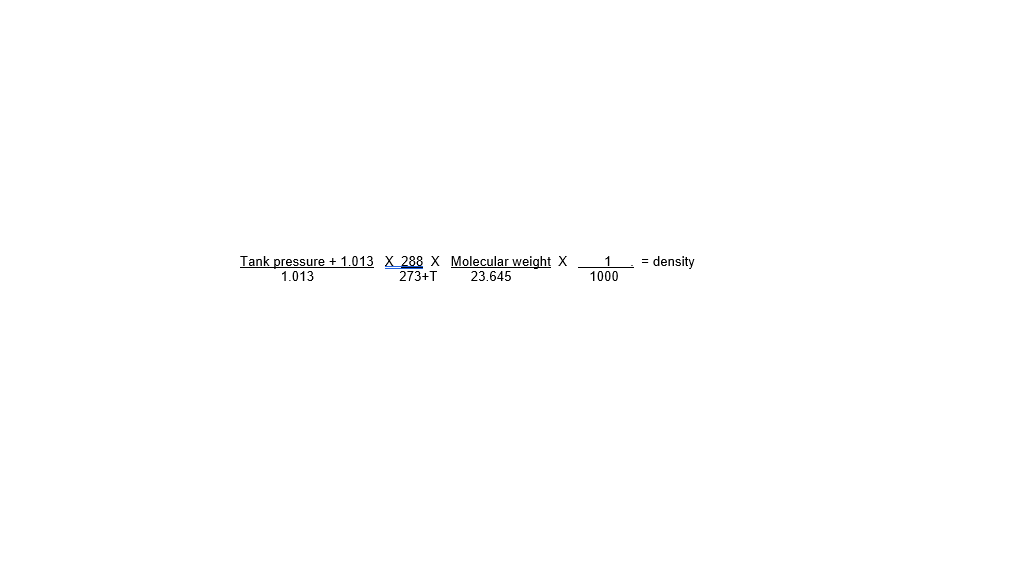
2) When ship’s gauge is in Kg/Cm2
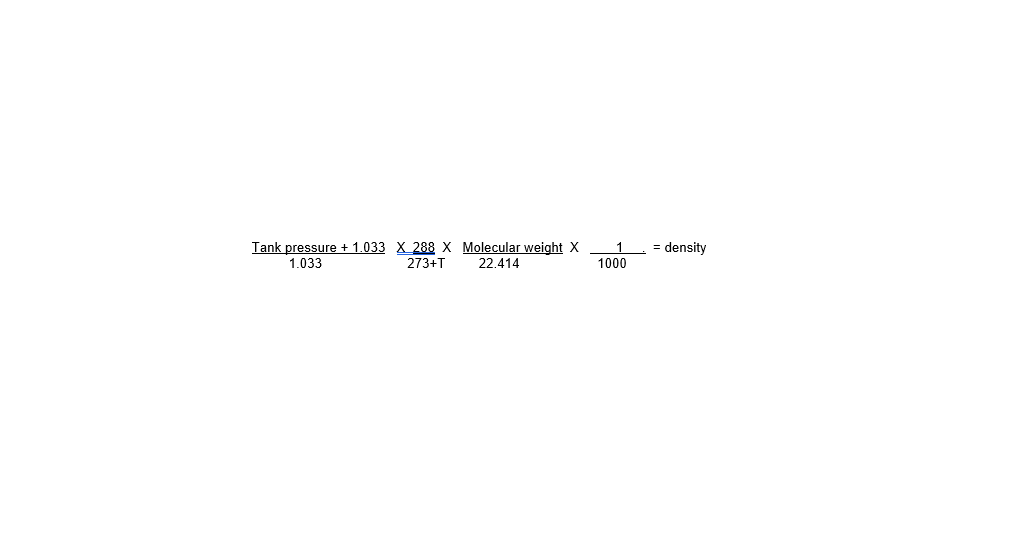
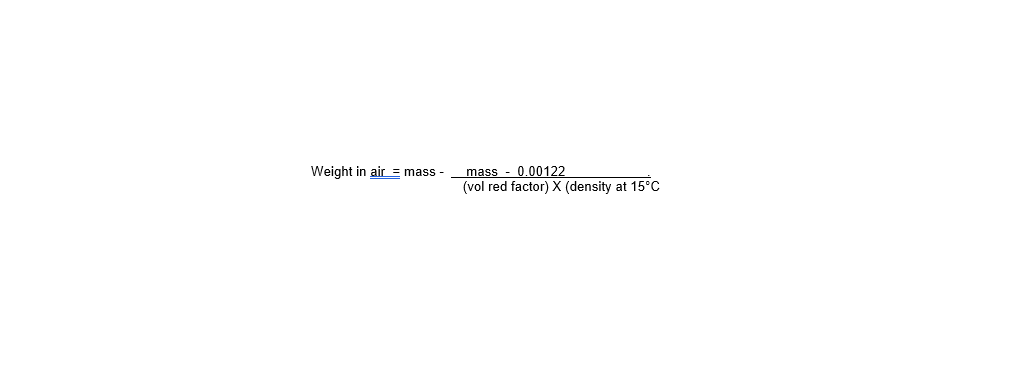
Density is tones in vacuum.
If the mass(weight in vacuum) is to be calculated as “weight in air then the following formula can be used.
Example for calculation of partial pressure.
A ship is carrying a cargo of 100mt of propane and 400mt of butane. The propane and butane have to be mixed in one of the tanks. The tank temperature is -8°C
The saturation vapor pressure for propane at this temperature is 3.69bar
The saturation vapor pressure for butane at this temperature is 0.78bar.
We have to calculate what is the saturation pressure of the mixture(total pressure in the tank)
Secondly what will be the mixing conditions of the vapor phase above the liquid surface (the vapor mixture sucked into the reliquefaction system).
Answer
First of all we have to calculate how many mole we have of Propane and Butane respectively. We must therefore find molar mass of these substance.
Propane chemical formula Is C3H8
Molecular mass propane (C3H8)= 12.01115g/mol x 3 =36.03345g/mol + 1.00797g/mol x 8 = 8.06376g/mol =44.1g/mol
Molecular mass butane (C4H10) = 12.01115g/mol x 4 =48.0446g/mol + 1.00797g/mol x10 =10.0797g/mol =58.1g/mol
The mass ratio between Propane and Butane is 100mt :400mt
Same we can say 100g : 400g
m = n
—
Mr
m=mass Mr =molecular mass
n=no. of moles
a) no. of moles of propane = 100g/44.1g/mol =2.27mol
b) no. of moles of butane = 400g/58.1g/mol =6.88mol
total = 9.15mol
hence we calculate the mole fraction in liquid for both gases
Propane =2.27/9.15 =0.248 =24.8%
Butane =6.88/9.15 =0.752 =75.2%
Partial pressure of propane =0.248 X 3.69bar = 0.915bar
Partial pressure of butane =0.752 X 0.78bar = 0.587bar
Total = 1.502bar
Hence tank pressure (sat . press – atm press = 0.502bar
The mixing ratio of the gas phase(over the surface of the liquid is calculated as follows:
Propane in the vapor phase:0.915bar/1.502bar= 0.609=60.9%
Butane in the vapor phase:0.587bar/1.502bar =0.391 =39.1%
DIFFUSION SPEED OF GAS
The diffusion speed of gas is inversely proportional to the square root of the molecular mass of the gas.
V1 = √M2
— —
V2 √M1
M is molecular weight of the particular gas.
Example:
NH3 has a diffusion speed of 0.09cm/s at a specific pressure and temperature .What is the calculated diffusion speed for propane under the same condition.
0.09cm/s = √44.09g/mol
——– ————
V2 √17.03g/mol
Therefore diffusion speed of propane is 0.0559cm/s
Example for calculating time required to decrease the a set number of degrees for a gas cargo(we shall not consider heat losses).
Data.
Process plant: single stage direct cooling
Cargo: Propane (pure)
Cargo Quantity: 1000m/t
Tank Temperature :-5°C
Compressor suction Pressure :3.0bar
Compressor suction temperature :+6°C
Compressor delivery Pressure :6.95bar
Compressor delivery temperature :+55°
Compressor suction volume :350m3/hour
Atmospheric pressure: 1000mb
Temp. cargo is to be cooled to -10°C
We will first find the saturation pressure of the cargo from the mollier diagram is
4.06 bar (tank pressure is 3.06bar) by using the cargo temperature.The condensation temperature is +18°C at the corresponding condensation pressure of 7.95bar (we can therefore, assume that the sea water temperature is about +8°C)There after we take out Enthalpy values for boiling liquid at -10°C , -5°C and +18°C. as well as Enthalpy values for saturated vapor at -5°C. We also need the density of the super heated vapor at +6°C/4.0 bar (abs) .
Note we have marked off certain points of intersection on the diagram with h1, h2 etc.
This is so that these positions can be identified for various calculations etc.
T1 stands for the cargo temperature before cooling and T2 stands for the temperature we will have after cooling off cargo
When we are to calculate the cooling time to cool the cargo from -5°C to -10°C we must first calculate how much heat (enthalpy) we are to remove from each . The enthalpy difference between T1 and T2 shows how much heat we must remove from each Kilo of Propane cargo to reduce the temperature from -5°C to -10°C. We also know how many Kilos of cargo we are to cool down(1000mt = 10,00000kilo)
The calculation will be :
Heat to be removed (Q)= (511.6-499.5)Kj/Kg x 1000000Kg
= 12100000kj.
We now Know the above heat is to be removed and also the capacity of the plant
Hence we can determine the time required.
The formula for net cooling capacity (Qnet) looks like this:
Qnet stands for net cooling capacity
vs stands for compressor volume
∫s stands for density of the vapor on the suction side
∆h stands for the enthalpy difference between saturated vapor after the phase change and boiling liquid before the expansion valve (h1 – h4)
We will calculate the net cooling capacity in our example
Qnet = Vs X ∫s X ∆h
= 350m3/hour X 8.3kg/m3 X (893.2 – 570.2) kj/Kg
= 938315kj/hour
Cooling time = Heat to be removed
———————
Net cooling capacity
= Q = 1210000kj
——– ————-
Qnet 938315kj/hour
= 12.9hrs
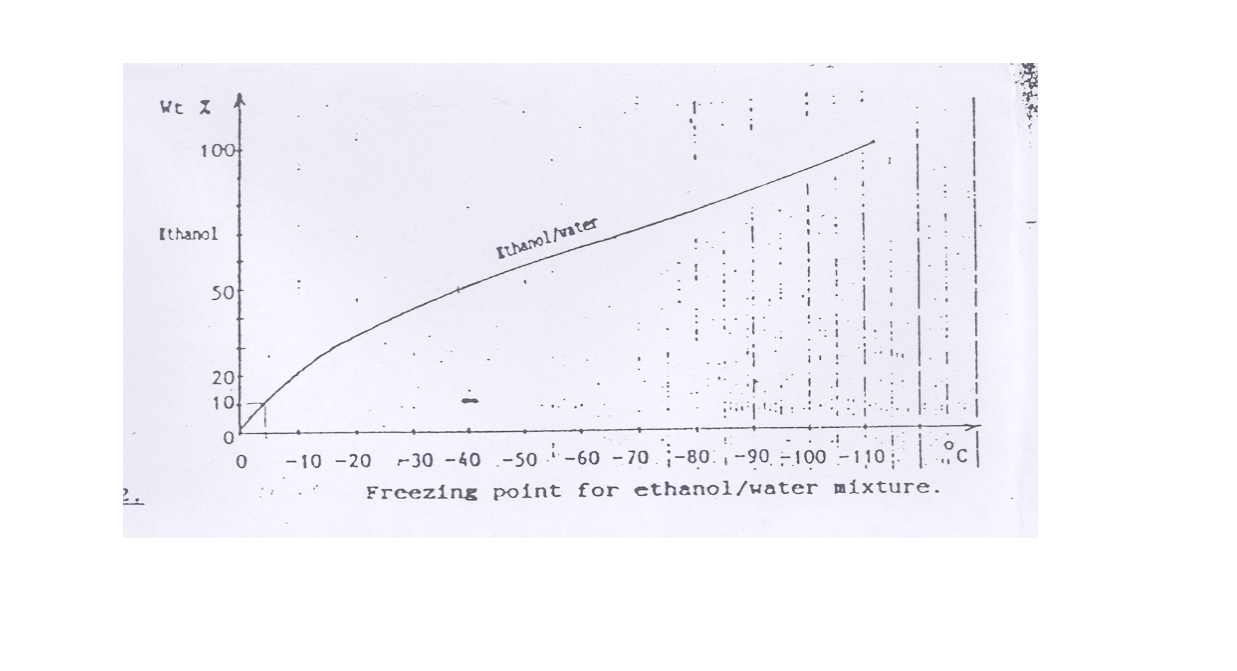
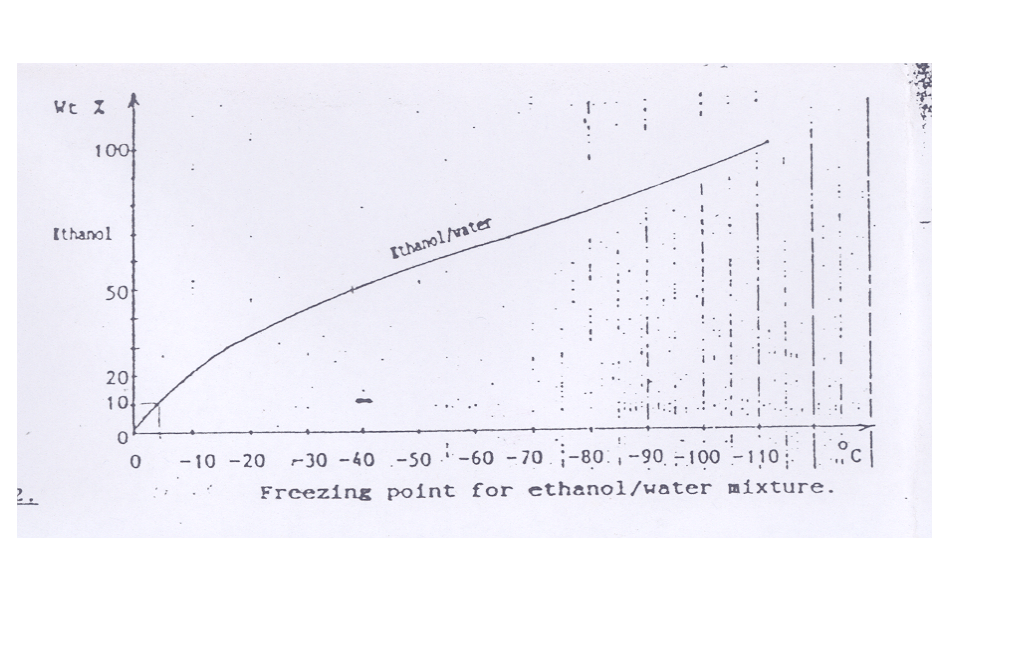
Graph showing % by volume of Ethanol required for reducing the freezing point of fresh water
THUMB RULE FOR CALCULATION OF NUMBER OF CHANGES DURING INERTING
n = In O2‘
—–
O2”
n = number of changes
In = natural logarithm
O2’= vol % before inerting/venting
O2”= vol% after inerting/venting
The formula can also be used when venting with air(Oxygen content of 21 by vol %
n = In O2’-21
———-
O2”-21
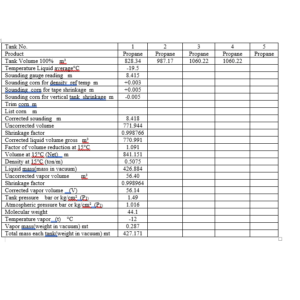
TYPICAL EXAMPLE OF CARGO CALCULATION REPORT