Introduction
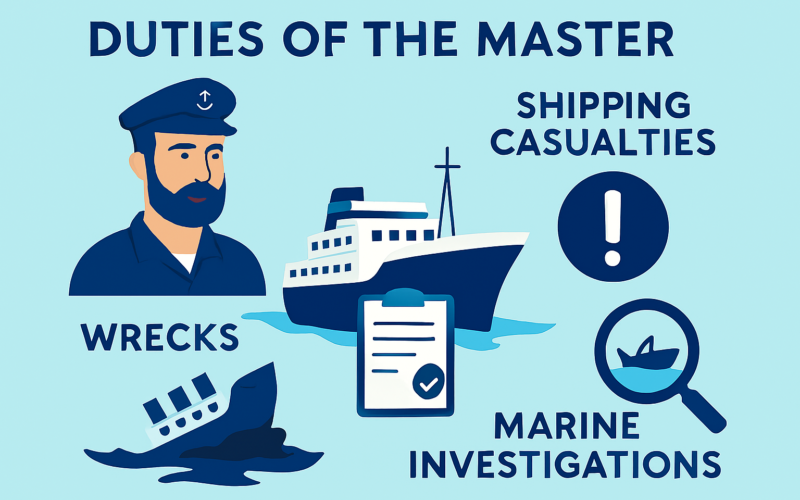
Under the Merchant Shipping Act, 1958, the master of a ship holds a position of critical responsibility. Beyond navigation, the master is legally accountable for safety, reporting casualties, protecting life and property, and cooperating with investigations. The Act establishes detailed procedures to ensure transparency, accountability, and justice following maritime accidents.
Duties of the Master in Case of Shipping Casualties
A shipping casualty is deemed to occur when a ship is lost, abandoned, stranded, or materially damaged, particularly when such events take place on or near the Indian coast. A casualty also includes situations where one ship causes material damage to another, or where loss of life occurs due to an incident on board.
Additionally, if an Indian ship suffers such a casualty anywhere in the world and credible evidence becomes available in India, it is treated as a shipping casualty under the Act. Similarly, if an Indian ship is presumed lost and relevant evidence exists in India regarding her last voyage, reporting obligations apply.
In such cases, the master, harbour master, or pilot must immediately report the casualty to the appointed officer. Upon receiving reliable information, the appointed officer informs the Central Government and may conduct a preliminary investigation.
Preliminary and Formal Investigations
Following a shipping casualty, the appointed officer may initiate a preliminary inquiry to establish basic facts. The report of this inquiry is forwarded to the Central Government.
If necessary, or if directed by the Central Government, the officer applies to a court for a formal investigation. Courts conducting such investigations have the authority to inquire into allegations of incompetence or misconduct against the master, mate, or engineer.
Before any formal inquiry begins, the officer concerned must be provided with a written statement outlining the case and given a fair opportunity to present a defense.
Powers of the Court of Investigation
A court conducting a formal investigation has extensive powers to ensure justice and accountability. It may issue warrants for arrest to secure the presence of witnesses or accused persons and may authorize officers to board vessels for this purpose.
If the court finds a master, mate, or engineer guilty of incompetence or misconduct, it may suspend or cancel their certificate of competency. In cases where such action is not justified, the court may issue a formal censure instead.
The court may also remove a master from command if necessary and appoint a replacement. These powers ensure that only competent and responsible individuals remain in charge of ships.
Marine Boards of Inquiry
In certain circumstances, a Marine Board of Inquiry may be convened by an Indian consular officer or a senior naval officer. This occurs when immediate investigation is required due to complaints by the crew, interests of shipowners or cargo owners, allegations against the master or officers, ship loss or stranding, or loss of life or serious injury.
Constitution of a Marine Board
A Marine Board consists of the officer convening the board, who acts as the presiding officer, and two other members selected for their knowledge of maritime or mercantile affairs. This composition ensures technical expertise and impartiality during investigations.
Powers of a Marine Board
After investigation, a Marine Board may take several actions. It may remove the master if safety or commercial interests require it and appoint a qualified replacement. The board may suspend the certificate of a master or officer found incompetent or guilty of misconduct, provided the individual has been given a fair opportunity to defend himself.
The board may also discharge a seaman and order forfeiture of wages, decide disputes related to wages or fines, order surveys of ships, and allocate costs of proceedings. Orders made by the board are entered in the ship’s official log book and signed by the presiding officer.
Definition of Wreck under the Act
The Merchant Shipping Act defines “wreck” broadly to include goods or vessels found in the sea, tidal waters, or on the shore. This includes goods that have sunk, remain floating, are attached to floating objects for later recovery, or have been abandoned. A vessel abandoned without hope of recovery also falls within the definition.
Preservation of Life and Property in Case of Wreck
The Central Government appoints a Receiver of Wrecks whose duty is to preserve life, property, cargo, and equipment of a wrecked vessel. The receiver may take necessary action to maintain order and prevent obstruction or disorder during salvage operations.
Adjoining land may be used to assist wrecked persons or to land cargo and equipment, and any damage caused becomes a charge upon the ship or cargo. The receiver may also use reasonable force if required to protect life and property.
Obligation of the Master to Render Assistance
The Act places a strong duty on the master to render assistance at sea. When a master receives a distress signal or information that another ship or aircraft is in distress, he must proceed with all possible speed to render assistance unless it is unreasonable or unsafe to do so.
If the master is unable to assist, he must record the reasons in the official log book. All distress signals received and actions taken must be properly logged.
Duties in Case of Collision
In the event of a collision, the master must render assistance to the other vessel, crew, and passengers if it can be done without endangering his own ship. He must remain at the scene until satisfied that no further help is required.
The master must also exchange essential information, including the name of his ship, port of registry, and voyage details. A detailed log book entry must be made, and the nearest principal officer must be informed.
Duties Following a Major Accident
When a vessel meets with a major accident affecting seaworthiness, hull integrity, or machinery, the master must immediately inform the owner, charterers, underwriters, and appropriate authorities. A survey must be arranged at the first port of call, and a protest should be noted to preserve legal rights.
Depending on the circumstances, a certificate of seaworthiness or an interim certificate of class may be issued. Failure to obtain the appropriate certificate can jeopardize insurance coverage and contractual protections.