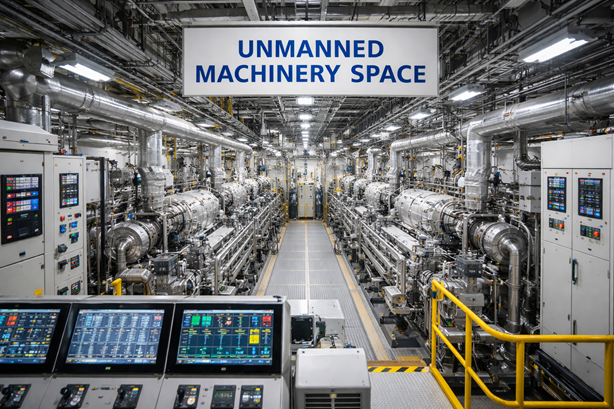
Before Going UMS
Before going UMS, the Duty Engineer must ensure that all day service tanks for fuel, cylinder oil and header tanks for cooling water, lubricating oil, etc are full. An inspection of all active and operational machinery and systems in all the machinery spaces, particularly for fuel and lubricating oil leakage, is to be carried out.
- That the main engine is on bridge Control
- Check that all bilges and seawalls are empty.
- Test Oil Mist Detector alarm on M.E , test bilge wells High Levels Alarms , test Boiler High/Low/Cut out alarms where applicable
- Check that bilge pump is in auto position.
- Check that Emergency DG is in stand-by position.
- Check that Stand-by DG is on auto-start.
- Check that steering gear motors are in stand-by position.
- Check that all stand-by pumps are on auto-start.
- Check that OWS overboard valve is secured (OWS stopped when E/R unmanned and if not automatic discharge).
- Check that all fire loops are activated.
- Check whether all watertight and weather doors/openings are closed.
- Check that the Purifier Room and Steering Gear door is closed
- Check cabin / public rooms alarms prior to the engine room being unmanned.
- Inform bridge and confirm UMS before leaving E/R
- Check that all flammable liquids are in sealed canisters.
- Check that all oil spills etc have been cleaned up.
- Check that all waste, rags and other cleaning materials are stowed away.
- Check that all Engine Room gear, spare parts etc are properly secured.
- Check that all alarms are active.
- Check that all fire detection sensors are active.
- Check that all fire doors are closed.
- Test the “Deadman” alarm and Engineer’s Call Alarms, ensuring they are sounding in public rooms, Bridge, Cargo Offices and appropriate cabins.
Entering / Leaving the Engine Room During Unmanned Period
The Duty Engineer Officer must report to the Bridge when he is entering and leaving the Machinery Spaces.
Whenever the duty engineer is required to enter the machinery spaces during UMS periods, including attendance for evening rounds and to respond to alarms, the “Deadman” alarm system is to be operated, where fitted. On vessels without a “Deadman” alarm system, the duty engineer must contact the bridge every 15 minutes to verify his safety.
In the case of an alarm, the Duty Engineer Officer must verify the cause of the alarm, and take necessary measures to rectify the cause. If necessary he is to call another Engineer Officer.
In the case of fire, flooding, serious machinery or electrical generation malfunction or similar threat to safety, the Duty Engineer Officer must call the Bridge and the Chief Engineer.
Two full log entries of the engine room machinery parameters are to be made during the 8 hr manned period, and one log entry for the unmanned period.
The Chief Engineer is to issue standing instructions specific to the vessel detailing the operation of the machinery during the unmanned period.
Means are to be adopted to ensure that entry into unmanned machinery spaces outside normal working hours is restricted to the Duty Engineer and any other persons as authorised by the Chief Engineer. Access doors are to carry appropriately worded “Entry Prohibited” signs indicating the times during which the special restrictions are applicable.
The following are some basic precautions to be taken when in rough weather:
Steering control
- In open sea, vessel is normally in auto pilot. It is advisable to change over to hand or manual control to avoid excessive hunting of the rudder.
- One person should go and check all the oil levels, linkages and other important parameters of the steering gear in the steering room.
- If one motor is running, switch on other motor and run both of them together to get maximum available torque to turn the rudder.
- Sufficient man power including senior officers to be present in the bridge.
Machinery control
- If engine room is on UMS mode, man the engine room and make sure sufficient man power is available.
- Monitoring all the parameters of the main propulsion plant and auxiliary power plant machineries.
- After getting rough weather warning, all the spares in the engine room are to be stowed and lashed properly.
- In bad weather, propeller will come in and out of water and will fluctuate the main engine load. Hence rpm is to be reduced or main engine control setting is to be put on rough weather mode.
- Always make sure for correct sump level of all the machineries as during rough sea ship will roll, resulting in false level alarm which can even trip the running machine and lead to dangerous situation in bad weather.
- Level of all the important tanks is to be maintained so that pump inlet should not loose suction at any time.
- Stand by generator is to be kept on load until the bad weather situation stops.
- Water tight doors in the machinery spaces to be closed.
- Sky light and other opening to be closed.
- All trays are to be avoided from spilling in event of rough weather
Other common precautions
- It is to be instructed to the crew not to go out on open deck in rough weather.
- All the deck items like mooring ropes, lashing equipments, drums etc. to be stored and lashed properly after their use.
- All openings in the deck for cargo and other spaces to be kept shut.
- All opening to the accommodation to be kept shut.
- Shaft tunnel and other internal access space are to be used to go to steering room or other compartment.
- Every one must be aware of his/her duties pasted in the muster list.
- Elevator to be switched off as during rolling and pitching trip may occur and can cause trapping of the person inside.
- Always wear all the PPE’s and use railings and other support while walking through any part of the ship to avoid trips and fall.