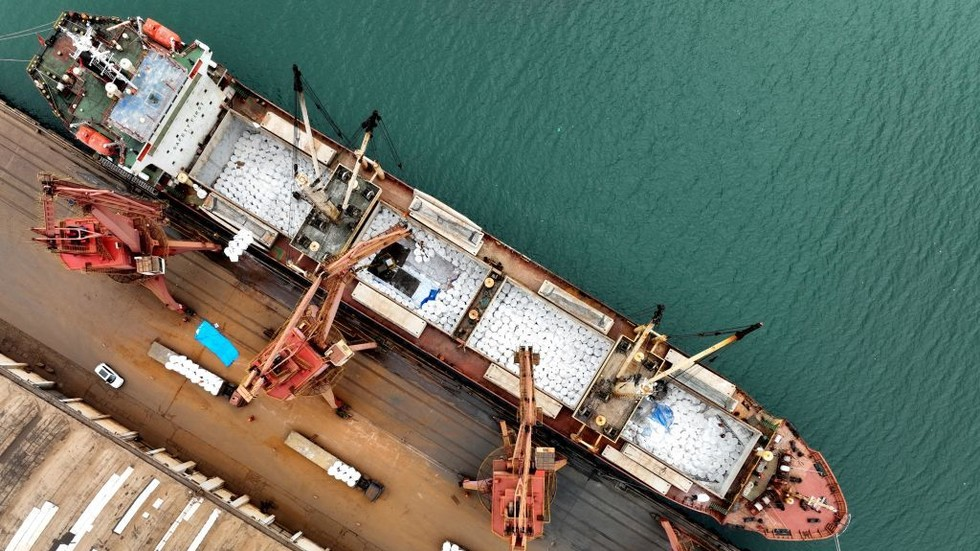
Millions of tonnes of substances (raw materials and products) are transported in bulk by sea across continents for the fertilizer industry. Some of the materials are classified as dangerous for transport. It describes various precautions to take to minimise safety and environmental risks.
The fertilizer industry is a global and large tonnage industry, requiring shipments of large quantities of raw materials and finished products across continents. This is because fertilizers are essential for crop production and agriculture, and the source materials for the three main plant nutrients viz. nitrogen, phosphate and potassium are not available naturally in all regions. In modern manufacturing processes nitrogen is obtained from air to produce ammonia, the process requiring natural gas or other similar hydrocarbons as the main raw material. Ammonia is then used to produce ammonium nitrate (AN) and urea, which are widely used main nitrogen fertilizers.
The main source of phosphate (commonly expressed as P2 O5) is rock phosphate mineral, which is processed to produce phosphoric acid. Ammonisation of phosphoric acid enables production of mono-ammonium phosphate (MAP) and di-ammonium phosphate (DAP); whereas acidification of the rock can give single super-phosphate (SSP) and triple superphosphate (TSP). These materials are the common sources of P2 O5. Lastly, potassium (expressed as K2 O) is mainly sourced from potassium chloride, described in the industry as potash, which is mined.
Other source materials are also used for the above nutrients, for example, ammonium sulphate (AS), potassium nitrate, potassium sulphate, calcium nitrate and sodium nitrate.
Fertilizers, which contain more than one nutrient, are known as Compound or NPK (NK or NP); they are produced by combining some of the above materials. Thus, the fertilizer industry is involved in transporting by sea millions of tonnes of these substances in bulk (i.e. in unpackaged form).
safety and environmental aspects of loading and unloading bulk materials at ports.
Potential hazards:
The main substances of interest as regards to potential physicochemical hazards are those based on ammonia and/or nitrate (NO3 -) ion; ammonium salts being relatively unstable at elevated temperatures and nitrate being oxidizing in nature. Thus, products which deserve attention mainly include (AN) and those based on AN, potassium nitrate, ammonia and ammonium salts (MAP, DAP, urea).
Potential hazards AN possesses oxidizing properties and, as such, can react with most combustible materials.
Some fertilizers based on AN and potash (a chloride source with catalytic effect on AN decomposition) can exhibit the so-called self-sustaining decomposition (SSD) capability. They can continue to decompose exothermally once initiated by a hot source, even after the source is removed. The associated release of toxic fumes is a significant potential hazard. Ammonium salts e.g. MAP, DAP, urea and AS, are capable of releasing ammonia gas when heated e.g. in a fire; but would require much heat input; they are not classified as dangerous in transport regulations.
Ammonia, a major raw material for the fertilizer and many other industries, is transported in large quantities in ships mostly in refrigerated form. Ammonia vapours are toxic, and liquid ammonia can cause severe cold burns. Although ammonia gas is flammable within certain range of concentrations; it is very difficult to ignite and does not readily sustain combustion in outdoor situations. Environmental hazards Most of the solid fertilizer raw materials and products are not considered as hazardous to the aquatic life.
Classification Based on the hazardous properties described above a number of fertilizer materials are classified as dangerous in the transport regulations in Books which describes the Transport of Dangerous Goods Model Regulations and the International Maritime Dangerous Goods Code (IMDG).
It is uncommon to ship nitric acid, hot AN solutions and ammonia solutions as bulk sea cargos; they are not considered here further. Urea-AN solution is transported and used in large quantities, particularly in the US; it is not classified.
Industry guidance for safe practices General The fertilizer industry, particularly in western Europe and USA, has taken a proactive role in promoting safety.
For safe transportation of potentially hazardous products handled, the industry trade associations have published a number of guidance documents. For the sea transport, a number of recommendations for good practice have been made. Most of these apply to nitrate-based (e.g. AN-based and KNO3 ) fertilizers; but in the interest of safety, it would be sensible to apply them to ammonia-based as well (e.g. MAP, DAP, urea). When chartering, vessels should be assessed to satisfy official statutory requirements and company criteria, if any. The charter party and/or the voyage instructions should include reference to safety inspections, precautions relating to the specific risks from the product (e.g. toxic hazard, decomposition or fire) and communications to the port authorities, coastguards and charterers/suppliers of any emergency.
For loading, transportation and unloading the cargos, checklists should be used to ensure that all necessary safety precautions are taken e.g. inspection of cargo holds prior to loading and ship/shore safety requirements, as per IMO regulations, where appropriate, or industry guidance.
Prior to loading a ship, the ship master should be given relevant safety information such as product safety data sheet and emergency plans/actions relating to the product hazards.
AN-based, ammonia-based and nitrate-based fertilizers for these products, with regard to their potential hazards described earlier, the main safety principles applicable are:
- Avoidance of storage of combustible substances near fertilizers;
- Avoidance of storage of incompatible substances near fertilizers;
- Avoidance of cross contamination with remains of previous cargoes;
- Avoidance of cross contamination of next cargo with fertilizer;
- Avoidance of sources of heat likely to affect the fertilizer; and
- Avoidance of application of heat (e.g. welding) to any section which may have trapped/confined .
Fertilizer Safety precautions and instructions concerning avoidance of heat sources should be given to the ship’s master. Particular care should be taken to ensure that light bulbs do not get buried in the fertilizer heaps. Equipment such as a compact shovel used for removing the bulk fertilizer and emptying the vessel’s hold should be fitted with safety items such as a fire extinguisher, spark arrestors on the exhaust and a collecting device for leaked oil and grease.
No refuelling of the shovel/loader should be permitted in the ship’s hold.
The fertilizer industry has transported substantial quantities of solid bulk fertilizer materials safely worldwide without serious incidents over the last five decades thanks to the regulatory controls and industry guidance. The safety record is not as good with ammonia shipments as serious incidents have occurred during transfer operations. Strict adherence to sound safety practices is required, both in maintenance and operation.
To minimize deterioration in quality and to avoid safety problems in transport, attention should be paid both to the initial fertilizer properties and the correct fertilizer handling procedures. The correct handling and transportation of fertilizer should be based on the climate conditions, type of fertilizer and on how it is shipped (bulk or bags).
Safety and quality inspection of vessels and warehouses:
- Vessels shall be inspected according to international (IMO) quality and safety procedures and according to the uniform inspection standard.
- Ensure no cross-contamination during transshipments or in the warehouse.
- No electric installation shall come in direct contact with the fertilizer.
- DO NOT SMOKE signs should be displayed and respected.
- Warehouse floor, conveyor belts and equipment must be clean, dry and free of remainders.
- Do not store off-spec/rejects close to the product.
- Clean, dry holds, free of contamination and loose rust.
- Tight hatch covers, sea-going vessels to be tested by using Ultrasound Leak Detector.
- Repair when the hatch covering is not tight (rubber gaskets, compression bar).
- Bulkheads of wood should be covered with plastic.
- Treat tank tops with rust remover before loading technical urea and calcium nitrate.
- Loading must not occur during precipitation or heavy fog.
- Transport by truck or wagon should be dry, clean and covered against weather and spillage.
- Avoid high product drop during loading. Cascade loading spout or conveyor belts are preferred.
- The cargo shall be trimmed according to IMO-regulations (BC code). If possible, trimming should be restricted to the end of the loading.
Discharging:
- Shore cranes or ship cranes equipped with grabs are recommended.
- Inspect the cargo before start of discharge, check the hatch coamings and the cargo surface. If the product is damaged (contamination/water ingress), call for surveyors and inform the master about this decision.
- Take photos of any damaged goods.
- If the damage has resulted in product being spilled, then this should be dealt with in accordance with the directions given on the product Safety Data Sheet (SDS).
- Do not remove the plastic covering (when provided) the product until unloading starts.
- Do not discharge during precipitation or heavy fog. Close the hatches.
- Ensure that water damaged cargo and contaminants are separated from sound product.
- Do not mix spilled or wet material on the quay or deck of vessel with sound product.
- Minimize driving into the product to reduce formation of dust and fines.
- Be careful in handling the product to avoid crushing.
- Keep unloading equipment clean and dry.
- Fast unloading operation is important to reduce water absorption.
- Remove spillage from grab hopper frequently.
- The inner bag is waterproof, if any damage comes to it, the fertilizer may be affected. Therefore always be aware of any external damage caused by transportation or unloading
Manual handling of fertilizer bags:
- Protecting your body when handling a chemical product is always recommended whether the product is classified as hazardous or not. Avoid direct contact with skin and eyes. Always read the label on the package. It contains important information on the potential hazards and how to minimise the associated risks.