


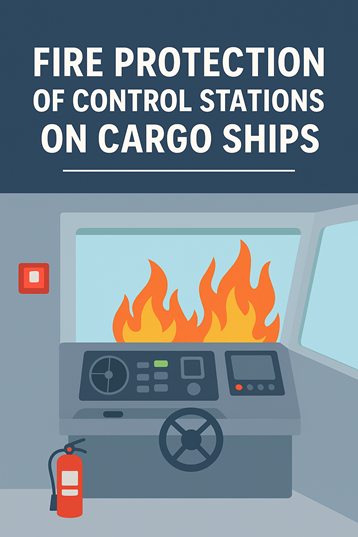
Effective fire protection on cargo ships is essential for safeguarding personnel, machinery, and the vessel itself. Among the most critical areas requiring robust protection are control stations—spaces that house essential command, communication, navigation, and fire-detection equipment. SOLAS (Safety of Life at Sea) provides detailed requirements to ensure the safety and survivability of these spaces, especially on new cargo ships.
This article explains the fire protection standards, arrangements, and best practices for control stations on new cargo ships.
What Are Control Stations?
According to SOLAS, control stations are spaces containing:
- Navigational equipment (e.g., wheelhouse)
- Main and emergency switchboards
- Fire control equipment and panels
- Communication systems (GMDSS, PA/GA)
- Engine control room
- Spaces with centralized alarm systems and monitoring systems
These locations must remain operational in the event of a fire because they are vital to ship safety and emergency response.
1. Fire Integrity Requirements (Structural Fire Protection)
A-Class Divisions
Control stations must be enclosed by A-60 class bulkheads and decks, especially when adjacent to:
- Machinery spaces of category A
- High fire-risk areas
- Accommodation blocks
If separated from low-risk locations, some administrations allow reduced ratings (A-30 or A-0), but A-60 is the default standard for new cargo ships.
Fire Doors
- A-60 fire doors or equivalent
- Self-closing arrangements
- Remote release capability (where applicable)
These ensure the space remains protected even during evacuation.
2. Ventilation & Smoke Protection
Ventilation Dampers
Ventilation openings to control stations must be protected with:
- Fire dampers, remotely operable
- Independent ventilation systems to prevent the spread of smoke
Positive Pressure Requirement
Bridge and control spaces often maintain positive air pressure to prevent smoke ingress during a fire.
3. Fire Detection and Alarm Systems
Control stations must be continuously protected by:
- Automatic fire detection systems
- Smoke and heat detectors suitable for electrical/electronic spaces
- Redundant alarm systems to guarantee survivability
Monitoring panels should remain operational even if adjacent areas are compromised.
4. Emergency Power & Cable Protection
Cable Routing
Essential cables running to or from control stations must:
- Avoid high-risk areas
- Be fire-resistant (minimum 180 minutes under flame conditions as per IEC 60331)
- Have redundancy when passing through hazardous zones
Emergency Lighting
Emergency lighting must activate automatically and last long enough for safe operation during failures.
5. Firefighting Arrangements
Although control stations are not classified as high-risk fire zones, the following equipment is normally required:
- At least one portable CO₂ or clean-agent extinguisher
- Fire blanket
- Accessibility to nearest fire hydrant
Clean agents are preferred due to the presence of sensitive electronics.
6. Location & Arrangement Considerations for New Cargo Ships
SOLAS recommends that control stations be:
- Centrally located
- Easily accessible during emergencies
- Protected from external exposure like cargo fires, deck fires, or fuel spills
New ship designs often integrate additional safety features like:
- Dedicated protected escape routes
- Fire-shielding for bridge wings
- Redundant ECR and navigational control panels
7. Compliance with SOLAS Chapter II-2
Key SOLAS references:
- II-2/9 – Containment of Fire
- II-2/10 – Fire Fighting
- II-2/13 – Means of Escape
- II-2/5 – Fire Detection & Alarm
- II-2/3 – Definitions (including control stations)
These collectively govern the required fire safety framework for control stations on cargo ships.
Conclusion
Control stations serve as the nerve centers of a cargo ship. Their continuous operability during fire emergencies is crucial. Compliance with SOLAS fire protection requirements—structural integrity, safe access, fire detection, ventilation control, and firefighting equipment—ensures that these areas remain safe and functional even under the most adverse conditions.
Well-designed control stations on new cargo ships significantly improve survivability, operational safety, and emergency readiness.