

IMO Resolution MSC.581(110)

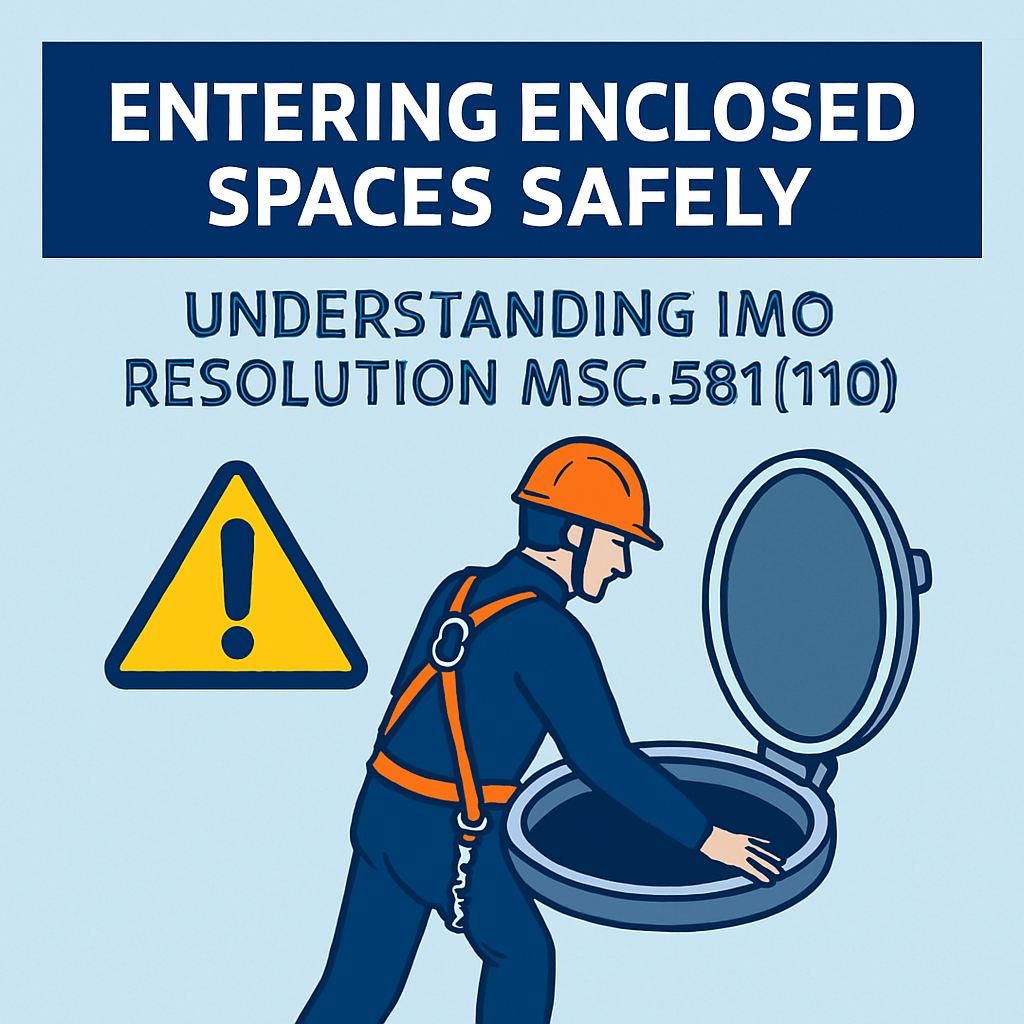
Revised Recommendations for Entering Enclosed Spaces Aboard Ships
Entering enclosed spaces remains one of the most dangerous routine operations on board ships, responsible for a significant number of fatalities every year. In response to continuing accidents and near-misses, the International Maritime Organization (IMO) adopted Resolution MSC.581(110) at the 110th session of the Maritime Safety Committee (MSC).
This resolution provides revised and strengthened recommendations for enclosed space entry, replacing the earlier Resolution A.1050(27), and reflects lessons learned from real casualty investigations.
1. Purpose of MSC.581(110)
The primary objective of MSC.581(110) is to prevent deaths and serious injuries caused by unsafe entry into enclosed spaces by:
- Improving hazard identification
- Strengthening risk assessment and permit-to-work systems
- Enhancing atmospheric testing requirements
- Reinforcing training, drills, and emergency preparedness
- Promoting a strong safety culture, including the right to stop unsafe work
The resolution is recommendatory, but it is expected to be implemented through a ship’s Safety Management System (SMS) under the ISM Code.
2. Expanded Definition of Enclosed Spaces
MSC.581(110) broadens and clarifies the definition of an enclosed space.
An enclosed space is defined as a space which:
- Has limited openings for entry and exit
- Is not designed for continuous occupancy
- May have poor ventilation
- May contain or develop hazardous atmospheres
Examples include:
- Cargo holds
- Ballast tanks
- Fuel tanks
- Chain lockers
- Double bottoms
- Void spaces
- Cofferdams
- Refrigerated cargo holds
- Sewage tanks
The resolution also emphasizes connected and adjacent spaces, which may share atmospheres and therefore pose hidden dangers.
3. Enclosed Space Register (New Emphasis)
A key enhancement in MSC.581(110) is the requirement for ships to maintain an Enclosed Space Register.
The register should:
- List all enclosed spaces on board
- Identify connected or adjacent spaces
- Specify known or potential hazards
- Outline precautions and controls required before entry
This ensures no space is overlooked and that risks are assessed space-by-space, not generically.
4. Risk Assessment and Permit-to-Work System
Before entry, a space-specific risk assessment must be carried out.
The risk assessment should consider:
- Oxygen deficiency or enrichment
- Presence of toxic gases (e.g. H₂S, CO, CO₂)
- Flammable atmospheres
- Residual cargo or chemicals
- Temperature extremes
- Risk of engulfment or flooding
Enclosed Space Entry Permit
An entry permit must be completed and approved before entry. The permit confirms that:
- Atmosphere has been tested and is safe
- Ventilation has been carried out
- Personnel are trained and briefed
- Communication and rescue arrangements are in place
The resolution recommends that permits be time-limited, typically not exceeding 8 hours, and cancelled if conditions change.
5. Mandatory Atmospheric Testing (Major Update)
MSC.581(110) strengthens requirements for gas detection.
Portable gas detectors must be capable of measuring:
- Oxygen (O₂)
- Flammable gases
- Toxic gases
- Carbon Dioxide (CO₂) ← new explicit requirement
This addition reflects fatal accidents where elevated CO₂ levels caused rapid unconsciousness without warning.
Atmosphere testing must be:
- Conducted before entry
- Repeated during entry
- Continued throughout the work
6. Ventilation Requirements
Before entry:
- Spaces must be thoroughly ventilated
- Ventilation must reach all parts of the space
- Natural ventilation alone is often insufficient
During entry:
- Ventilation should be continuous, where practicable
- Ventilation must not introduce additional hazards
7. Personnel Responsibilities and Safety Culture
MSC.581(110) clearly defines responsibilities:
Master
- Overall responsibility for enclosed space safety
- Ensures procedures, training, and equipment are in place
Officers
- Conduct risk assessments
- Authorize permits
- Supervise entries
Crew
- Follow procedures
- Use protective equipment
- Stop work immediately if conditions become unsafe
The resolution strongly supports a “Stop Work Authority”, empowering any person to halt entry if safety is compromised.
8. Rescue and Emergency Preparedness
A critical lesson from past accidents is that many fatalities occur during rescue attempts.
MSC.581(110 requires:
- No entry for rescue unless properly equipped
- Rescue plans to be space-specific
- Availability of:
- Rescue harnesses
- Lifelines
- Breathing apparatus
- Stretcher and first-aid equipment
Training and Drills
- Enclosed space drills must be conducted regularly
- Drills should simulate realistic rescue scenarios
- Crew must be familiar with emergency communication procedures
9. Training and Familiarization
All personnel involved in enclosed space entry must receive training covering:
- Hazards of enclosed spaces
- Gas detection equipment use
- Permit-to-work systems
- Emergency response procedures
Training applies to:
- Ship’s crew
- Superintendents
- Contractors
- Shore personnel
10. Integration into Safety Management System (SMS)
MSC.581(110 should be fully incorporated into the ship’s SMS, including:
- Procedures
- Checklists
- Risk assessments
- Records and audits
This ensures compliance, consistency, and continuous improvement.
Conclusion
IMO Resolution MSC.581(110) represents a significant advancement in enclosed space safety. By expanding definitions, mandating CO₂ monitoring, strengthening risk assessments, and emphasizing rescue preparedness, the resolution addresses the real causes of enclosed space fatalities.
Although recommendatory, failure to implement MSC.581(110) may be considered a serious deficiency during audits, inspections, and accident investigations.
Safe entry into enclosed spaces is not about speed — it is about preparation, discipline, and saving lives.