



DRAFT SURVEY
Introduction
A ship as a carrier can face many claims arising from the short delivery of cargo. There are various ways in which cargo loaded can be accounted for. On General Cargo ships, cargo is either loaded as pieces or unitised. On Container ships, each container is stuffed under survey and sealed prior to being loaded onboard. On Tankers, special calculations involving the temperature and specific gravity are used to ascertain the quantity of liquid loaded. Timber Carriers once again use the piece or bundle method for accounting cargo loaded. A Ro-Ro ship would use the system of tally and identity of each unit, be it a car, truck, trailer, bus or machinery on wheels.
How about dry bulk cargo that is poured into the holds of a ship? Bulk carriers are either loaded by grabs or by means of conveyor belts and chutes. Sophisticated terminals have accurate shore scales where the cargo is weighed prior to being put on the belt or into a truck. However the ship as the carrier may still be held responsible at the discharge port if the figures loaded and the figures discharged differ by a large amount.
A draft survey is the “before and after” survey, which determines by measurement, the vessel’s displacement before and after loading or discharging. The difference between these two displacements is the weight of cargo loaded or discharged.
The purpose of a draft survey is to determine the amount of cargo loaded or discharged for the benefit of all the interested parties — the shippers, the receivers, the charterers and the ship owners.
A well-conducted draft survey of a large vessel should achieve accuracy to within 0.5%.
A deadweight survey is carried out under circumstances when it may not be possible to conduct the before and after surveys, or there is no need to do so. For example, the ship’s officer wants to know the quantity of cargo onboard at any juncture during the loading or discharge. He can do a deadweight survey. The weights of all non-cargo elements on the vessel are determined; bunkers, ballast, fresh water, stores, etc. These are then added to the light displacement (including any lightship constant). This total is then deducted from the present displacement to give the approximate weight of cargo on board.
Objectives
- To explain lightship weight and lightship constant.
- To explain the general steps of a draft survey.
- To explain the significance of trim, list, hog and sag and the corrections to be applied.
- To lay out the general format for calculations of a draft survey.
Lightship weight
The Lightship weight is the weight of the ship’s hull and its full equipment, engine room spares, water in the boilers to the working level and lubricating oil in the engines. It does not include weight of personnel, cargo, fuel, stores and water. It is obtained by means of an inclining experiment when the ship is built. The inclining experiment may have been performed years ago depending on the age of the ship. The lightship weight will increase with the passage of time due to change of equipment, the build up of paint over the surface of the ship, the storage of old equipment, mud in the ballast tanks, scale in tanks and so on. This growth is accounted for in the Lightship Constant.
Lightship Constant or Constant
The value of the lightship constant is obtained from each draft survey. You shall learn how the value is obtained in this module. The value will vary from survey to survey but a record must be maintained so that an average value of the constant will be readily available.
The value of constant has its significance when we do a Deadweight Survey. Here in a single survey we have to determine cargo quantity. We obtain the displacement from the draft, subtract all deductibles from the displacement, then subtract lightship and Constant to obtain the residual deadweight which is the quantity of cargo onboard.
General steps of a draft survey
Preparation for survey
- Prior to arrival ballast tanks should be adjusted to a level covered by the sounding tables so that the right figure of ballast can be obtained. This is done because should ballast tanks be pressed up, they could still retain air pockets. Again in case of an empty tank it is difficult to establish that the tank is completely empty without visual inspection. Hence there should be some water in it.
- Prior arrival at the load port ballast holds should be empty of ballast if possible. This is due to the fact that ballast holds are not well calibrated and large errors may creep up in establishing quantity of water in them.
- The trim of the vessel should be adjusted to be safe and suitable for navigation but within the limits of the trim correction given in the sounding tables.
- The vessel should be brought upright.
- Documents required for the survey should be kept ready. Documents will include the ship’s particulars, the hydrostatic tables, capacity plan with deadweight scale, general arrangement plan, sounding tables, corrections to drafts, correction for list, corrections to soundings, trim corrections if provided for the ship and hydrometer certificate.
- Equipment is to be kept ready and will include the sampling bucket and sample jars, hydrometer, sounding tape, a powerful flashlight incase of darkness, ladders for observing the drafts if a launch is not available.
- There should be no movement of ballast, fresh water, bunkers cargo and hatches and moorings until the measurements are taken and agreed by the surveyor and the ship’s officer.
Documentation and Information
- The surveyor and the ship’s officer discuss documentation details such as the ship’s particulars, and the location and state of all compartments.
- Instruction pages of the hydrostatic particulars and sounding tables are a check made of the tank capacities with the studied and capacity plan.
- The base for measurement of vertical heights, the reference point for longitudinal measurements, the units and the sign conventions used in the tables are verified.
- full sounding depths of tanks, the summer draft and freeboard and the record of recent tank soundings should be noted.
- If a bunker survey is not carried out, the Chief Engineer’ bunker figures (fuel oil, diesel oil and lubrication oil) are required, also the daily port consumption quantities.
- Should any bunkers or stores be delivered during the vessel’s stay in port then those additional quantities are to be included in the final survey.
- The position of the anchors should be checked, should any alterations be proposed during the stay then the weight of the anchors and cables should be determined. However on large vessels this would hardly make a difference.
Density
- Using a clean, dry sample bucket take samples from half draft depths from at least two positions on the offshore and onshore sides, avoiding the ship’s overboard discharges and stagnant water between ship and jetty. Take samples of about one litre and do not mix them.
- Take the density of each sample quickly, protecting the sample jar from the wind and direct sunlight. Gently lower the hydrometer into the sample until it floats freely. Take the hydrometer reading where the overall level liquid surface meets the graduated stem, not the top of the meniscus. Avoid parallax by placing the eye in line with the liquid level.
- If density readings of the various samples show no major variation then calculate the average value. However if there are suspicious variations in the readings the additional samples should be taken.
Drafts
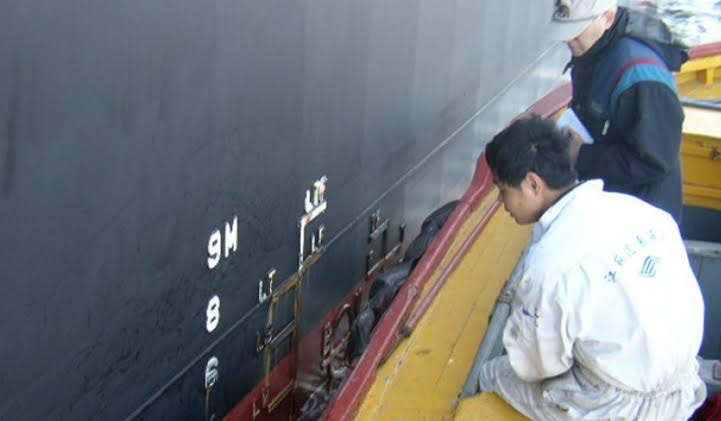
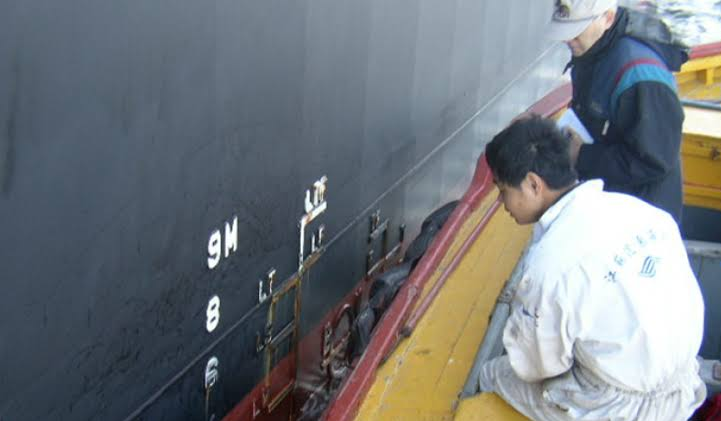
- A six-point draft (forward, midship and aft —port / starboard) should be read with great care and every effort should be made to read the drafts from a level as close to eye level as possible. A boat is preferable to a ladder for reading the offshore drafts. Reading the onshore drafts from the jetty is preferable to using a ladder or reading forward drafts from the forecastle deck.
- If required the midship drafts can be obtained by measuring the freeboard from the waterline to the top of the deckline.
- Drafts and density should be obtained at nearly t most accurate at slat he same time if possible. They are k water but this may not always be practical.
- Due allowance for swell must be made when reading drafts and a series of averaged readings will lead to greater accuracy.
Case 1: Ship on even keel, upright, no hog, and no sag
Consider a ship to be on even keel and upright. The ship is neither hogged nor sagged. Let us consider the steps for carrying out deadweight survey.
- First of all as the ship is upright, le. no list the drafts forward read on the port and starboard sides will be the same. The same applies for aft port / starboard and for midship port / starboard.
- As the ship is on even keel ie. has no trim, forward and aft drafts will be the same.
- As the ship is neither hogged nor sagged, the forward, aft and midship drafts will be the same.
- Also since the ship has no trim, the drafts as read at the draft marks will be the same as the drafts at the perpendiculars and at midships.
- So the hydrostatic draft will be the same as the forward, aft and midship drafts.
- With this hydrostatic draft we obtain the displacement from the hydrostatic tables.
- This displacement will have to be corrected to the density of the water in which the ship is floating.
- Now we have to obtain the deductibles on board the ship. They will include ballast water and fresh water by soundings. As there is no trim, the soundings obtained from the sounding pipes will be the true soundings and so we easily obtain the volume of water in the tanks. Allowing for the density of the water in tanks we obtain the quantity of ballast.
- Displacement less deductibles, less lightship weight, less lightship constant will give us a fairly accurate figure of the cargo onboard.
- Had we done initial and final surveys (le. a draft survey) then the difference in the before and after displacements would directly give us the cargo figure.
Case 2: Ship with trim and list, either with hog or sag
This is a more realistic situation and due to trim, list, hog or sag we have to proceed with the steps below, correcting the drafts and then the displacement in order to obtain an accurate cargo figure by draft survey.
Correcting the drafts
- Correct the observed drafts to the centreline, i.e. the mean of the port and starboard drafts.
Forward Mean Draft = (Fp + Fs ) ÷ 2
(Forward port plus Forward stbd. ÷ by 2)
Aft Mean Draft = (Ap + As) ÷ 2
(Aft port plus Aft stbd. ÷ by 2)
Midship Mean Draft = (Mp + Ms) ÷ 2
(Midship port + midship stbd. ÷ by 2)
- Correct the centreline drafts to their value at the correct position of the perpendiculars and midships. This is done because the forward and aft draft marks may not be situated at the forward and aft perpendiculars respectively. The midship draft marks may not be situated at the true midship position. Hence corrections are to be applied to the Mean Forward, Aft and Midship drafts to bring them to the perpendiculars and to true midships respectively. The ship’s stability booklet may have tabulated corrections to be applied. If these corrections do not exist then the distance of the draft marks to the perpendiculars will be given. Apply the following corrections:
Forward Correction =
Apparent Trim x Distance D FP to Df Distance Da to Df
Aft Correction =
Apparent Trim x Distance D AP to Da Distance Da to Df
Midship Correction =
Apparent Trim x Distance D M to Dm Distance Da to Df


Where:-
Apparent Trim = the difference between Da and Df
AP :- aft perpendicular
FP :- forward perpendicular
LBP:- length between perpendiculars
D AP:- draft at aft perpendicular
Da DM:- draft at aft draft marks draft at midships
Dm:- draft at midship draft marks
D FP:- draft at forward perpendicular
Df:- draft at forward draft marks
Sign convention:
If the direction of the misplacement of the draft mark from the perpendicular is the same as the direction of the trim, then the correction is negative (-). i.e. if the vessel is trimmed by stern and the draft mark is situated aft of the after perpendicular then the correction is subtracted from the observed draft to obtain draft at the perpendicular.
Note: when the vessel is on even keel, then no correction has to be applied. The Mean of Corrected Fore and Aft Drafts {(Fc + Ac) /2} is called “M1”.The Mean of Corrected Midship Draft is called “M2”
Allow for hog or sag and obtain the correct draft midships (true hydrostatic draft).
The correction to the perpendiculars and midships assumes that the keel of the vessel is straight. In this case there is no hog or sag and no correction is required to obtain the mean of means or the true hydrostatic draft. However most often this equired is not the case. If MI is greater than M2 then the vessel is hogged, and if M1 less than M2 the vessel is sagged. In these cases a correction must be applied.


AMD indicates the ‘Arithmetic Mean Draft. It is the mean of the forward and aft drafts that gives us the midship draft if there was no hog or sag.
The figure also indicates the actual draft and actual freeboard when the vessel is hogged or sagged.
If the actual draft is less than AMD then the vessel is hogged.
If the actual draft is greater than AMD then the vessel is sagged.
There are several methods of calculating the correction for hog and sag. We are going to learn two methods.
Method 1
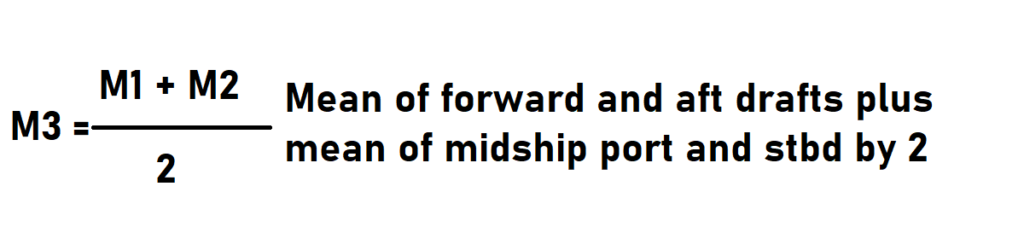

M3 is also known as the ‘Mean of Means’

M4 is the Quarter mean or True Hydrostatic Draft
Method 2
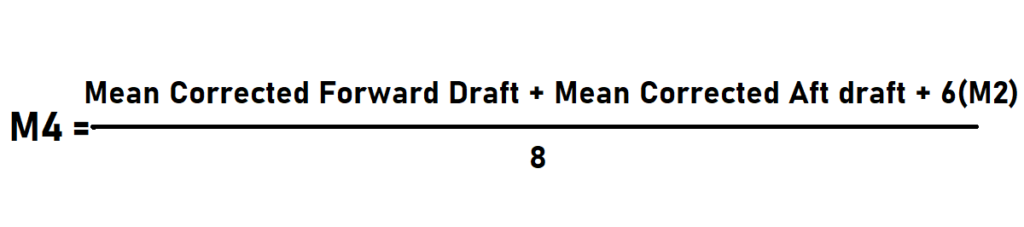
M4 is the True Hydrostatic Draft.
Both the above methods will produce the same results.
Obtain Displacement and apply corrections
- Enter the hydrostatic tables with this True Hydrostatic Draft M4, to obtain the uncorrected displacement (W). Also extract the values of MCTC, LCF, and TPC that are required for the Trim Corrections.
- Correct this value of displacement for:
a) Density
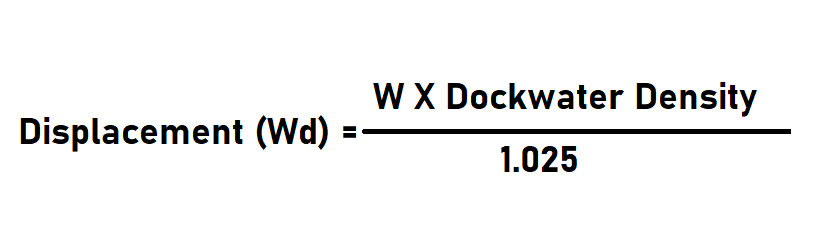

Apply the Index Error if any as quoted on the hydrometer certificate.
Do not apply any correction for temperature.
Do not adjust draft for density but correct the displacement instead.
b) First Trim Correction
The displacement scale is calculated assuming the vessel to be on even keel. The first trim correction, also known as the layer correction, is applied to correct the draft amidships to the true mean draft at the centre of flotation.
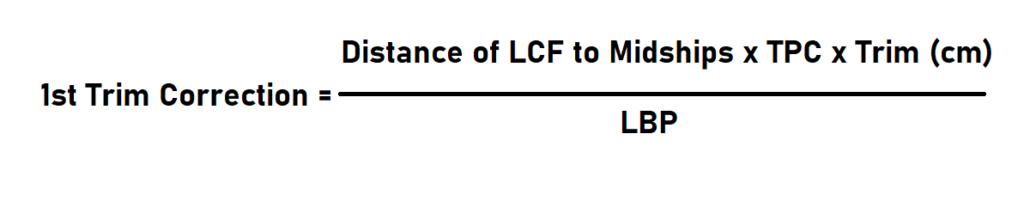



Sign Convention:
| Trim | LCF Forward of midships | LCF aft of midships |
|---|---|---|
| By Stern | negative (-) | Positive (+) |
| By head | positive (+) | negative (-) |

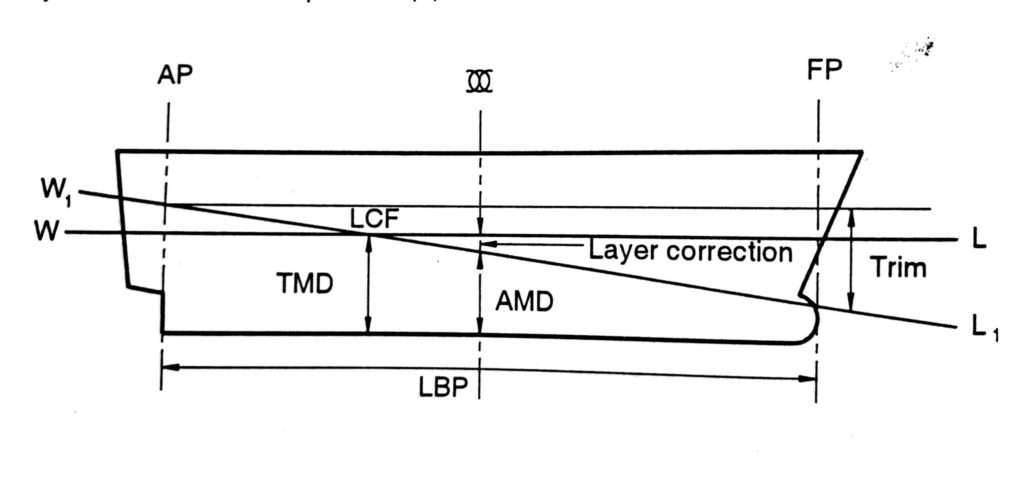
In figure, WL is the water line when the vessel is on even keel.
W1L1 is the waterline when the vessel is trimmed.
AMD is the arithmetic mean draft i.e. mean of forward and aft drafts that gives midship draft.
TMD is the true mean draft at the position of the centre of floatation (at LCF).
Layer correction is the difference between TMD and AMD.
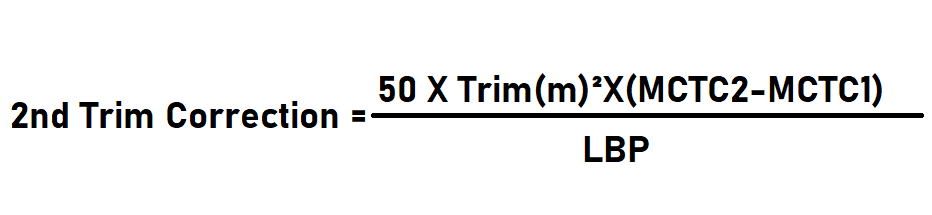
c) Second Trim Correction
As the vessel trims, the centre •of flotation (LCF) shifts. The second trim correction is applied for this shift of LCF. The position of the LCF as specified in the hydrostatic particulars is normally for the even keel condition. What we require is the draft at the final position of LCF and the displacement corresponding to this draft.

Where:
MCTC2 = MCTC for mean adjusted draft + 50 cm
MCTC1 = MCTC for mean adjusted draft — 50 cm
Sign Convention:
2nd Trim Correction is always positive (+).
Actual Displacement = Displacement corrected for density and 1st Trim Correction + 2nd Trim Correction.
Normally the 1st and 2nd corrections are algebraically added together and called total trim correction.
D) Correction for List
If a vessel is listed, then the mean of the side drafts is a centreline draft which is less than the actual draft that would have been observed had she been upright. This may be ignored for small angles of list. However for larger angles a correction needs to be applied.
Correction for List (in tonnes) = 6(TPC2 TPC1) x (Mp difference Ms)
Where:
Mp and Ms = midship drafts on port / stbd. sides
TPCp = TPC value for Mp
TPCs = TPC value for Ms
Therefore:
Actual Displacement = Displacement corrected for density, Trim Corrections and Correction for List.
Sign Convention:
Correction for List is always positive (+).
Determine the quantity of Deductibles
- Deductibles are the components of the ship’s total weight, which must be deducted from the actual calculated displacement in order to determine the Weight of the cargo on board.
- Deductibles will include ballast water, fresh water, fuel oil, diesel oil, lubricating Oil and stores, provisions, crew and their effects. The latter will be more or less constant during a draft survey and can be added on to the light ship. However if the vessel is to receive a large quantity of stores then such weights will have to be accounted for in the final survey.
- Every compartment capable of carrying water should be carefully sounded.
- When at an exposed berth the movement of the vessel may create errors. To overcome this problem several soundings should be taken and the average value is to be taken.
- The sounding tape must be checked to ensure that it reaches the bottom of the tank. It must be noted that the vertical tank height and the length of sounding pipe may be different.
- Full tanks may have air pockets especially when the ship is trimmed. Hence the level of the water within the tanks should be within the range for which the trim correction can be applied.
- Empty tanks will probably have residual water even at zero soundings. These indeterminable quantities can be ignored at both the before and after surveys, provided that all parties are satisfied that no changes have taken place during the interval between surveys.
- If ballast soundings are outside the maximum range of the calibration tables then ballast should be run out until the level is suitable.
- The duct keel, pipe tunnel, peak tanks and swimming pool must not be overlooked when taking soundings.
- Cargo -hold bilges must be checked and sounded. Any bilges pumped out during the port stay must be recorded. When a vessel loads a dry cargo that has been wetted, a record of bilges pumped out during the voyage is very useful evidence to explain any apparent loss of cargo at the discharge port.
- Ballast holds cause problems due to poor calibration and hull deformation. Hence they should Preferably be emptied prior arrival at the load port.
- Bunker tanks need not be inspected or sounded during a draft survey unless a bunker survey is also required. The chief engineer’s figures of fuel oil, diesel oil and lubricating oil are accepted along with Daily consumption figure for the vessel’s the stay in port.
- The sounding Pipes of the tanks may be at a position where they will always give the correct sounding of the tanks irrespective of the trim Hence observed
- soundings will have to be corrected for the trim of the vessel. Sounding tables will most often give the trim correction for each tank, These corrections are calibrated for every half metre of trim.
- If no trim correction is available for the soundings, It may be calculated by the formula:


Where: ‘d’ is the distance from the sounding pipe to the tank centre,
(Approximate measurements can be taken from the plans of the tanks).
Sign Convention:-
| Trim | Sounding forward of tank centre | Sounding aft of tank centre |
|---|---|---|
| By Stern | negative (-) | Positive (+) |
| By head | positive (+) | negative (-) |
Refer to the figure:-

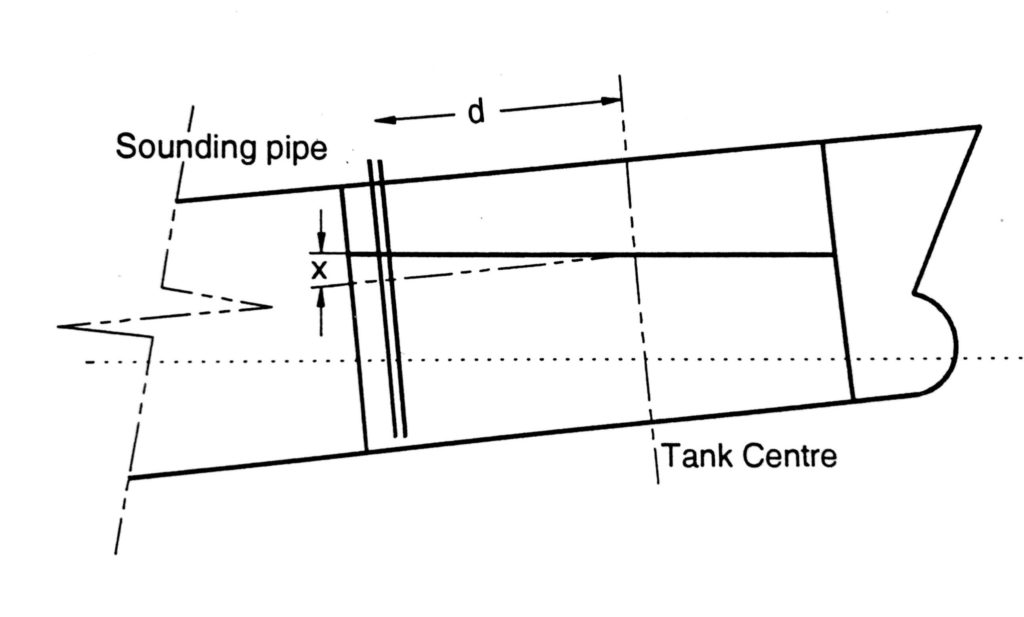
16. By sounding a ballast tank and using the sounding tables, the volumes of liquid is obtained. It is most important that each tank should be sampled for density as well as being sounded for volume. The density of the water must be accurately checked.
17. Calculate the mass of water by the formula Mass = Volume x Density.
18. Tanks for liquids, particularly ballast tanks, are subject to a build up of residues and scale. The quantity of this sediment is hard to assess. To reduce this effect on ballast calculation, leave a measurable quantity of water in a tank rather than pumping it dry (unpumpable ballast water serves the purpose). Now the error of the unknown weight of sediment is reduced to the difference between the density of water and density of the sediment.
19. Anchors may be in the hawse pipes, where they contribute to the lightship may have been used for mooring the ship. There will be information onboard to establish the weight of the missing anchors and cables. If the is no information, then use the following formula for calculating the weight of the cables:


Where link diameter is the diameter of the steel rod, which makes up each link.
The weight of the anchors will be obtained from the certificates on board.
Final survey
After completion of loading or discharging as the case may be, repeat steps of DENSITY , DRAFTS, CORRECTING THE DRAFTS, DETERMINE THE QUANTITY OF DEDUCTIBLES.
Format for calculations of a draft survey:-
DRAFT STATEMENT
| Meters | Meters | |
|---|---|---|
| Draft Forward (port) | ||
| Draft Forward (stbd) | ||
| Draft Forward (mean) | ||
| Stem Correction | ||
| Draft forward (corr’d to fore pp) | ||
| Draft aft port | ||
| Draft aft starboard | ||
| Draft aft mean | ||
| Stern correction | ||
| Draft aft (corrected to aft pp) | ||
| Draft fore and aft Mean | ||
| Draft midship port | ||
| Draft midship starboard | ||
| Draft midship mean | ||
| Midship Correction | ||
| Draft midship (corrected to midship pp) | ||
| Sag(+) Hog(-) | ||
| Mean of Means | ||
| Quarter Mean | ||
| Trim fwd(-) aft(+) |
| kg/m³ | kg/m³ | |
|---|---|---|
| Observed Density | ||
| Ship Table Density (kg/m³) | ||
| Hydrometer |
| Metric Tonnes | Metric Tonnes | |
|---|---|---|
| Displacement (at ……kg/m³) | ||
| First Trim Correction | ||
| Second trim correction | ||
| Total Trim Correction | ||
| Displacement corrected for Trim | ||
| Correction for density average | ||
| Displacement corrected for Density | ||
| Total Deductibles | ||
| Displacement corrected for deductibles |
SUMMARY OF DEDUCTIBLES
| Metric Tonnes | Metric Tonnes | |
|---|---|---|
| Ballast Water | ||
| Fresh Water | ||
| Fuel Oil | ||
| Diesel Oil | ||
| Slops | ||
| Lubricating Oil | ||
| Swimming Pool Water | ||
| Anchor and Chain | ||
| Others | ||
| Total Deductibles |
| CARGO STATEMENT | Metric Tonnes |
|---|---|
| Starting displacement corrected | |
| Finishing displacement corrected | |
| Difference in displacement = TOTAL CARGO IN BULK IS: | |
| OBSERVATIONS: Shore scale quantity(If available)MT |
| Metric Tonnes | |
|---|---|
| Corrected Light Displacement | |
| Deductibles | |
| Lightship | |
| Constant | |
| Means of previous constant |
Conclusion
a) Consider the format of draft survey given above. The difference in displacement obtained from the initial and final draft surveys gives the cargo on board. Let us say that the ship was coming to load. Then the initial displacement obtained from the draft survey would be the sum of Lightship plus Lightship Constant. The final displacement would be Cargo plus Lightship plus Lightship Constant. Hence the difference gives us the cargo loaded. This method of draft survey eliminates the error of change in Constant. Similarly if the ship was coming in to discharge. Then the initial displacement is Cargo plus Lightship plus Lightship Constant. The final displacement would be Lightship plus Constant. The difference gives us the cargo discharged. From the above, by subtracting the known Lightship weight, we obtain the Constant of the ship. This Constant will vary from survey to survey but we can obtain an average value over a period of time.
b) Shortage claims on bulk carriers are a major concern to ship owners. The result is claims involving significant sums of money. While it may be impossible to overcome every problem that may be encountered, the ship’s officer must practice vigilance and sincerity while carrying out the survey in an organised and methodical manner in order to achieve maximum accuracy.