


Introduction
Crude oil tankers carry massive quantities of crude oil from production terminals to refineries worldwide. Accurate cargo calculations are essential for safety, stability, efficiency, and legal compliance. Inaccurate calculations can cause overloading, cargo losses, environmental hazards, and even compromise the ship’s stability.
This guide covers step-by-step procedures and calculations used in modern tanker operations.
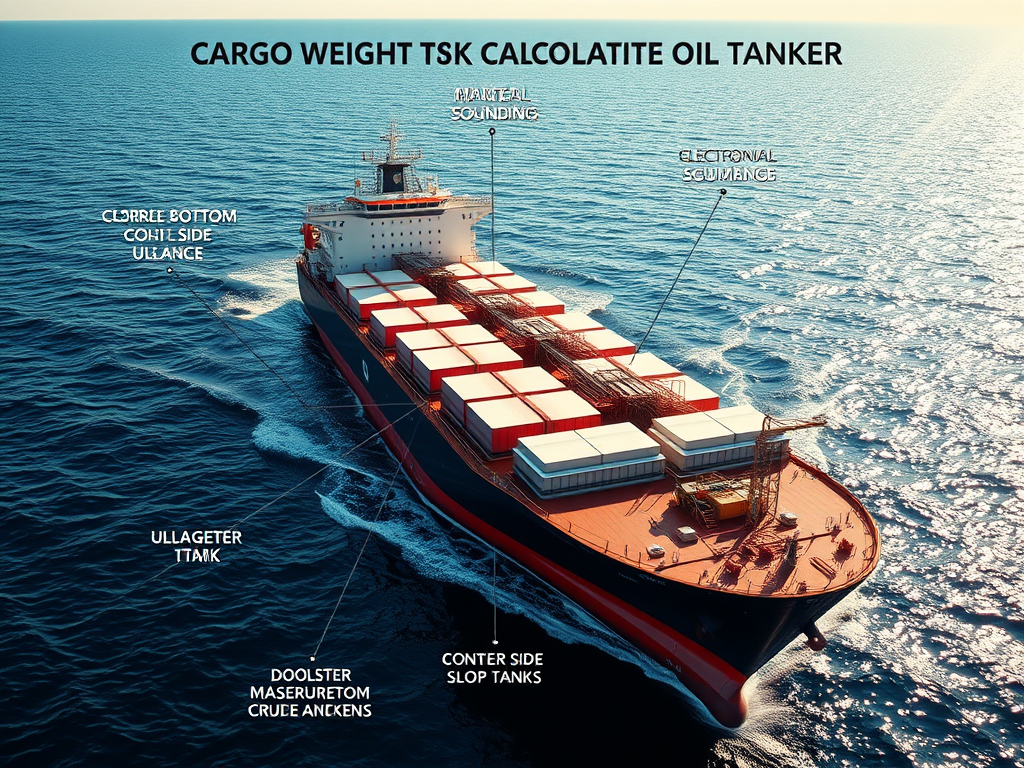
1. Types of Tanks in Crude Oil Tankers
Crude oil tankers have multiple tanks for cargo storage, commonly arranged as:
- Double Bottom Tanks: Lowest tanks, used for heavy crude fractions.
- Double Side Tanks: Along the sides of the vessel.
- Center Tanks: Midship, typically deeper, used for stable loading.
- Slop Tanks: For residual oil and wash water.
Each tank has a calibration table specifying ullage vs. volume.
2. Cargo Volume Measurement
Volume measurement begins with ullage or sounding.
Step 1: Measure Ullage
Ullage is measured from the deck plate to the oil surface using:
- Manual sounding tape
- Electronic sensors (for modern tankers)
Step 2: Correct for Trim and List
If the vessel is not upright:
- Measure at multiple points (forward, midship, aft)
- Average readings or use calibration correction tables
Step 3: Determine Observed Volume
Use the tank’s calibration table: Vobs=f(ullage)V_{obs} = f(\text{ullage})Vobs=f(ullage)
Where VobsV_{obs}Vobs is in cubic meters (m³).
3. Cargo Weight Calculation
Weight is calculated using the observed volume and density. W=Vobs×ρobsW = V_{obs} \times \rho_{obs}W=Vobs×ρobs
Where:
- WWW = Cargo weight in metric tonnes (MT)
- VobsV_{obs}Vobs = Volume in cubic meters
- ρobs\rho_{obs}ρobs = Density at observed temperature (MT/m³)
Example 1: Observed Weight Calculation
- Ullage reading = 2 m
- Tank calibration table → Volume = 8,500 m³
- Observed density = 0.88 MT/m³
W=8,500×0.88=7,480 MTW = 8,500 \times 0.88 = 7,480 \text{ MT}W=8,500×0.88=7,480 MT
4. Temperature Correction
Oil expands/contracts with temperature. Correct to 15°C (standard for cargo declaration). V15°C=Vobs×(1−α×(Tobs−15))V_{15°C} = V_{obs} \times (1 – \alpha \times (T_{obs} – 15))V15°C=Vobs×(1−α×(Tobs−15))
- α\alphaα = Thermal expansion coefficient of crude oil (~0.00064 /°C)
- TobsT_{obs}Tobs = Observed oil temperature in °C
Example 2: Volume Correction
- Vobs=8,500 m³V_{obs} = 8,500 \text{ m³}Vobs=8,500 m³
- Tobs=30°CT_{obs} = 30°CTobs=30°C
- α=0.00064/°C\alpha = 0.00064/°Cα=0.00064/°C
V15°C=8,500×[1−0.00064×(30−15)]V_{15°C} = 8,500 \times [1 – 0.00064 \times (30-15)]V15°C=8,500×[1−0.00064×(30−15)] V15°C=8,500×(1−0.0096)≈8,418 m³V_{15°C} = 8,500 \times (1 – 0.0096) \approx 8,418 \text{ m³}V15°C=8,500×(1−0.0096)≈8,418 m³
5. Density Correction (Mass Correction)
Density changes with temperature. Correct weight at observed temperature to 15°C using: ρ15°C=ρobs1+α×(Tobs−15)\rho_{15°C} = \frac{\rho_{obs}}{1 + \alpha \times (T_{obs}-15)}ρ15°C=1+α×(Tobs−15)ρobs
Then: W15°C=V15°C×ρ15°CW_{15°C} = V_{15°C} \times \rho_{15°C}W15°C=V15°C×ρ15°C
Example 3: Corrected Weight
ρ15°C=0.881+0.00064×15=0.881.0096≈0.872MT/m3\rho_{15°C} = \frac{0.88}{1 + 0.00064 \times 15} = \frac{0.88}{1.0096} \approx 0.872 MT/m³ρ15°C=1+0.00064×150.88=1.00960.88≈0.872MT/m3 W15°C=8,418×0.872≈7,338 MTW_{15°C} = 8,418 \times 0.872 \approx 7,338 \text{ MT}W15°C=8,418×0.872≈7,338 MT
6. Free Water Adjustment
Crude oil often contains free water or sediments. It must be subtracted from total cargo weight. Wcargo=W15°C−WwaterW_{cargo} = W_{15°C} – W_{water}Wcargo=W15°C−Wwater
Example:
- Free water measured = 38 m³
- Density of water = 1 MT/m³
Wcargo=7,338−38=7,300 MTW_{cargo} = 7,338 – 38 = 7,300 \text{ MT}Wcargo=7,338−38=7,300 MT
7. Draft Survey Method
A draft survey measures ship displacement before and after loading to determine cargo weight. This serves as a verification.
Steps:
- Measure draft readings at bow, midship, stern.
- Correct for trim and list.
- Determine displacement using hydrostatic tables.
- Calculate cargo weight:
Wcargo=Displacement after loading−Displacement before loading−Ballast waterW_{cargo} = \text{Displacement after loading} – \text{Displacement before loading} – \text{Ballast water}Wcargo=Displacement after loading−Displacement before loading−Ballast water
8. Practical Example – Full Tanker Calculation
Suppose a VLCC (Very Large Crude Carrier) has:
| Tank | Ullage (m) | Observed Volume (m³) | Density (MT/m³) |
|---|---|---|---|
| 1 | 1.2 | 12,500 | 0.85 |
| 2 | 2.0 | 11,200 | 0.86 |
| 3 | 1.8 | 11,700 | 0.84 |
Step 1: Calculate weight per tank
- Tank 1: 12,500 × 0.85 = 10,625 MT
- Tank 2: 11,200 × 0.86 = 9,632 MT
- Tank 3: 11,700 × 0.84 = 9,828 MT
Step 2: Total cargo weight Wtotal=10,625+9,632+9,828=30,085 MTW_{total} = 10,625 + 9,632 + 9,828 = 30,085 \text{ MT}Wtotal=10,625+9,632+9,828=30,085 MT
Step 3: Temperature correction (if average T = 30°C, α=0.00064/°C) V15°C≈Vobs×(1−0.00064×15)=Vobs×0.9904V_{15°C} \approx V_{obs} \times (1 – 0.00064 \times 15) = V_{obs} \times 0.9904V15°C≈Vobs×(1−0.00064×15)=Vobs×0.9904
Corrected total weight ≈ 30,085 × 0.9904 ≈ 29,780 MT
Step 4: Free water adjustment (e.g., 200 MT water) Wcargo=29,780−200=29,580 MTW_{cargo} = 29,780 – 200 = 29,580 \text{ MT}Wcargo=29,780−200=29,580 MT
9. Important Notes
- Always cross-check with draft survey to ensure cargo weight matches displacement.
- Take multiple readings per tank to account for ship list and trim.
- Temperature and density corrections are critical, especially for long-haul VLCC voyages.
- Free water and sediments must be documented for customs and charterer compliance.
10. Conclusion
Crude oil tanker cargo calculations are a combination of physics, mathematics, and maritime engineering. Accuracy ensures:
- Safe operations
- Legal compliance
- Financial accuracy for charter parties
By carefully following ullage readings, tank calibration, temperature/density corrections, free water adjustments, and draft surveys, operators can manage oil cargo safely and efficiently.