


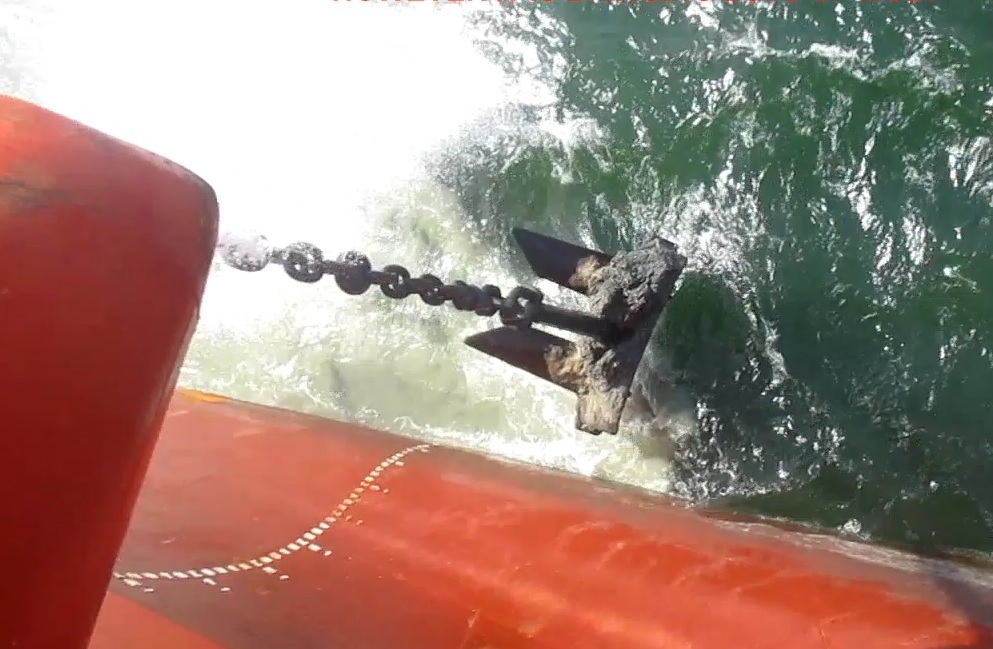
Anchoring represents a critical operation in that operator errors may produce immediate and significant accidents or create severe threats to the ship, its crew and cargo as well as the environment and other property. This section provides information on safe anchoring procedures.
A licensed deck officer should supervise the letting go/ walking back and weighing of the anchor. Only experienced crew members should be assigned to anchor work.
On approaching coastal/ shallow waters, both anchors must be cleared and kept ready for use.
Anchors must not be dropped by brake from a height of more than 20 meters above the sea bed, other than in emergencies.
Walking back the anchor until it is touching the bottom is equally hazardous as any weight on the chain will then be transferred to the windlass motor which not being designed for such loads could be damaged due to overloading. Hence care must be taken during such operations.
Anchoring in depths over 80 meters can lead to situations where the windlass motor is unable to pick up the weight of the anchor and cable. Hence anchoring at such depths should be avoided as far as possible.
The force exerted by ice cannot be restrained by the ships’ anchoring equipment. Anchoring in ice should therefore be avoided except in an emergency.
Limitation of Anchoring Equipment
It is of utmost importance to understand the limitations of the anchoring equipment and the following must be borne in mind every time the anchoring equipment is put to use :
1. The anchoring equipment is intended for temporary mooring of a vessel within a harbour or sheltered area, when the vessel is awaiting berth, tide etc.
2. The windlass is not designed for stopping or holding a vessel which is drifting as the maximum pulling capacity of the windlass is usually about 10% of the chain Minimum Breaking Load (MBL). So it is important that the main engine is used to ease the strain on the chain and relieve the tension completely when heaving in the anchor, the chain must be nearly vertical to ensure low tension.
3. The windlass is usually designed for heaving a free hanging anchor from a depth of 82.5 meters (approximately 3 shackles length).Master should be familiar with the requirements of his ship specific equipment, for which he should be guided by the maker’s manual.
4. Waves and swells can induce hazardous dynamic forces in to the anchoring system. When a anchored vessel is pitching and yawing due to heavy weather the tension of anchor chain can triple.
5. With the windlass engaged, especially when heaving, the hydraulic motor is the weakest link in the anchoring system. So if the anchor chain runs out, even very small, then the motor in most cases gets completely damaged requiring replacement.
6. The anchoring equipment is designed to hold a ship in good holding ground (sand, mud, clay, etc) so as to avoid dragging of the anchor. In poor holding ground (rocky, boulders, stones, etc), the holding power of the anchors is significantly reduced.
7. For design strength criteria of the anchoring equipment, a current speed of 2.5 m/sec and wind speed of 25 m/sec is assumed, based on a scope of chain between 6-10 times the water depth. Basis design strength, following components of the anchoring gear are likely to get damaged in case of an accident in the following sequence (weak to strong):
a. Hydraulic motor
b. Brake bands
c. Anchor cable stopper
d. Anchor cable
All crew to be familiar with design/ operating limitations of windlasses / anchoring equipment fitted on ship as per maker’s manual.
Anchoring the vessel
An operational briefing should be conducted before anchoring between the Master and Officer in charge of anchoring. The Master must take the following into consideration:
- Vessel’s speed is reduced in ample time before anchoring.
- Direction and strength of wind and current have been observed.
- Tidal stream when manoeuvring at low speeds.
- The sea room available for anchoring, in particular to seaward.
- Depth of water and type of seabed on planned or advised anchor drop position.
- Which anchor will be used and the length of anchor cable required (both anchors should be used alternately unless warranted by weather or some specific requirements for turning, berthing or during STS).
- Adequate notice must be given to the engine room and anchor party as to when it needs to be called for ‘stand-by’.
- The anchors, lights, shapes and sound signaling apparatus must be kept ready for use.
- On coming to an anchorage, a clear berth is to be chosen within the anchorage limits. The ship’s position shall be fixed, as soon as possible after arrival at the anchorage, by cross bearings and the depth of water ascertained and checked with the tide tables.
- The vessel’s anchoring position must be reported to the Port authorities or pilot station as deemed necessary.
- As far as possible, avoid passing ahead of anchored vessels when approaching, the anchoring position as the vessel will tend to drift on to the anchored vessel due to wind current
- Speed over ground to be zero or nearly zero.
- The proximity of navigational hazards and other vessels.
- The clearance from the nearest vessel is preferable to be more than 0.5 nm and so the anchor cable to be paid out should be decided accordingly.
- Vessels shall only anchor at designated anchorages and NOT anchor outside the port limit.
- In case of emergency, master has overriding authority in consideration of safety of life, vessel and the environment.
Anchoring in exposed strong winds or currents
Master shall be careful of the following:
Anchor chain may be subjected to unexpected loads and cause the anchor to drag, for example:
- In the initial stage of laying out the chain while anchoring if the chain gets piled up.
- Causing the chain to lie curved or snaked on the sea bottom.
- Since judging the speed over ground may be difficult, it is better to set a landmark exactly abeam of ship or check the speed over the ground by means of log (Doppler type set on ground mode) or GPS speed, etc.
- In case of using a single anchor for anchoring, make the approach and anchor stemming the tide. Check the current direction from the headings of other ships anchored nearby.
- Pay out ample anchor chain to lay it across slowly but not too much to pile up as the latter may cause the anchor to drag initially or result in the anchor cable piling up forming a loop around the anchor before the shank becomes horizontal.
- When current or wind is from the side of the ship, use the anchor towards the side the wind/current is from so that as the anchor holds the vessel swings away from the chain. You may need to use the engines/helm to assist the vessel to slowly swing in the correct direction.
- As far as possible, avoid current from astern. However, if it is unavoidable, reduce the headway of the ship and let go anchor on the turning side of the ship at a short distance before the scheduled anchorage spot.
- Use the engine to ease pressure if there is too much tension on the chain.
Emergency Anchoring
In certain situations, the anchors are highly valuable assets in order to save the vessel. There are basically two scenarios in emergency anchoring – either we have time to plan the actions or we need to act immediately.
Emergency anchoring procedure may include, but are not limited to, the following:
If danger is imminent:
Act decisively and use both anchors simultaneously. Allow both anchors to run out their cables untill sufficient is out to enable the anchors to hold.
If we have time to assess the situation and to plan ahead:
Call for assistance – notify shore staff
Study the charts and in particular notice depths and topography of the drifting path.
Strive to achieve a 1:3 depth/ chain ratio (or better)
A ship with quite considerable headway may be brought up quite rapidly with two anchors used in above fashion.
Large tankers may well part their cables when anchoring at speed above 1 knot. If a ship uses only one anchor, she is likely to part the cable very quickly and then forge ahead into danger.
Emergencies are rare and even if you regularly train for the worst, a real situation will always be different. Training and knowledge automatically enhance the crews’ skills and their ability to deal with an emergency anchoring.
Letting Go (Dropping) Anchor in an Emergency:
The following points must be kept in mind when letting go anchor in an emergency:
1. The Officer must be at the forecastle with a portable VHF, a torch and his team with required tools to release the bow stoppers.
While clearing away anchors in the previous operation, the brakes as well as the bow stoppers must be checked for efficient operation.
2. The Ship’s sides must be checked for boats, skiffs, tugs, barges and other such obstructions, especially below the anchor to prevent harm to a third party.
3. The Officer must be continuously in contact with the Bridge to relay correct information to and receive orders from the Master.
4. The Officer must open the brake and let the anchor run out directly from the hawse pipe, as and when the required information is received. There is no time to walk back the anchor in case of an emergency due to probable imminent danger.
5. The cable must be checked at all times to count the number of shackles passed as per orders from the bridge.
6. In case there is too much cable paid out without keeping an eye on it, the anchor tends to hold tight causing the cable to part by the vessel’s momentum.
7. In case there is less cable paid out, the anchor won’t really make the required full contact with the seabed, defeating the very purpose of dropping it in the first place.
8. The number of shackles paid out is normally in the region of two to three times the depth of water. The whole point of this emergency operation is to enable the ship anchor to drag along the seabed bottom, providing maximum resistance to the movement of the vessel without causing damage to the anchor or the vessel.
9. If there is insufficient searoom, in which to payout a good scope, the cables must be snubbed after approx. 2 shackles have run out and then the anchor dragged along the bottom to reduce headway. However, this may be dangerous in harbours, where there are submarine cables.
As with any emergency operation, dropping anchor under the circumstances requires swift action that can prevent any imminent danger. The handling of the vessel and her anchors will differ as per the characteristics but the above points give a general direction to the procedure that is required in such a case.
Methods of Anchoring
Vessels may generally use any one of the following methods:
- “Dropping” or “letting go” anchor from the hawse pipe or just above the water line.
- “Walking back” anchor just above the sea bed.
- Paying out under power.
- “DROPPING” OR “LETTING GO” ANCHOR FROM THE HAWSE PIPE OR JUST OVER THE WATER LINE
- This method of anchoring is normally used in depths of up to 20 meters.
- The anchor is lowered just above the water line. The brakes must be tightened and gear disengaged.
- Look over the side before letting go anchor. Display anchor signals.
- Once anchor is let go the speed of the cable should be controlled by applying brakes (snubbing the cable) in order to prevent running out of the cable.
- When the brakes are secured, the anchor digs into the seabed, preventing the vessel from moving any further astern over the ground.
- The sternway is stopped by the action of the anchor as strain comes onto the chain. Then, due to the catenary of the chain, the vessel moves forward and stops.
- The vessel is then described as being “Brought Up.”
- After anchoring and tightening the brakes the cable stopper must be used.
- Cable stoppers must be flush over a horizontal link and should be secured in position to prevent it from jumping under load. Do not leave the windlass gear engaged.
- To provide an early warning of anchor cable slippage a flag may be used which must be visible from the Bridge.
WALKING BACK ANCHOR
- This method of anchoring is normally used in depths between 20 to 50 meters.
- The anchor must be walked back all the way to just above the seabed.
- The brake should then be secured and the windlass taken off the gear.
- The anchor should be let go taking care that the vessel is moving astern such that the anchor cable will not pile up in a heap on the sea bottom.
- The required scope of the anchor cable must be paid out. Care is to be exercised in controlling the paying out speed and Master must ensure that vessel speed over ground is less than the paying out speed. Increased vessel’s speed over ground or uncontrolled paying out of the cable can cause the cable to be inadvertently paid out till the bitter end, thereby causing damage to the bitter end release arrangement, spurling pipe, windlass and finally to losing the anchor along with the cable.
- Repeated applications of the brake after short lengths of cable have been paid out can keep the system under control and prevent excessive acceleration of the gypsy.
- When the brakes are secured, the anchor digs into the seabed, preventing the vessel from moving any further astern over the ground.
- The sternway is stopped by the action of the anchor as strain comes onto the chain. Then, due to the catenary of the chain, the vessel moves forward and stops. The vessel is then described as being “Brought Up.”
- After anchoring and tightening the brakes the cable stopper must be used. Cable stoppers must be flush over a horizontal link and should be secured in position to prevent it from jumping under load.
- Do not leave the windlass gear engaged. To provide an early warning of anchor cable slippage a flag may be used which must be visible from the Bridge.
- Most of the losses related to anchor have been attributed to too high speed over ground, too little cable being paid out during the walking back of the anchor prior to letting go or allowing too much chain to pay out when the brake is opened.
“Dynamic brake power (stopping power)” and “Static brake power (Holding power)”
The dynamic brake power is weaker than the static brake power. And in case of “dropping anchor after walking back until 5-10m above the sea bottom” in the deep water, if the chain goes out too fast due to the heavy weight of the chain, there is a possibility that the brake would not hold the chain. In order to avoid such a critical situation, the running speed of the chain shall be well controlled by proper / frequent use of the brake.
PAYING OUT UNDER POWER
This method of anchoring is normally used in depths above 50 meters:
- The anchor must be walked back all the way under power.
- The speed over ground of the vessel must be close to zero.
- Generally, the winding load of the windlass is weaker than the static brake power of the same. And in case of walking back until sea bottom or heaving up the anchor in the deep water, if the chain has excessive load due to the current and/or the wind, there is a strong possibility that the windlass (hydraulic motor) will be seriously damaged.
- In order to avoid such a critical situation, the chain shall be tightly secured by the brake. Repeated applications of the brake after short lengths of cable have been paid out can keep the system under control and prevent excessive forces on the gypsy.
- Needless to say, in that case, the master shall minimize the tension of the chain with using her main engine, rudder, and bow-thruster properly as well.
Anchoring in depth above 80 meters should be avoided, as far as possible. However, in some cases such as anchoring at Fujairah, if anchoring has to be done in depth above 80 meters, master should carry out risk assessment
HEAVING-UP ANCHOR
When “heaving-up anchor” in the deep water, the master shall pay attention to a possibility that the windlass will have an excessive load by the chain due to following causes:
- Increase of the load due to heavy weight of the chain with long catenaries.
- Increase of the load due to drifting of the vessel by unexpected current and/or wind to striking force by swell.
As of the countermeasures for above, Master is advised to act as follows.:
During heaving-up anchor, the tension of the chain can be minimized with using vessel’s main engine, rudder, and bow-thruster properly.
The master must pay special attention to an increase of the load to the windlass due to striking force by swell. If the tension of the chain could not be minimized, then stop heaving-up anchor and hold the chain by the brake.
Plot and record the ship’s position during heaving-up anchor.
Due caution is to be exercised when heaving in adverse weather, to avoid windlass motor damage / failure. It is very important that Officer in charge of the anchor party advises the correct position & weight on the cable to the Bridge party & keeps on updating as the position & weight of the cable changes while the Bridge party is using Engines to maintain as little stress on the cable as possible.
Hauling power of the windlass is determined on the basis of weight of the anchor and anchor chain and can be obtained from the yard manual. The windlass is usually designed for heaving a free hanging anchor from a depth of 82.5 meters (approximately 3 shackles length).
DRAGGING ANCHOR
Raise General Alarm, inform master, warn other ships in the vicinity and, if necessary, seek the help of harbour or port pilots and tugs.
Establish the cause of the anchor dragging. Call up office immediately or send an email, depending on the urgency, detailing the circumstances of the anchor dragging and action being taken by Master.
If risk of collision or contact with another vessel exists then:
1. Vessel should consider which of the two is the better option to be taken within the short time available, i.e. picking-up anchor and moving away or paying out / slipping the cable to increase the distance / time from contact.
2. If time and circumstances permit, pick-up anchor and move to a safer location.
3. If time or circumstances do not allow for picking up the anchor then:
a. Try running out the rest of the chain to increase distance.
b. If this is likely not to or will not avoid contact with other vessel then cable may be slipped from the bitter end (with anchor buoy which was rigged on arrival) and the vessel manoeuvred out of the danger.
4. If time or circumstances do not allow for slipping of the anchor then use engines boldly to dredge the anchor, in which case the crew should be in a safe area well clear of the windlass and anchor chain. In the worst case scenario an astern movement (full) on the engines will only result in the cable snapping at the stopper and being lost with the anchor.
5. In an emergency, if collision is imminent, it is preferable to lose the anchor than to have contact with another vessel. In many cases it has been observed that even when collision is imminent (where another vessel is dragging on to own vessel at anchor, etc) the Bridge team tend to be intent on picking up the anchor. This will only result in precious time being lost and will do very little to avert an impact. In such cases losing the anchor and chain is far less expensive and damaging than a collision. So if the situation warrants DO NOT HESITATE to slip the anchor.